Home
Class 12
PHYSICS
Two long parallel conducting rails are p...

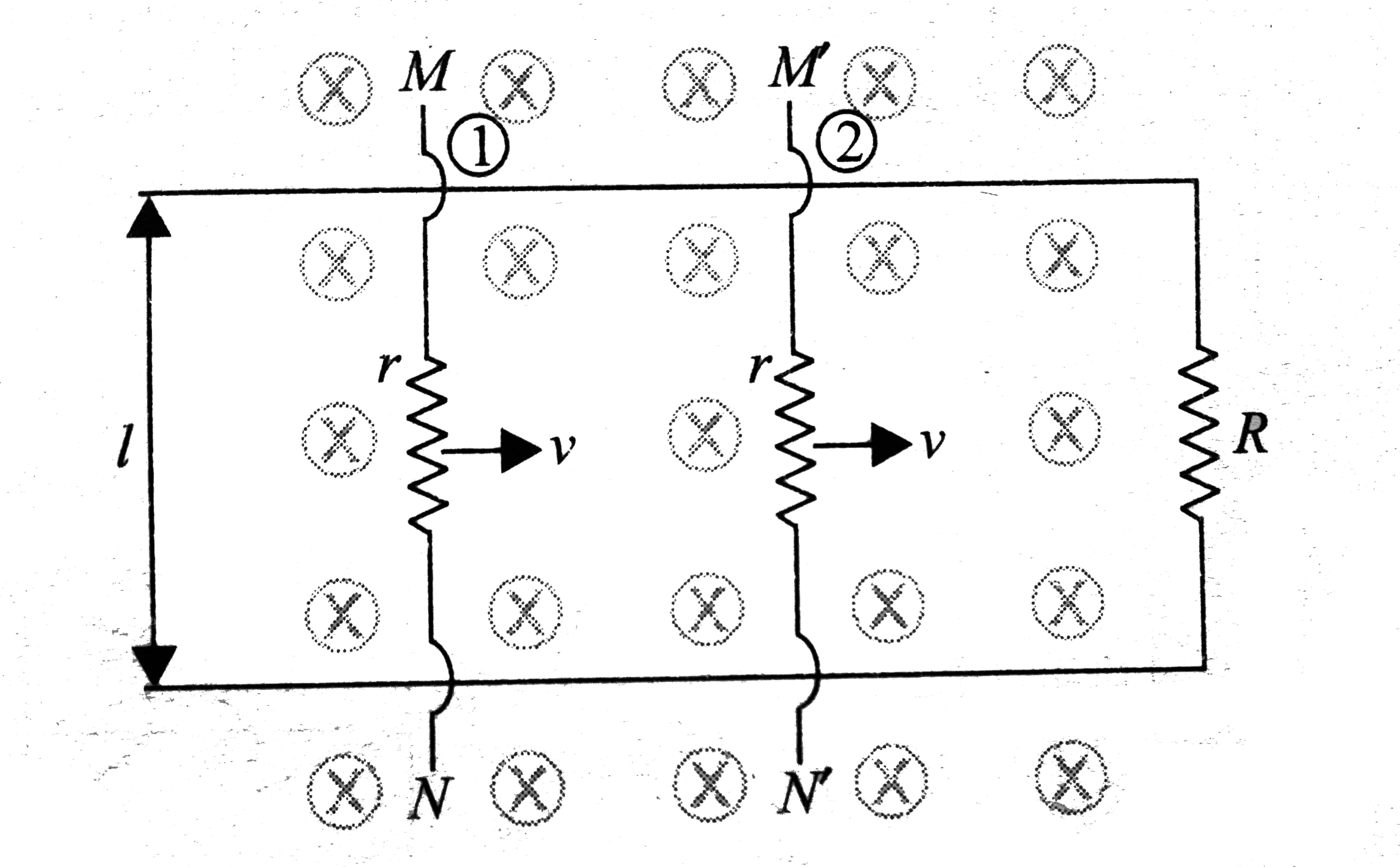
Two long parallel conducting rails are placed in a uniform magnetic field. On one side, the rails are connected with a resistance `R`. Two rods `MN and M'N'` each having resistance `r` are placed as showing in Fig. Now on the rods `MN and M'N'` forces are applied such that the rods move with constant velocity `v`.

The current flowing through resustance `R` if both the rods move with the same speed `v` toward right is

A

(a) `(BlR_(2)(v_(1)r_(2) - v_(2)r_(1)))/(R_(1)R_(2)(r_(1) + r_(2)) + r_(2)r_(1)(R_(1) + R_(2)))`

B

(b) `(BlR_(2)(v_(1)r_(2) + v_(2)r_(1)))/(R_(1)R_(2)(r_(1) + r_(2)) + r_(2)r_(1)(R_(1) + R_(2)))`

C

( c) `(BlR_(2)(v_(1)r_(2) - v_(2)r_(1)))/(R_(1)R_(2)(r_(1) - r_(2)) + r_(2)r_(1)(R_(1) - R_(2)))`

D

(d) `(BlR_(2)(v_(1)r_(2) - v_(2)r_(1)))/(R_(1)R_(2)(r_(1) + r_(2)) - r_(2)r_(1)(R_(1) + R_(2)))`

Text Solution

Verified by Experts

The correct Answer is:
A

(ii) ( a). Case I

`I = (e)/(R + (r//2)) = (Blv)/(R + (r//2))`
Case II
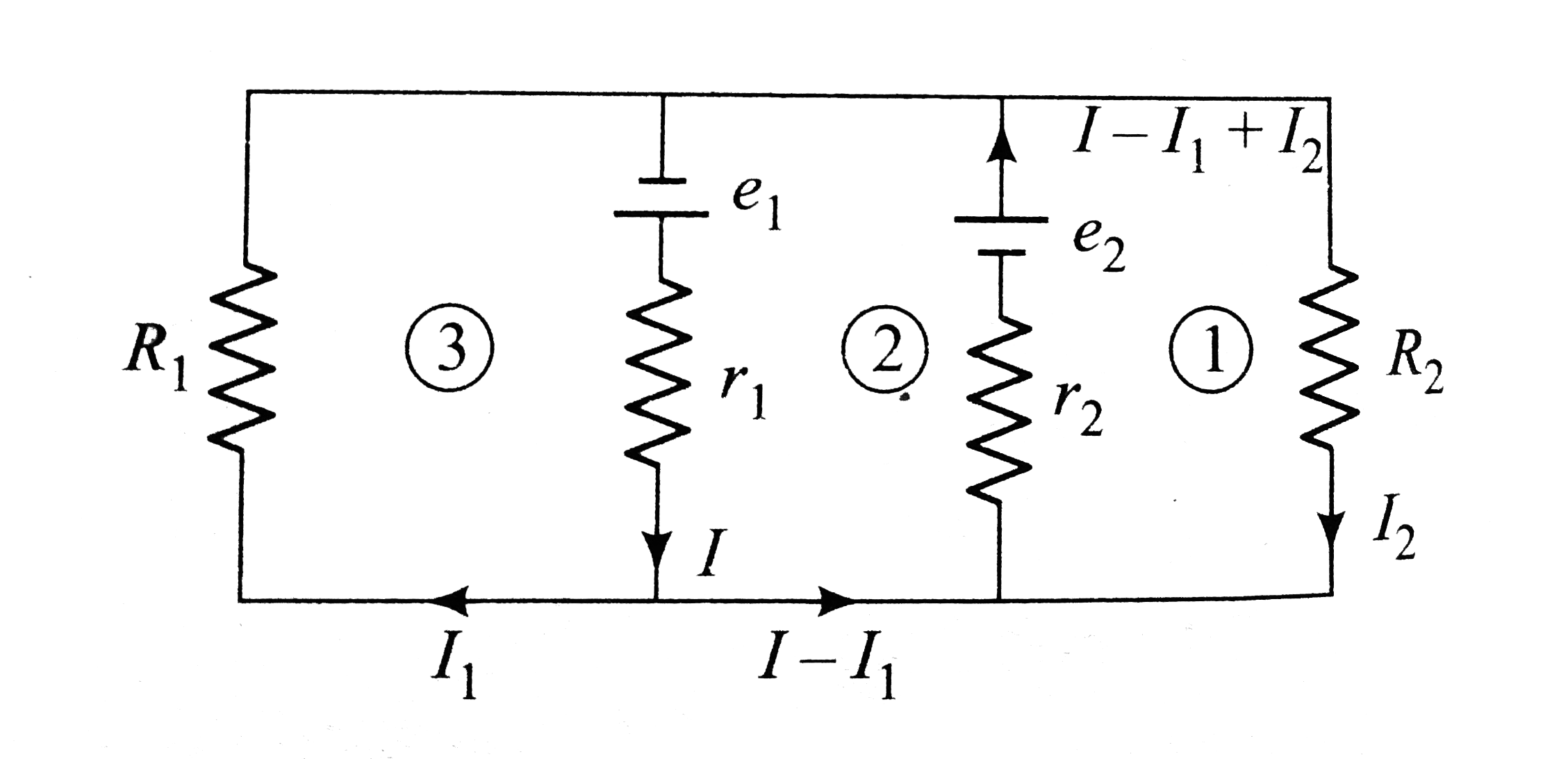
` -(I_(1) - I')R - I_(1)r + e = 0` For loop (1) (i)
`r(I-(1) + U') = 2e` For loop (2) (ii)
Solve to get, `I_(1) = I' = (e)/(R )`
Hence current in 'R' is zero. ltbr
(ii). `e_(1) = Blv_(1), e_(2) = Blv_(2)`
For (1) `rarr` `e_(2) = (I - I_(1) + I_(2))r_(2) + I_(2)R_(2)`
For (2) `rarr` `e_(1) + e_(2) = (I - I_(1) + I_(2))r_(2) + Ir_(1)`
For (3) `rarr` `e_(1) = Ir_(1) + I_(1)R_(1)`
Solve to get `I_(1) = (BlR_(2)(v_(2)r_(2) - v_(2)r_(1)))/(r_(1)R_(2)(r_(1) + r_(2)) + r_(2)r_(1)(R_(1) + R_(2)))`
Promotional Banner

Topper's Solved these Questions

  • ELECTROMAGNETIC INDUCTION

    CENGAGE PHYSICS ENGLISH|Exercise Exercises Integer|9 Videos
  • ELECTROMAGNETIC INDUCTION

    CENGAGE PHYSICS ENGLISH|Exercise Archives Fill In The Blanks|3 Videos
  • ELECTROMAGNETIC INDUCTION

    CENGAGE PHYSICS ENGLISH|Exercise Exercises Asserton - Reasoning|8 Videos
  • ELECTRICAL MEASURING INSTRUMENTS

    CENGAGE PHYSICS ENGLISH|Exercise M.C.Q|2 Videos
  • ELECTRON,PHONTS,PHOTOELECTRIC EFFECT & X-RAYS

    CENGAGE PHYSICS ENGLISH|Exercise dpp 3.3|15 Videos

Similar Questions

Explore conceptually related problems

Two long parallel conducting rails are placed in a uniform magnetic field. On one side, the rails are connected with a resistance R . Two rods MN and M'N' each having resistance r are placed as showing in Fig. Now on the rods MN and M'N' forces are applied such that the rods move with constant velocity v . (i). The current flowing through resistance R if the rod Mn moves toward left and the rod M'N' moves toward the right is

A small conducting rod of length l, moves with a uniform velocity v in a uniform magnetic field B as shown in fig __

A conducting rod is moved with a constant velocity v in a magnetic field. A potential difference appears across the two ends

A conducting rod of length l is moving in a transverse magnetic field of strength B with veocity v. The resistance of the rod is R. The current in the rod is

A sliding rod AB of resistance R is shown in the figure. Here magnetic field B is constant and is out of the paper. Parallel wires have no resistance and the rod is moving with constant velocity v. The current in the sliding rod AB when switch S is closed at time t=0 is

A rod having length l and resistance R is moving with velocity v on a pi shape conductor. Find the current in the rod.

A wire cd of length l and mass m is sliding without friction on conducting rails ax and by as shown. The verticle rails are connected to each other with a resistance R between a and b . A uniform magnetic field B is applied perpendicular to the plane abcd such that cd moves with a constant velocity of

Figure shows a conducting rod PQ in contact with metal rails RP and SQ which are 0.257 apart in i uniform magnetic field of flux density 0.4T acting perpendicular to the plane of the paper. Ends R and S are connected through a 5 Omega resistance. What is the emf when the rod moves to the right with a velocity of 5 ms^(-1) ? What is the magnitude and direction of the current through the 5 Omega resistance? If the rod PQ moves to the left with the same speed, what will be the new current and its direction?

Two parallel fixed conducting rails are l distance apart. They are connected by a conducting wire xy. A uniform magnetic field B is applied normal to its plane. Two other rods PQ and RT(RS = ST) are moved with a constant velocity v. Resistance/ length of these two rods are lamda no other wire has resistance. Then :

A conducting rod of length l slides at constant velocity v on two parallel conducting rails, placed in a uniform and constant magnetic field B perpendicular to the plane of the rails as shown in Fig.3.49. A resistance R is connected between the two ends of the rails. (a) Idenify the cause which produces change in magnetic flux. (b) Identify the direction of current in the loop. ( c) Determine the emf induced in the loop. (d) Compute the electric power dissipated in the resistor. (e) Calcualte the mechenical power required to pull the rod at a cinstant velovity.

CENGAGE PHYSICS ENGLISH-ELECTROMAGNETIC INDUCTION-Exercises Linked Comprehension
  1. Two long parallel conducting rails are placed in a uniform magnetic fi...

    Text Solution

    |

  2. Two long parallel conducting rails are placed in a uniform magnetic fi...

    Text Solution

    |

  3. Two long parallel conducting rails are placed in a uniform magnetic fi...

    Text Solution

    |

  4. A metal bar is moving with a velocity of v = 5 cm s^(-1) over a U-shap...

    Text Solution

    |

  5. A metal bar is moving with a velocity of v = 5 cm s^(-1) over a U-shap...

    Text Solution

    |

  6. In Fig. shown, the rod has a resistance R, the horizontal rails have n...

    Text Solution

    |

  7. In Fig. shown, the rod has a resistance R, the horizontal rails have n...

    Text Solution

    |

  8. In Fig. shown, the rod has a resistance R, the horizontal rails have n...

    Text Solution

    |

  9. A square conductind loop, 20.0 cm on a side placed in the same magneti...

    Text Solution

    |

  10. A square conductind loop, 20.0 cm on a side placed in the same magneti...

    Text Solution

    |

  11. A square conductind loop, 20.0 cm on a side placed in the same magneti...

    Text Solution

    |

  12. In a very long solenoid of radius R, if the magnetic field chabges at ...

    Text Solution

    |

  13. In a very long solenoid of radius R, if the magnetic field chabges at ...

    Text Solution

    |

  14. A standing wave y = 2A sin kx cos omegat is set up in the wire AB fixe...

    Text Solution

    |

  15. A standing wave y = 2A sin kx cos omegat is set up in the wire AB fixe...

    Text Solution

    |

  16. A standing wave y = 2A sin kx cos omegat is set up in the wire AB fixe...

    Text Solution

    |

  17. A fan operates at 200 volt (DC) consuming 1000W when running at full s...

    Text Solution

    |

  18. A fan operates at 200 volt (DC) consuming 1000W when running at full s...

    Text Solution

    |

  19. A fan operates at 200 volt (DC) consuming 1000W when running at full s...

    Text Solution

    |

  20. Figure shows a conducting rod of negligible resistance that can slide ...

    Text Solution

    |

