Home
Class 12
PHYSICS
In Fig. there are two sliders and they ...

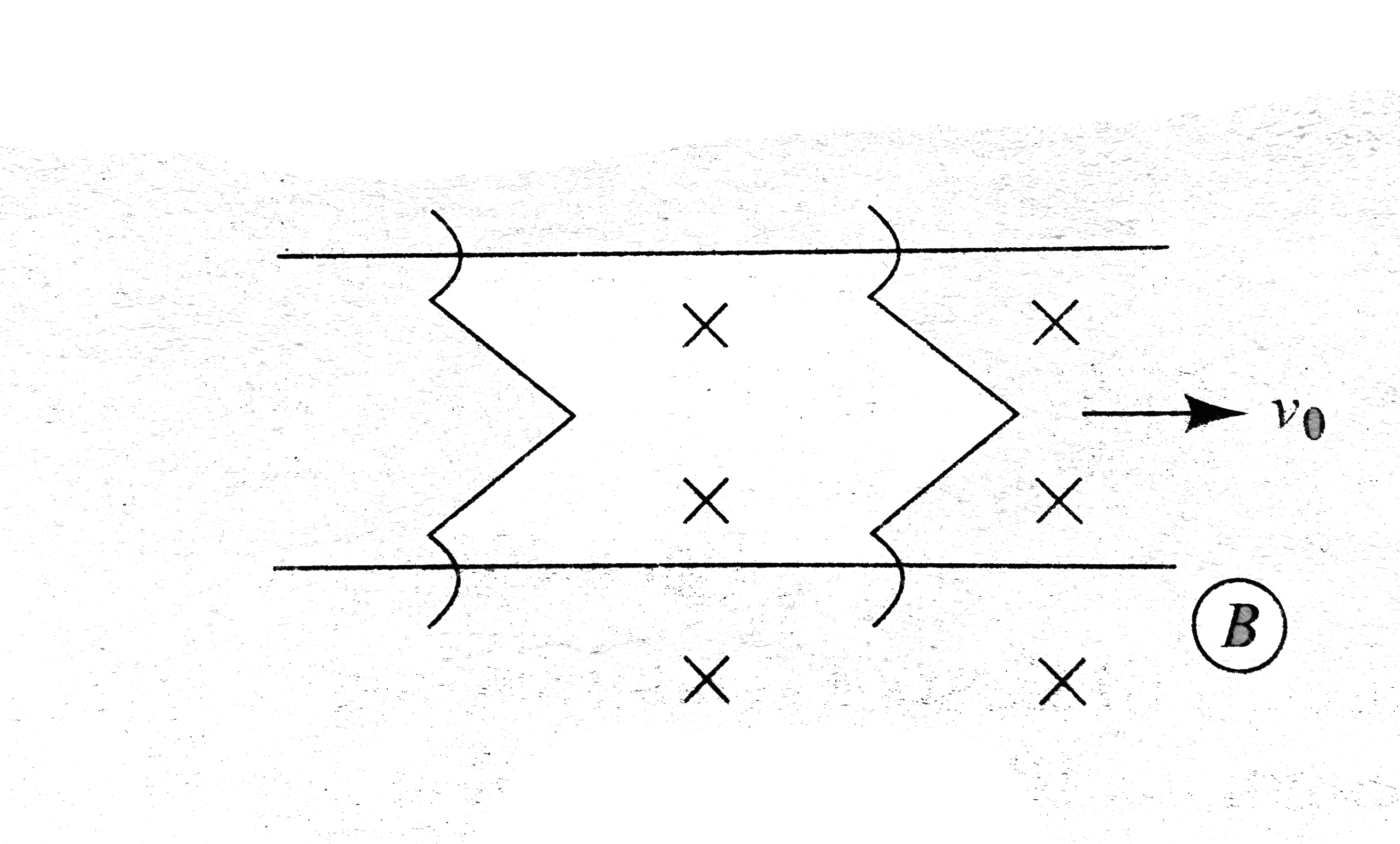
In Fig. there are two sliders and they can slide on two frictionless parallel wires in uniform magnetic field `B`, which is present everywhere. The mass of each slider is `m`, resistance `R` and initially these are at reat. Now, if one slider is given a velocity `v_(0) = 16ms^(-1)`, what will be the velocity (in `ms^(-1`)) of other slider after long time ? (neglect the emf self-inducetion)

Text Solution

Verified by Experts

The correct Answer is:

8

After long time, from conservation of momentum.
`mv_(0) = 2mv, v = (v_(0))/(2) = 8 ms^(-1)`.
Promotional Banner

Topper's Solved these Questions

  • ELECTROMAGNETIC INDUCTION

    CENGAGE PHYSICS ENGLISH|Exercise Archives Fill In The Blanks|3 Videos
  • ELECTROMAGNETIC INDUCTION

    CENGAGE PHYSICS ENGLISH|Exercise Archives Single Correct|11 Videos
  • ELECTROMAGNETIC INDUCTION

    CENGAGE PHYSICS ENGLISH|Exercise Exercises Linked Comprehension|36 Videos
  • ELECTRICAL MEASURING INSTRUMENTS

    CENGAGE PHYSICS ENGLISH|Exercise M.C.Q|2 Videos
  • ELECTRON,PHONTS,PHOTOELECTRIC EFFECT & X-RAYS

    CENGAGE PHYSICS ENGLISH|Exercise dpp 3.3|15 Videos

Similar Questions

Explore conceptually related problems

In Fig. there are two sliders and they can slide on two frictionless parallel wires in uniform magnetic field B , which is present everywhere. The mass of each slider is m , resistance R and initially these are at reat. Now, if one slider is given a velocity v_(0) , what will be the velocity (in ms^(-1 )) of other slider after long time ? (neglect the emf self-inducetion)

A rectangular loop with a slide wire of length l is kept in a uniform magnetic field as shown in the figure. The resistance of slider is R. Neglecting self inductance of the loop find the current in the wonnector during its motion with a velocity v.

A bar of mass mand length I moves on two frictionless parallel rails in the presence of a uniform magnetic field directed into the plane of the paper. The bar is given an initial velocity v_(i) to the right and released. Find the velocity of bar, induced emfacross the bar und the current in the circuit as a function of time.

A conducting rod shown in figure of mass m and length l moves on two frictionless horizontal parallel rails in the presence of a unifom magnetic field directed into the page., The rod is given an initial velocity v_0 to the right and is released at t=0 . Find s a function of time a. the volocity of the rod b. the induced current and c. the magntitude of the induced emf.

Two infinite parallel wire, having the cross sectional area 'a' and resistivity 'k' are connected at a junction point 'p' (as shown in the figure). A slide wire of negligible resistance and having mass 'm' and length 'l' can slide between the parallel wires, without any frictional resistance. If the system of wires is introduced to a magnetic field of intensity 'B' (into the plane of paper) and the slide wire is pulled with a force which varies with the velocity of the slide wire as F=F_(0)v , then find the velocity of the slide wire as a function of the distance travelled. (The slide wire is initially at origin and has a velocity v_(0) )

A non-uniform magnetic field vecB=B_(0)(1+y/d)(-hatk) is present in region of space in between y=0 & y=d .The lines are shown in the diagram.A particle of mass m and positive charge q is moving.Given an initial velocity vecv=v_(0)hati .Find the components of velocity of the particle when it leaves the field.

A magnetic field B = B_(0) sin (omega t) hat k covers a large region where a wire AB slides smoothly over two parallel conductors separated by a distance d, Fig. The wires are in the x-y plane. The wire AB (of length d) has resistance R and parallel wires have negligible resistance. If AB is moving with velocity upsilon , what is the current in the circuit ? What is the force needed to keep the wire moving at constant velocity ?

Consider parallel conducting rails separated by a distance l. There exists a uniform magnetic field B perpendicular to the plane of the rails as shown in Fig. Two conducting wires each of length l are placed so as to slide on parallel conducting rails. One of the wires is given a velocity v_(0) parallel to the rails. Till steady state is achieved, loss in kinetic energy of the system is

A conducting rod of length l slides at constant velocity v on two parallel conducting rails, placed in a uniform and constant magnetic field B perpendicular to the plane of the rails as shown in Fig.3.49. A resistance R is connected between the two ends of the rails. (a) Idenify the cause which produces change in magnetic flux. (b) Identify the direction of current in the loop. ( c) Determine the emf induced in the loop. (d) Compute the electric power dissipated in the resistor. (e) Calcualte the mechenical power required to pull the rod at a cinstant velovity.

Two magnetic fields exits in the two regions as shown in . A loop abcd of 40 xx 10 cm id placed in the field. The resistance per unit length of the loop is r = 2Omegacm^(-1) . All of a sudden, the loop is given a velocity v_(0) = 20cm s^(-1) towards roght. What is the potential difference V_(c ) - V_(b) ?
