Home
Class 12
PHYSICS
In the circuit shows in Fig the capacito...

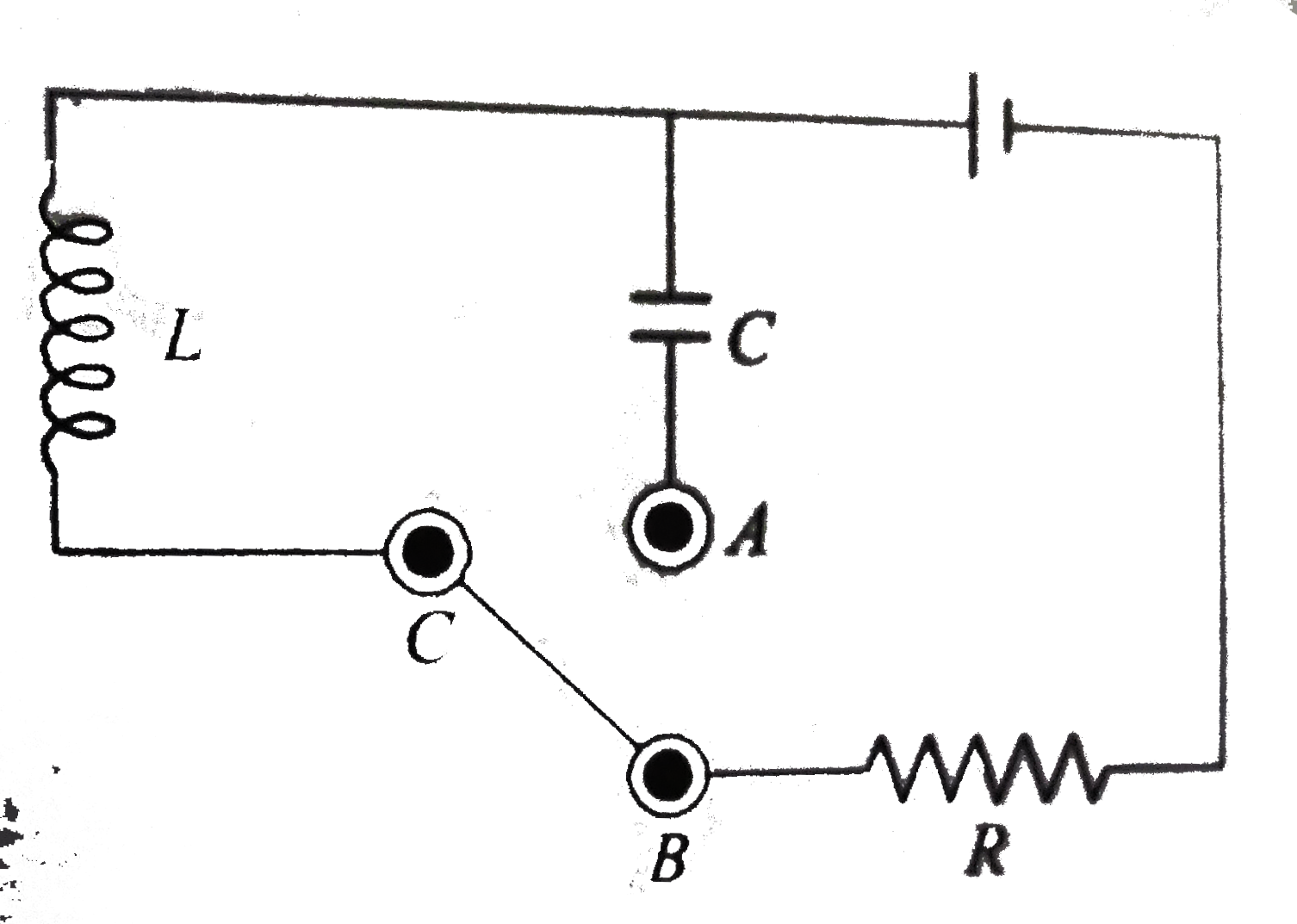
In the circuit shows in Fig the capacitor is initially uncharged and the two - way switch is connected in the position `BC`. Find the current through the resistence `R` as a function of time `t`. After time `t = 4` ms, the switch is connected in the position `AC`. Find the frequency of oscillation of the capacitor of the circuit in the position, and the maximum charge on the capacitor `C`. At what time will the energy stored in the capacitor be one-half of the total energy stored in the circuit? It is given `L = 2 xx 10^(-4)H, C = 5 mF, R = (In 2)/(10) Omega` and emf of the battery `= 1 V`.

Text Solution

Verified by Experts

The correct Answer is:

`(10)/(In 2) (1 - ((1)/(2))^((t)/(2xx 10^(-3)))) ; 10^(3) rad s^(-1) ; (7.5 xx 10^(-3))/(In 2) C`;
`4 ms + (n pi + (-1)^(n) pi//4)/(omega)`

Current in `R` or `L` at any time is given by:
`I = (varepsilon)/(R )(1 - e^(-Rt//L)) rArr I = (1)/((In 2)//10) [1 - e^(-(t In 2)/(10xx2xx10^(-4)))]`
`rArr I = (10)/(In2) [1-e^(In 2^-((t)/(2xx10^(-3))))] rArr I = (10)/(In 2) [1-((1)/(2))^ ((t)/(2xx10^(-3)))]`
Now at `t = 4 ms`
`I = (10)/(In2)[1-((1)/(2))^((4xx10^(-3))/(2xx10^(-3)))] = (10)/(In 2)[ 1- (1)/(4)] = (15)/(2 In 2) A`
Now the switch is shifted between `A` and `C`. Just after shifting the switch, current in inductor will be as calculated above. It can't change at once. Now due to this current, the capacitor will start charging. Frequency of oscillation is given by :
`omega = (1)/(sqrt(LC)) = (1)/(sqrt(2 xx 10^(-4) xx 5 xx 10^(-3)))= 10^(3) rad//s`
To find maximum charge : `(Q^(2))/(2C) = (1)/(2) LI^(2)`
`rArr Q = (sqrt(LC))I = (10^(-3) xx 15)/(2 In 2) rArr Q = (7.5 xx 10^(-3))/(In 2) C`
Energy in the capacitor is half of total energy when charge on
capacitor is `q = (Q)/(sqrt(2))`
Charge on capacitor at any time
`q = Q sin omegat [ :' at t = 0, q = 0]`
`rArr (Q)/(sqrt(2)) = Q sin omega t rArr omegat = npi + (-1)^(n) (pi)/(4)`
(1) `rArr t = (n pi + (-1)^(n) pi//4)/(omega)`
Total time, `T = 4 ms + (n pi + (-1)^(n) pi//4)/(omega)`
Promotional Banner

Topper's Solved these Questions

  • INDUCTANCE

    CENGAGE PHYSICS ENGLISH|Exercise Exercises (single Correct )|65 Videos
  • INDUCTANCE

    CENGAGE PHYSICS ENGLISH|Exercise Exercises (multiple Correct )|7 Videos
  • INDUCTANCE

    CENGAGE PHYSICS ENGLISH|Exercise Exercise 4.1|24 Videos
  • HEATING EFFECT OF CURRENT

    CENGAGE PHYSICS ENGLISH|Exercise Thermal Power in Resistance Connected in Circuit|27 Videos
  • MAGNETIC FIELD AND MAGNETIC FORCES

    CENGAGE PHYSICS ENGLISH|Exercise Multiple Correct Answer type|2 Videos

Similar Questions

Explore conceptually related problems

In the circuit shown, switch S is closed at time t = 0 . Find the current through the inductor as a function of time t .

In the circuit shown in figure, the capacitors are initially uncharged. The current through resistor PQ just after closing the switch is

In the circuit shown, the capacitor C_1 is initially charged with charge q_0 . The switch S is closed at time t = 0 . The charge on C_2 after time t is

In the circuit in Fig. switch S_(1) was closed for a long time . At time t = 0 the switch is opened. Find the angular frequency of oscillation of the charge on the capacitor.

In the circuit shown, all the capacitors are initially uncharged. The current through the battery just after closing the switch 'S' is

Consider the circuit shown. Switch is closed at t=0. Find the current through the battery as a function of time. Initially capacitor was uncharged.

Switch S is cloesd in the circuit at time t = 0 . Find the current through the capacitor and the inductor at any time t

In the circuit shown in fig. when the switch is closed, the capacitor charges with a time constant

The switch in figure is closed at time t = 0 . Find the current in the inductor and the current through the switch as functions of time thereafter.

Passage-III In the circuit shown, the battery is ideal with emf V. The capacitor is initially uncharged. The switch is closed at time t = 0 The current in branch containing capacitors at any time t is
