Home
Class 12
PHYSICS
An inductor and two capacitors are conne...

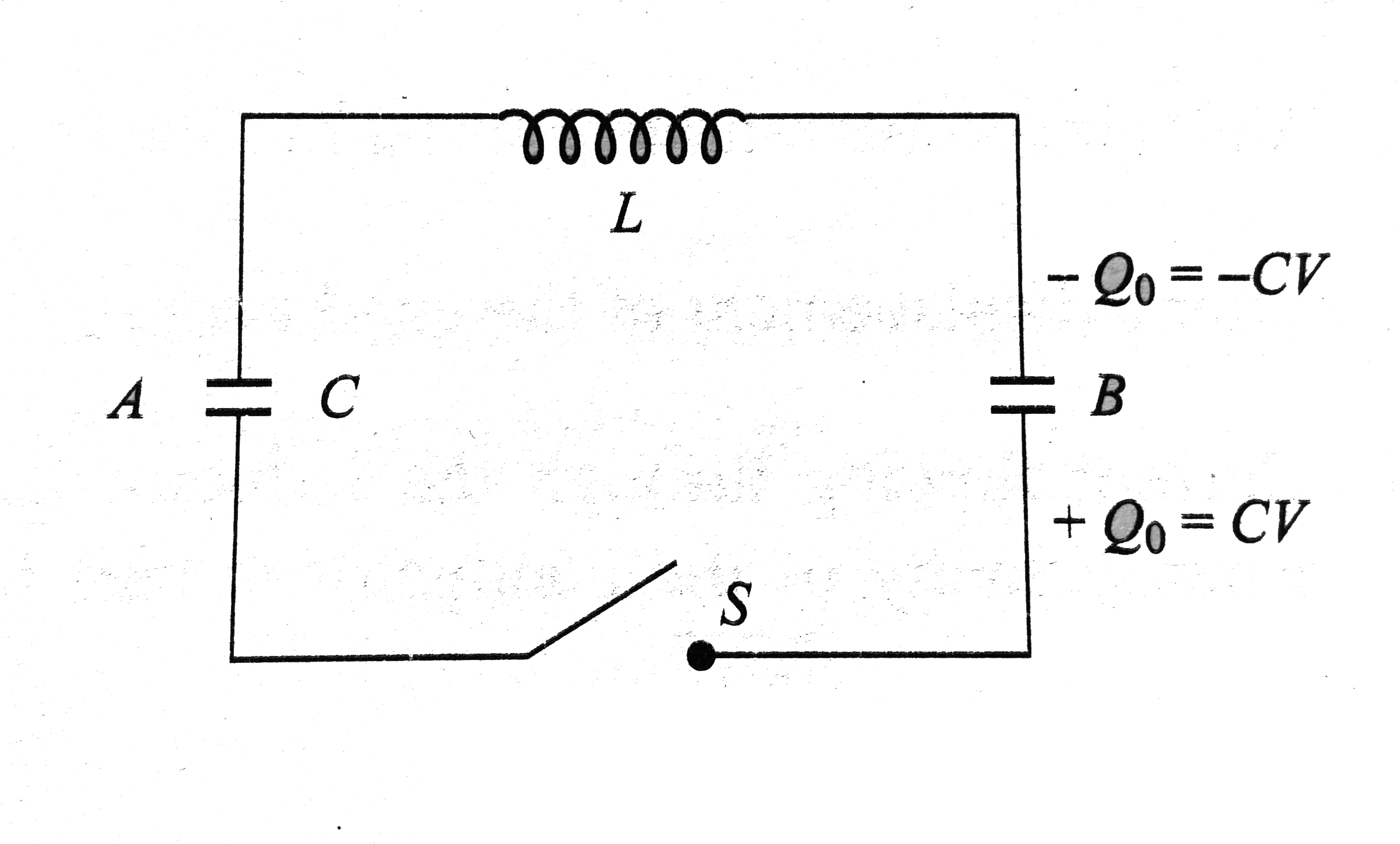
An inductor and two capacitors are connected in the circuit as show in Fig Initially capacitor `A` has no charge and capacitor `B` has `CV` charge. Assume that the circuit has no resistance at all. At `t = 0`, switch `S` is closed, then [given
`LC = (2)/(pi^(2) xx 10^(4)) S^(2)` and `Cv = 100 mC]`

A

when current in the circuit is maximum, charge on each capacitor is same

B

when current in the circuit is maximum, charge on capacitor `A` is twice the charge on capacitor `B`

C

`q = 50(1 + cos 100 pi t) mC`, where `q` is the charge on capacitor `B` at time `t`

D

`q = 50(1 - cos 100 pi t) mC`, where `q` is the charge on capacitor `B` at time `t`

Text Solution

Verified by Experts

The correct Answer is:
A, C

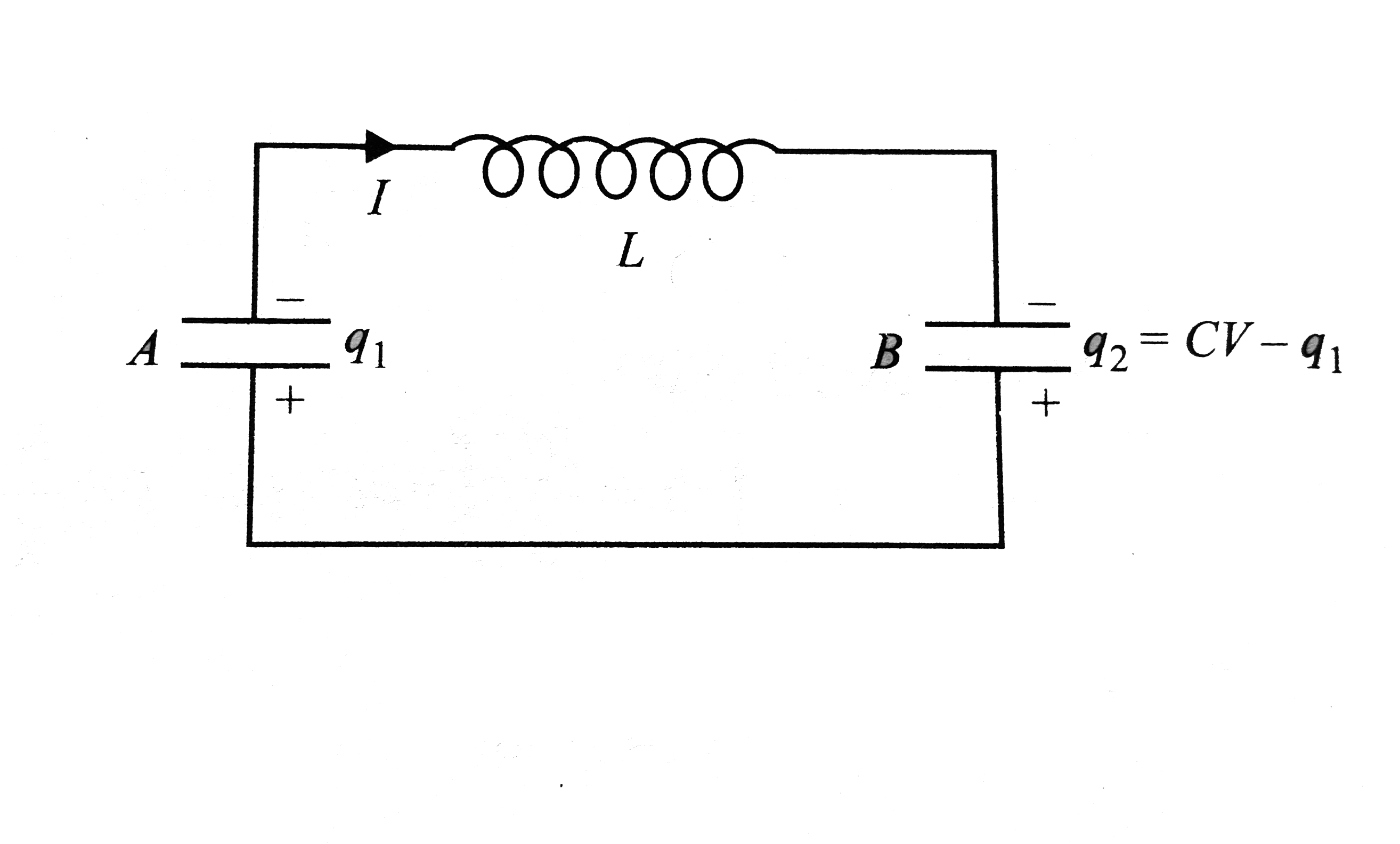
Let at any time, charge and current in the circuit wire are as shows.

`I = (dq_(1))/(dt)`
Applying kirchoff's law,
`(CV - q_(1))/(C ) - (q_(1))/(C ) - L(dI)/(dt) = 0 rArr (CV - 2q_(1))/(LC) = L (d^(2)q_(1))/(dt^(2))`
`rArr (d^(2)q_(1))/(dt^(2)) = - (2)/(LC) (q_(1) - (CV)/(2))`
`rArr q_(1) - (CV)/(2) = A sin (omega t + delta)` (i)
where `omega = sqrt((2)/(LC)) = 100 pi rad//s`
At `t = 0`, `q_(1) = 0 rArr 0 - (CV)/(2) = A sin delta` (ii)
Differentiating (i), `(dq_(1))/(dt) - 0 = A omega cos (omega t + delta)`
`rArr I = A omega cos (omega t + delta)`
At `t = 0, I = 0 rArr 0 = A omega cos delta rArr delta = (pi)/(2)`
From (ii), `A = - (CV)/(2)`
From (i), `q_(1) = (CV)/(2) - (CV)/(2) sin (omega t + (pi)/(2))` (iv)
`rArr q_(1) = (CV)/(2) (1 cos 100 pi t) mC`
Now `q_(2) = CV - q_(1) = (CV)/(2) (1 + cos omega t)` (v)
`= 50 (1 + cos omega pi t)`
From (ii), `I = - A omega sin omega t`
Current in the circuit is maximum for `omega t = (pi)/(2)*`
And for `omegat = (pi)/(2)`, we see from (iv) and (v) that `q_(1) = q_(2) = (CV)/(2)`
Promotional Banner

Topper's Solved these Questions

  • INDUCTANCE

    CENGAGE PHYSICS ENGLISH|Exercise Exercises (assertion-reasoning)|2 Videos
  • INDUCTANCE

    CENGAGE PHYSICS ENGLISH|Exercise Exercises (linked Compreshension)|36 Videos
  • INDUCTANCE

    CENGAGE PHYSICS ENGLISH|Exercise Exercises (single Correct )|65 Videos
  • HEATING EFFECT OF CURRENT

    CENGAGE PHYSICS ENGLISH|Exercise Thermal Power in Resistance Connected in Circuit|27 Videos
  • MAGNETIC FIELD AND MAGNETIC FORCES

    CENGAGE PHYSICS ENGLISH|Exercise Multiple Correct Answer type|2 Videos

Similar Questions

Explore conceptually related problems

Initially the capacitor is uncharged find the charge on capacitor as a function of time, if switch is closed at t=0.

In the circuit shown in fig. when the switch is closed, the capacitor charges with a time constant

Conisder the istuation shown in the figure. The capacitor A has a charge q on it whereas B is unchanged. The charge appearing on the capacitor B a long time after the switch is closed is

In the given LC circuit,if initially capacitor C has charge Q on it and 2C has charge 2Q. The polar ar as shown in figure. Then after closing switch S and t=0

Two capacitors A and B are connected in series with a battery as shown in the figure. When the switch S is closed and the two capacitors get charged fully, then

Two capacitors A and B are connected in series with a battery as shown in the figure. When the switch S is closed and the two capacitors get charged fully, then

Two capacitors A and B are connected in series with a battery as shown in the figure. When the switch S is closed and the two capacitors get charged fully, then

The switch S in the circuit diagram is closed at t = 0. The charge on capacitors at any time is

n the circuit shown in the figure, the capacitor C is charged to a potential V_(o) The heat generated and charge flow, in the circuit to when the switch S is closed, is

In the circuit shown in fig, if the switch S is closed at t = 0 , the capacitor charges with a time constant

