Home
Class 12
PHYSICS
Two parallel resistanceless rails are co...

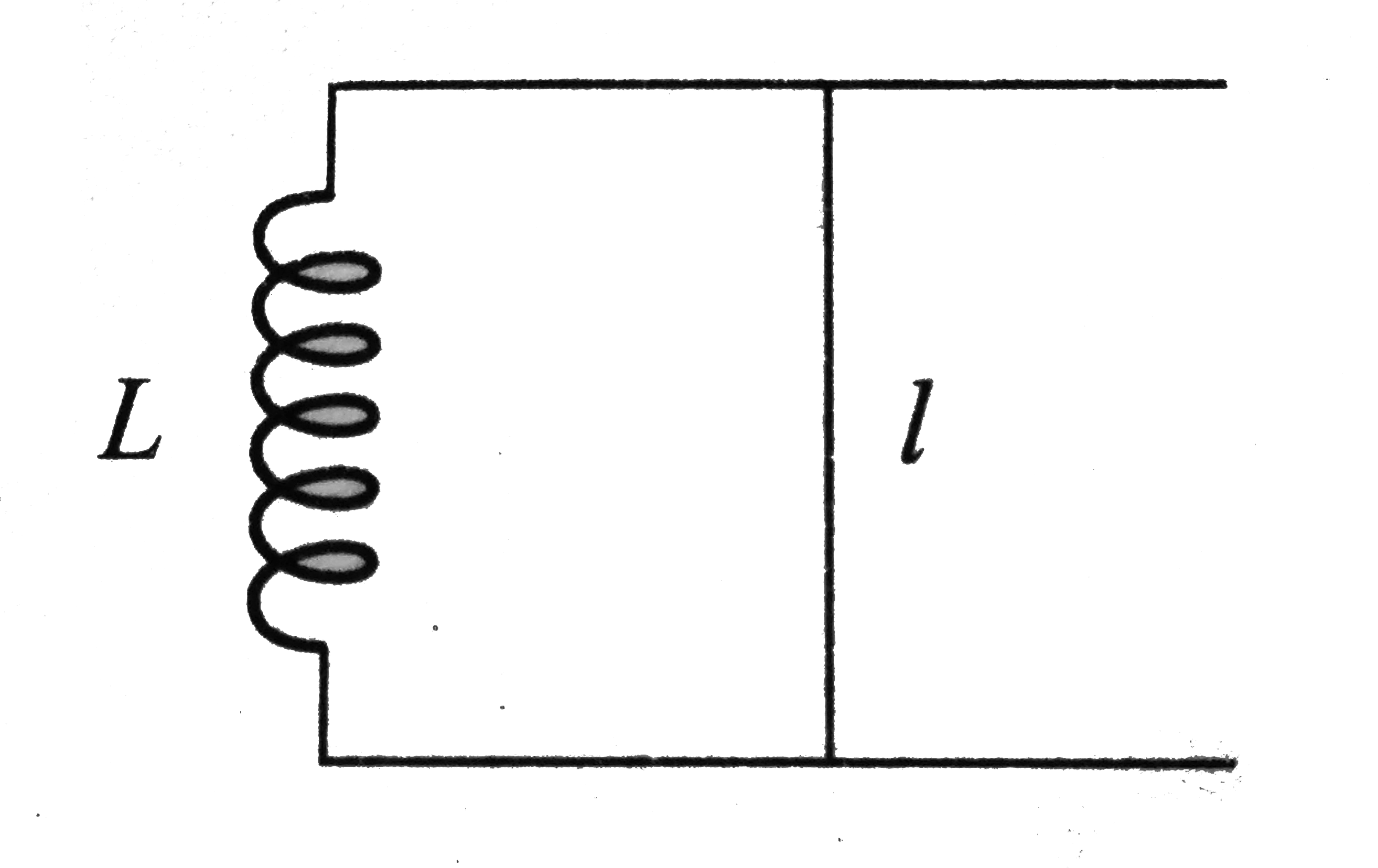
Two parallel resistanceless rails are connected by an inductor of inductance `L` at one end as shows in Fig. A magnetic field `B` exists in the space which is perendicular to the plane of the rails. Now a conductor of length `l` and mass `m` is placed transverse on the rail and given an inpulse `J` toward the rightward direction. Then choose the correct option (S).

A

Velocity of the conductor is half of the initial velocity after a displaacement of the conductor `d = sqrt((3J^(2)L)/(4B^(2)l^(2)m))`

B

Current flowing through the inductor at the instant when velocity of the conductor is half of the initial velocity is `i = sqrt((3J^(2))/(4Lm))`

C

Velocity of the conductor is half of the initial velocity after a displacement of the conductor `d = sqrt((3J^(2)L)/(B^(2)l^(2)m))`

D

Current flowing through the inductor at the instant when velocity of the conductor is half of the initial velocity is `i = sqrt((3j^(2))/(mL))`

Text Solution

Verified by Experts

The correct Answer is:

A, B

`L(di)/(dt) = B nu l rArr int di = (Bl)/(L) int nu dt rArr I = (Bl)/(L) x` (i)
`F = ma rArr - iBl = m nu (d nu)/(dx)`
`rArr -(B^(2)l^(2)x)/(L) = mnu (d nu)/(dx) rArr -(B^(2)l^(2))/(L) underset(0) overset(d) int x dx = underset(nu _(0)) overset(nu_(0)//2)int nu dnu`
`rArr -(B^(2)l^(2)d^(2))/(L) = (- 3 nu_(0)^(2))/(8), nu_(0) = (J)/(m)`
`rArr d = sqrt((3J^(2)L)/(4B^(2)l^(2)m))`
Put `x = d` in (i), `i = (Bl)/(L) sqrt((3J^(2)L)/(4B^(2)l^(2)m)) = sqrt((3J^(2))/(4Lm))`
Promotional Banner

Topper's Solved these Questions

  • INDUCTANCE

    CENGAGE PHYSICS ENGLISH|Exercise Exercises (assertion-reasoning)|2 Videos
  • INDUCTANCE

    CENGAGE PHYSICS ENGLISH|Exercise Exercises (linked Compreshension)|36 Videos
  • INDUCTANCE

    CENGAGE PHYSICS ENGLISH|Exercise Exercises (single Correct )|65 Videos
  • HEATING EFFECT OF CURRENT

    CENGAGE PHYSICS ENGLISH|Exercise Thermal Power in Resistance Connected in Circuit|27 Videos
  • MAGNETIC FIELD AND MAGNETIC FORCES

    CENGAGE PHYSICS ENGLISH|Exercise Multiple Correct Answer type|2 Videos

Similar Questions

Explore conceptually related problems

Shows a wire sliding on two parallel, conducting rails placed at a separaton l. A magnetic feld B exists in a direction perpendicular to the plane of the rails. What force is necessary to keep the wire moving at a constatn velocity v ?

Figure shows a wire sliding on two parallel, conducting rails placed at a separation L . A magnetic field B exists in a direction perpendicular to the plane of the rails. What force is necessary to keep the wire moving at a constant velocity V ?

Figure shows a wire of resistance R sliding on two parallel, conducting fixed thick rails placed at a separation l. A magnetic fild B exist in a direction perpendicular to the plane of the rails. The wire is moving with a constant velocity v. Find current through the wire

A conducting rod MN of mass m and length 'l' is placed on parallel smooth conducting rails connected to an uncharged capacitor of capacitance C and a battery of emf epsilon as shown. A uniform magnetic field B is existing perpendicular to the plane of the rails. The steady state velocity acquired by the conducting rod MN after closing switch S is (neglect the resistance of the parallel rails and the conducting rod)

A conducting wire xy of lentgh l and mass m is sliding without friction on vertical conduction rails ab and cd as shown in figure. A uniform magnetic field B exists perpendicular to the plane of the rails, x moves with a constant velocity of

A conducting wire xy of lentgh l and mass m is sliding without friction on vertical conduction rails ab and cd as shown in figure. A uniform magnetic field B exists perpendicular to the plane of the rails, x moves with a constant velocity of

PQ and MN are two parallel conductors at a distance l apart and connected by a resistance R as shown in figure. They are placed in a magnetic field B which is perpendicular to the plane of the conductors. A wire XY is placed over PQ and MN and then made to slide over PQ and MN with a velocity v. Neglecting the resistance of PQ, MN and wire XY, calculate the work done per second to slide the wire XY.

A copper wire ab of length l , resistance r and mass m starts sliding at t=0 down a smooth, vertical, thick pair of connected condcuting rails as shown in figure.A uniform magnetic field B exists in the space in a direction perpendicular to the plane of the rails which options are correct.

Consider parallel conducting rails separated by a distance l. There exists a uniform magnetic field B perpendicular to the plane of the rails as shown in Fig. Two conducting wires each of length l are placed so as to slide on parallel conducting rails. One of the wires is given a velocity v_(0) parallel to the rails. Till steady state is achieved, loss in kinetic energy of the system is

Two parallel long smooth conducting rails separated by a distance l are connected by a movable conducting connector of mass m . Terminals of the rails are connected by the resistor R and the capacitor C as shown in figure. A uniform magnetic field B perpendicular to the plane of the rail is switched on. The connector is dragged by a constant force F . Find the speed of the connector as a function of time if the force F is applied at t = 0 . Also find the terminal velocity of the connector.
