Home
Class 12
PHYSICS
In Fig i(1) = 10e^(-2t) A, i(2) = 4 A, a...

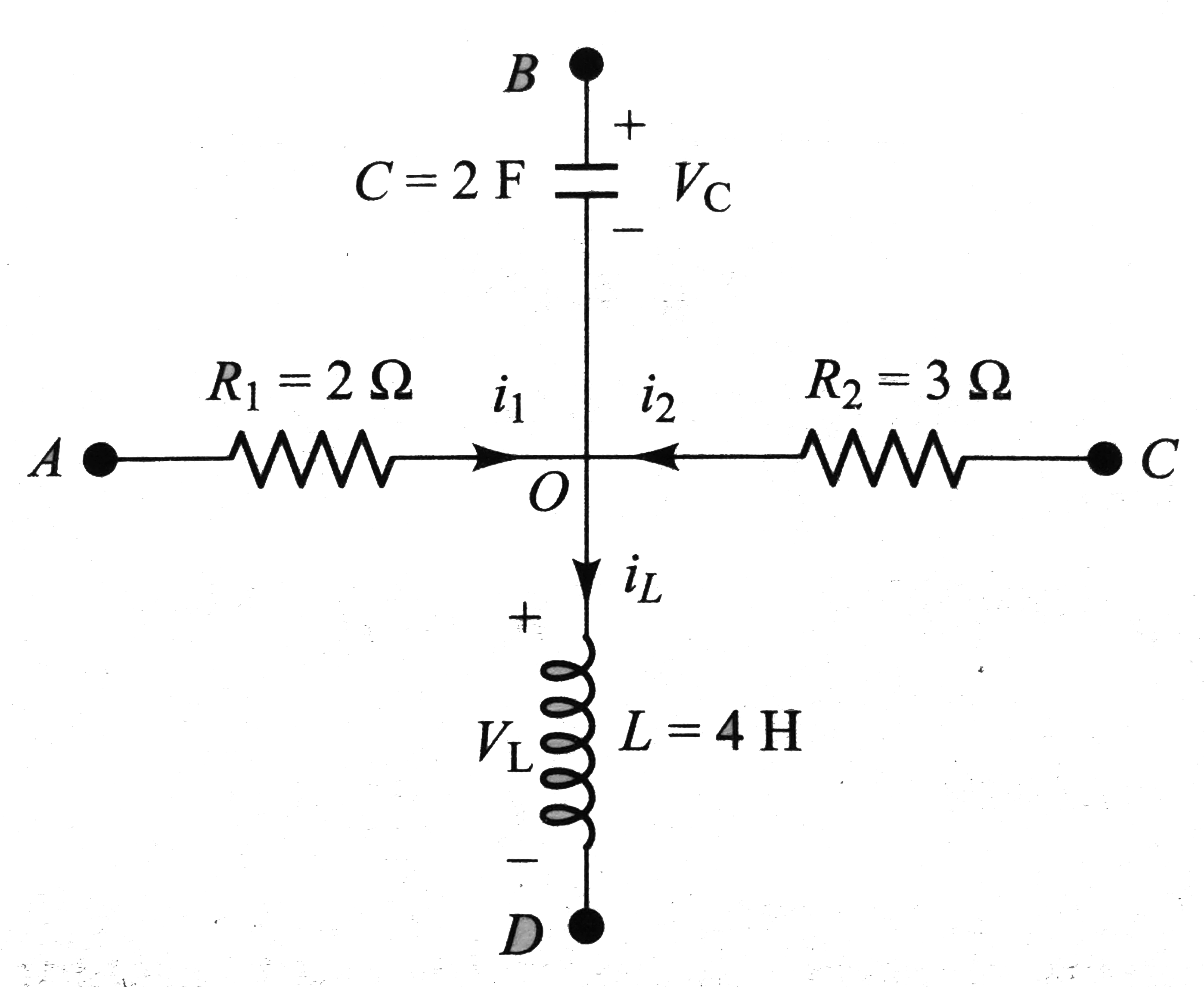
In Fig `i_(1) = 10e^(-2t) A`, `i_(2) = 4 A`, and `V_(C) = 3e^(-2t) V`.

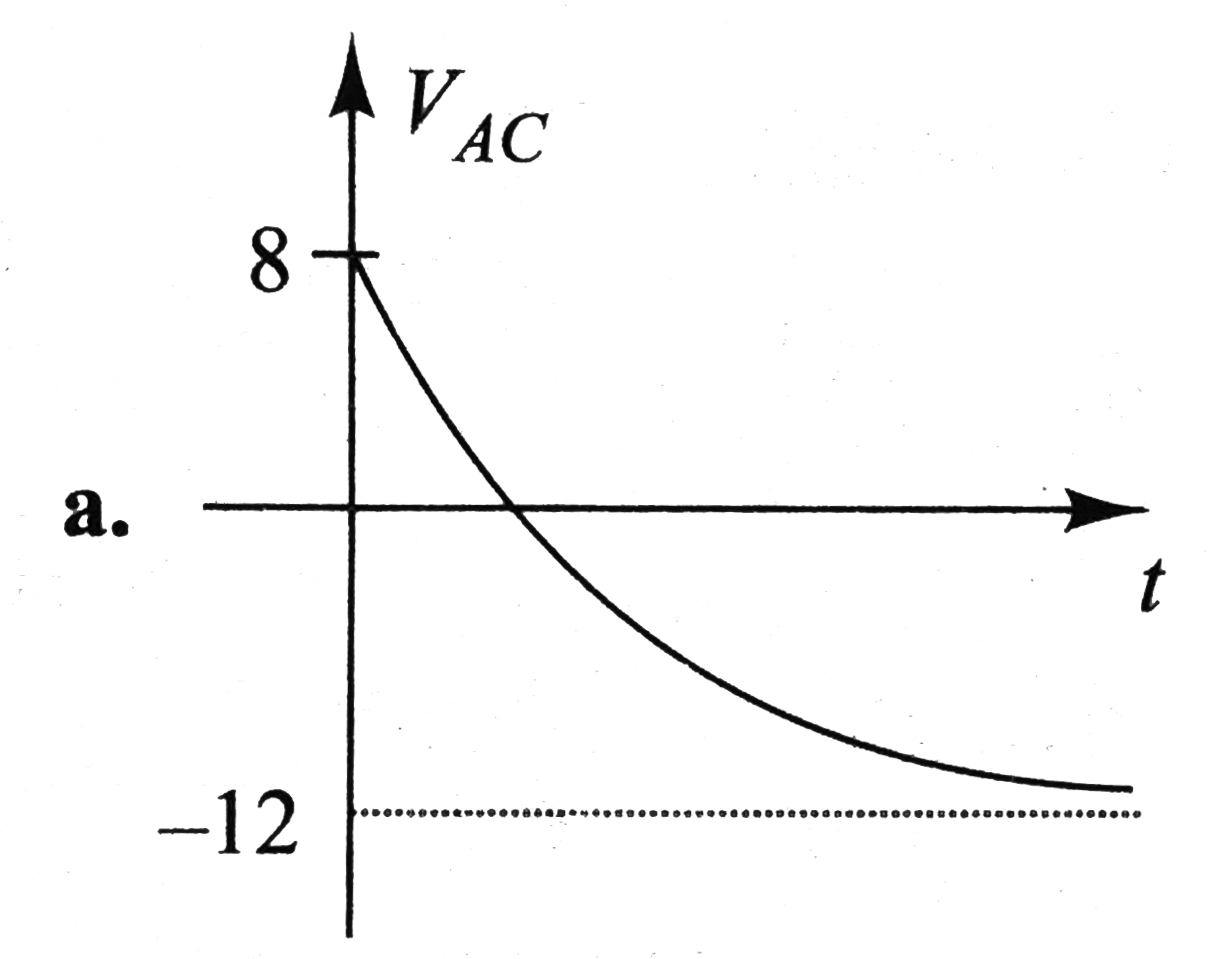
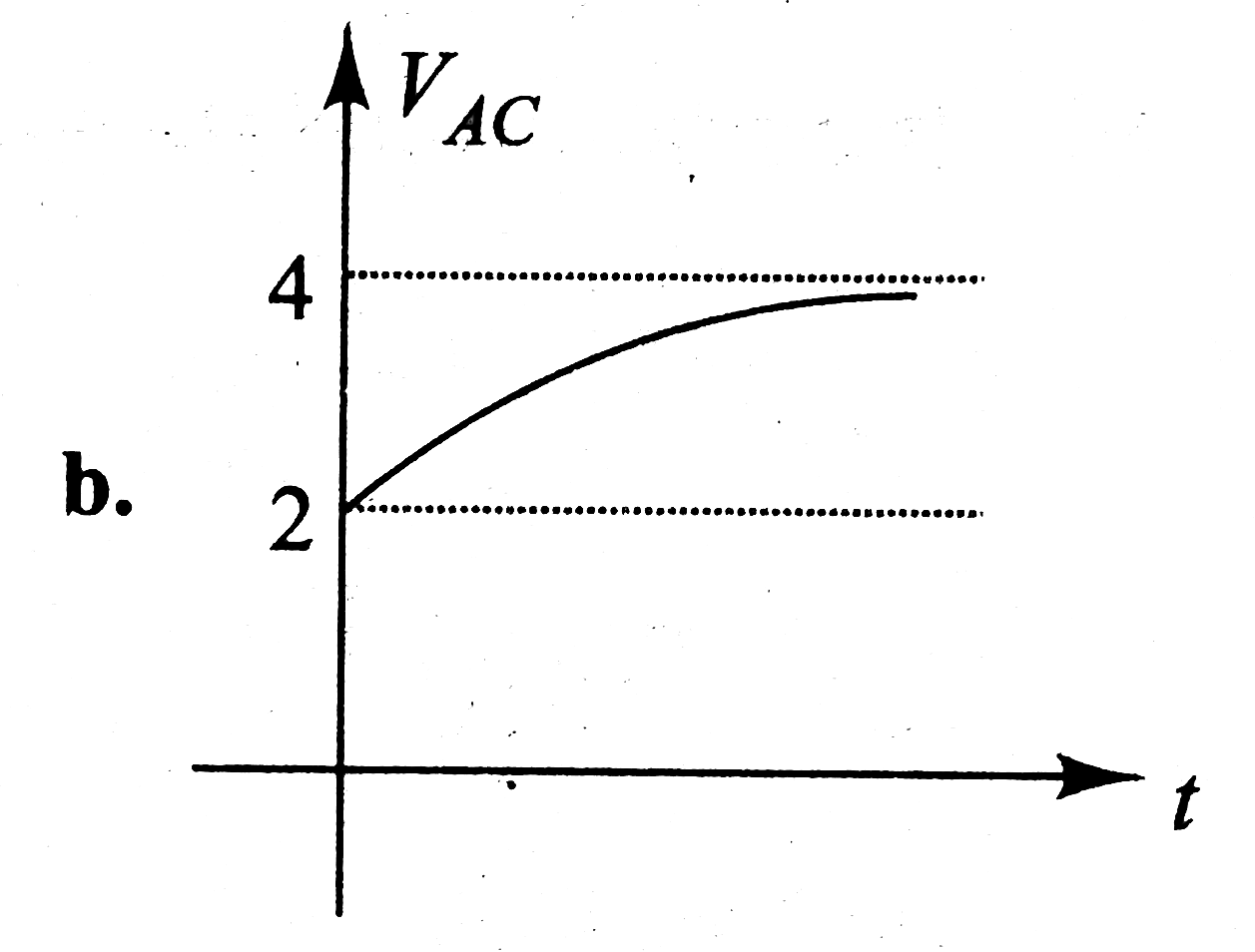
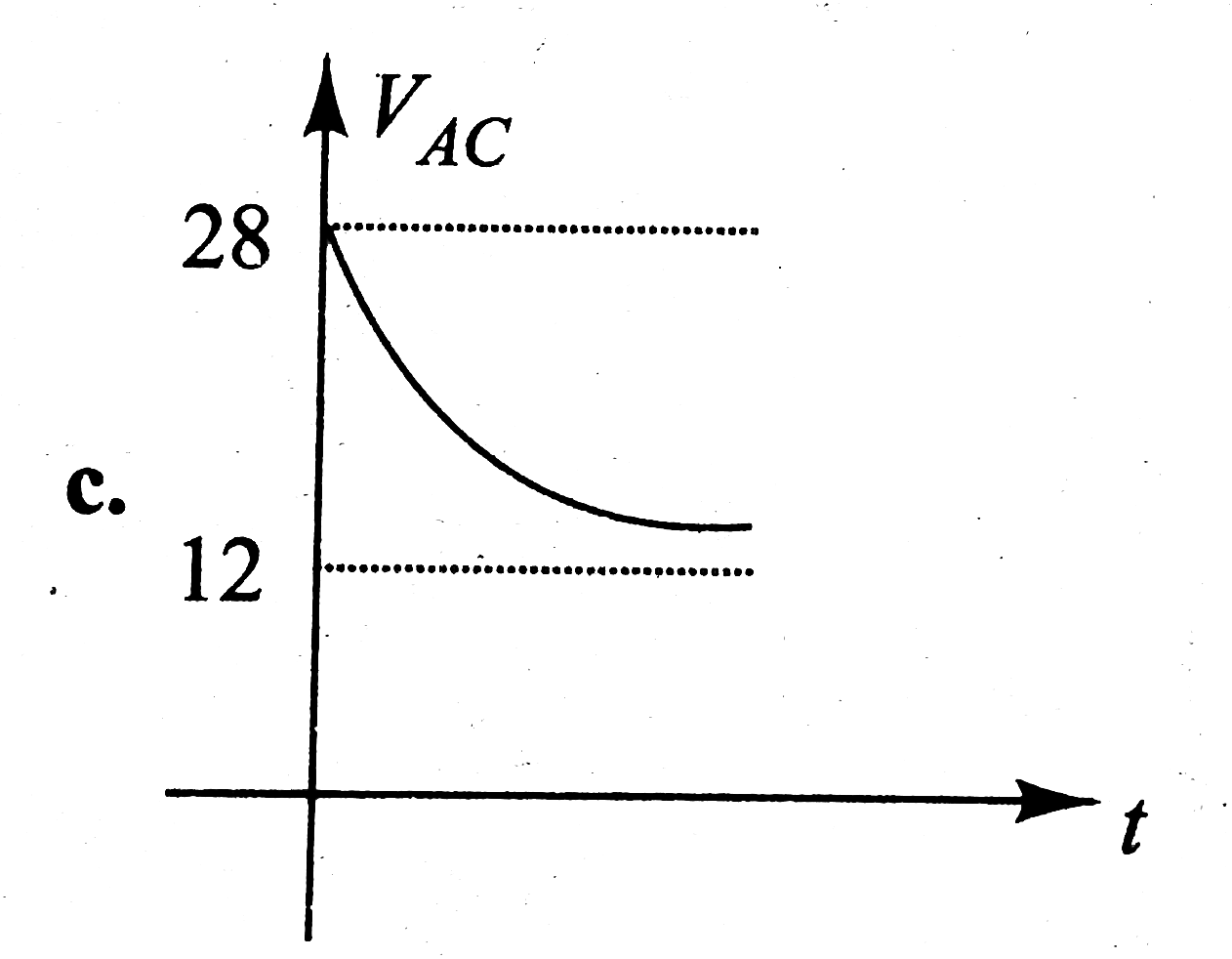
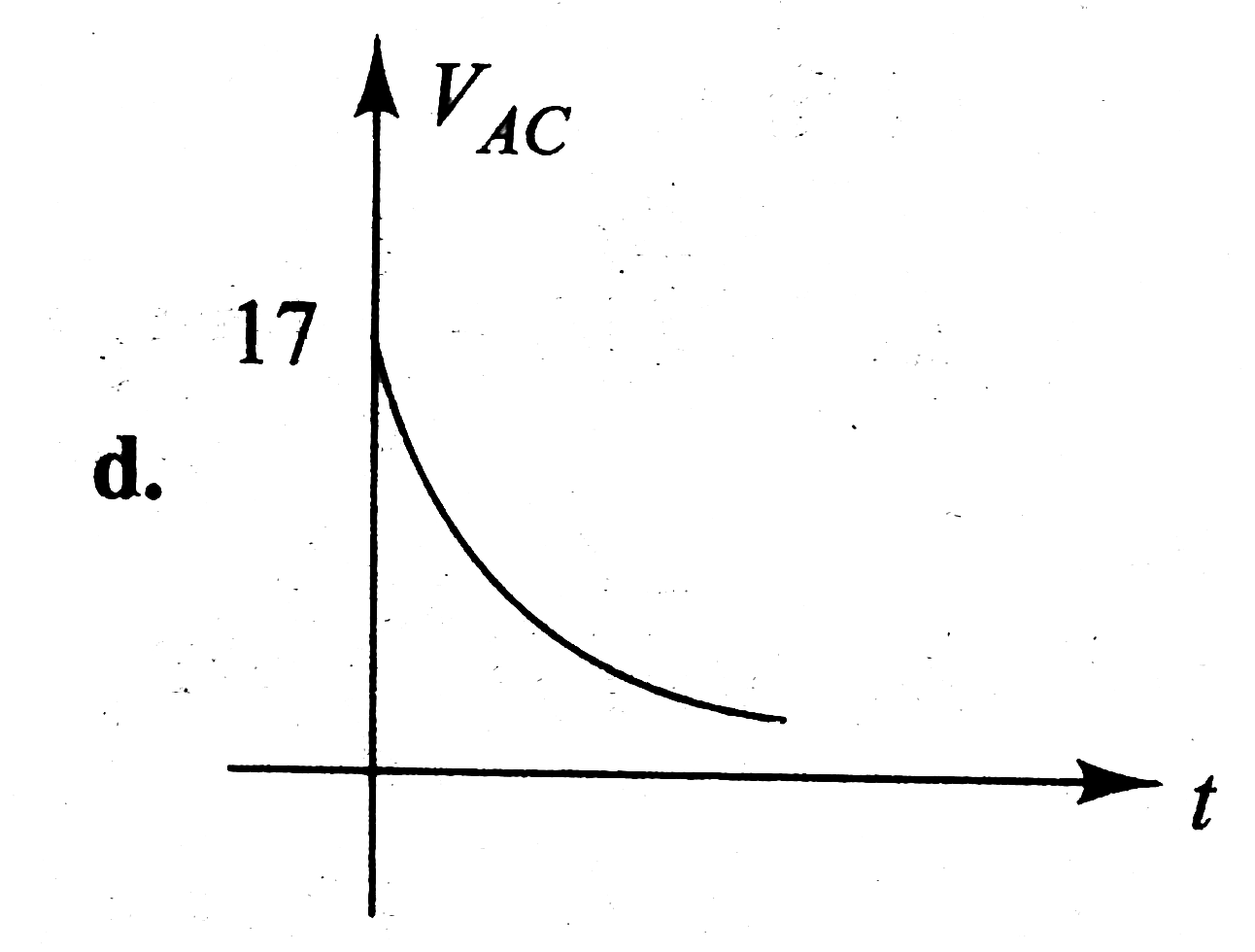
the vartiation of potential difference across `A` and `C(V_(AC))` with time can be respresented as

A

B

C

D

Text Solution

Verified by Experts

The correct Answer is:
A

Instanctaneous current in the capacitor,
`q = CV_(C) = (2)(3e^(-2t)) = 6e^(-2t) A`
Current, `i_(C) = (dq)/(dt) = - 12e^(-2t)A`
This current flows from `B` to `O`.
From `KVL`, we have
`i_(L) = i_(1) + i_(2) + i_(C) = 10e^(-2t) + 4 - 12e^(-2t)`
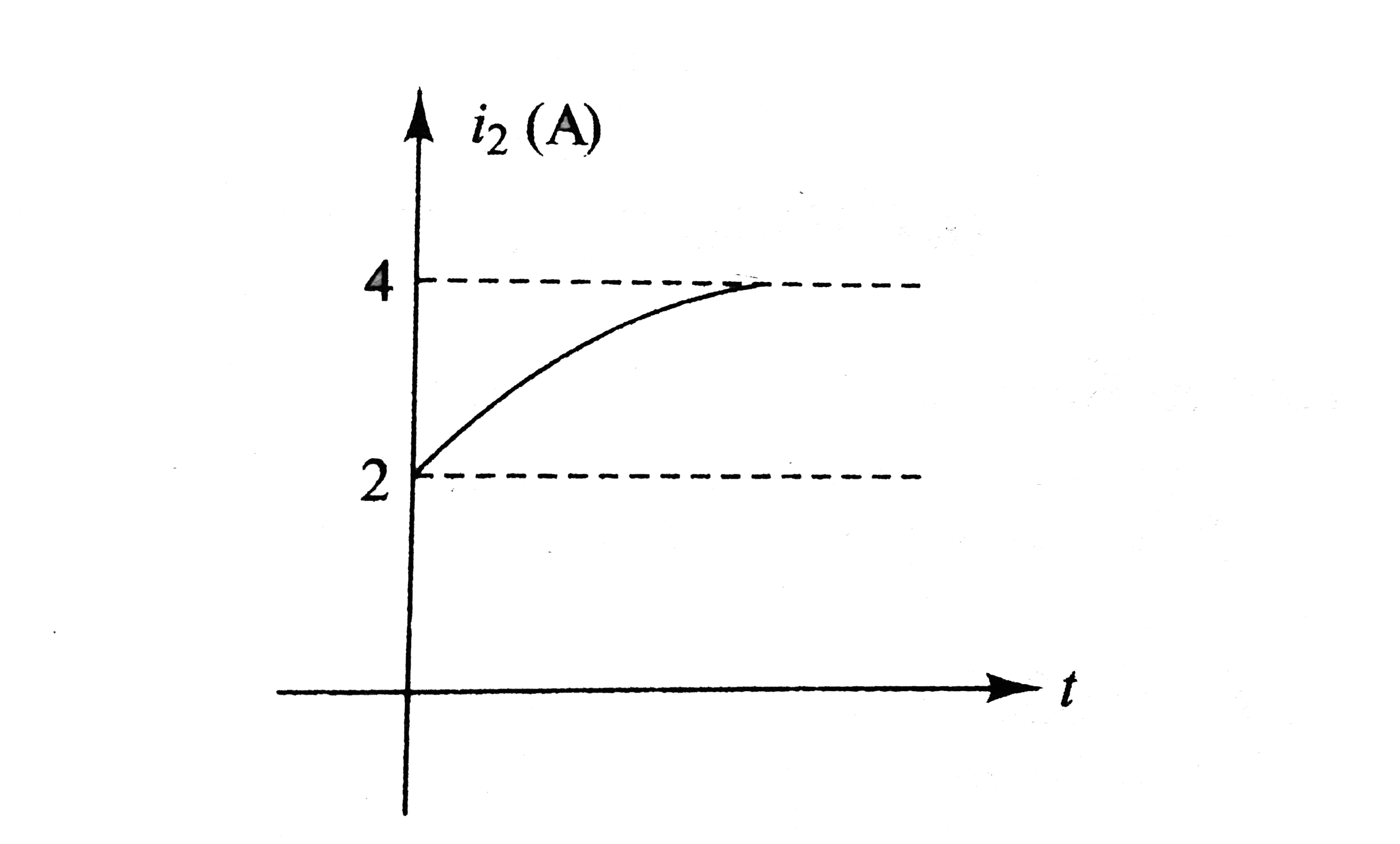
`= (4 - 2t^(-2t)) A = [2 + 2(1 - e^(-2t))]A`
`i_(L) vs`. time graph is as shows in Fig lt
`i_(L)` increases from `2 A` to `4 A` expontially.

`V_(L) = L(di_(L))/(dt)`
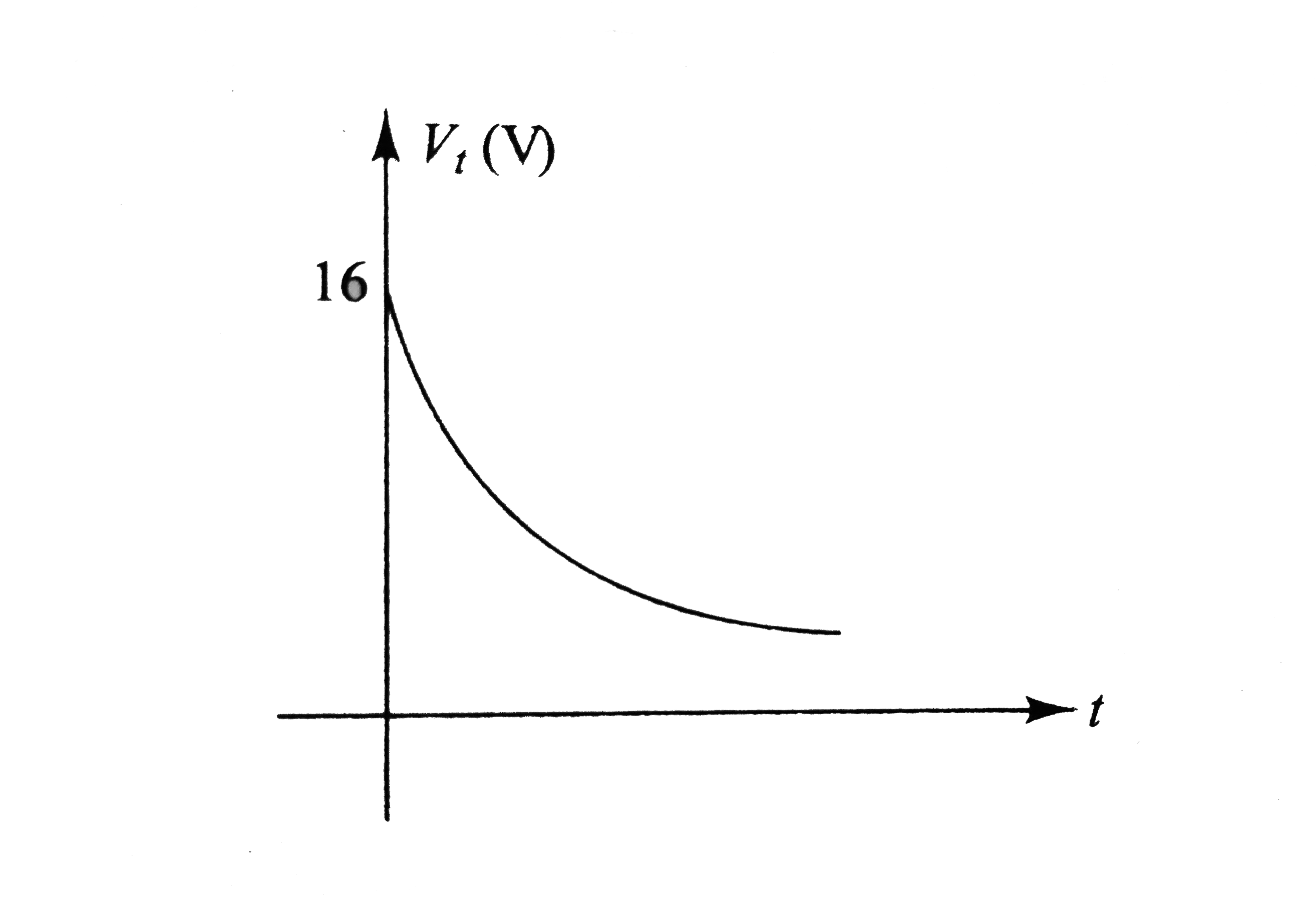
`= (4)(d)/(dt) (4 - 2e^(-2t)) = 16e^(-2t) V`
`V_(L)` decreases exponentially from `16 A` to `0` as shows in Fig
To determine `V_(AC)`, we begin from `A` and at `C`. From `KVL`,
we have

`V_(A) - i_(1)R_(1) + i_(2)R_(2) = V_(C)`
`V_(A) - V_(C) = i_(1)R_(1) - i_(2)R_(2)`
Substituting the values, we have
`V_(AC) = (10 e^(-2t))(2) - (4)(3)`

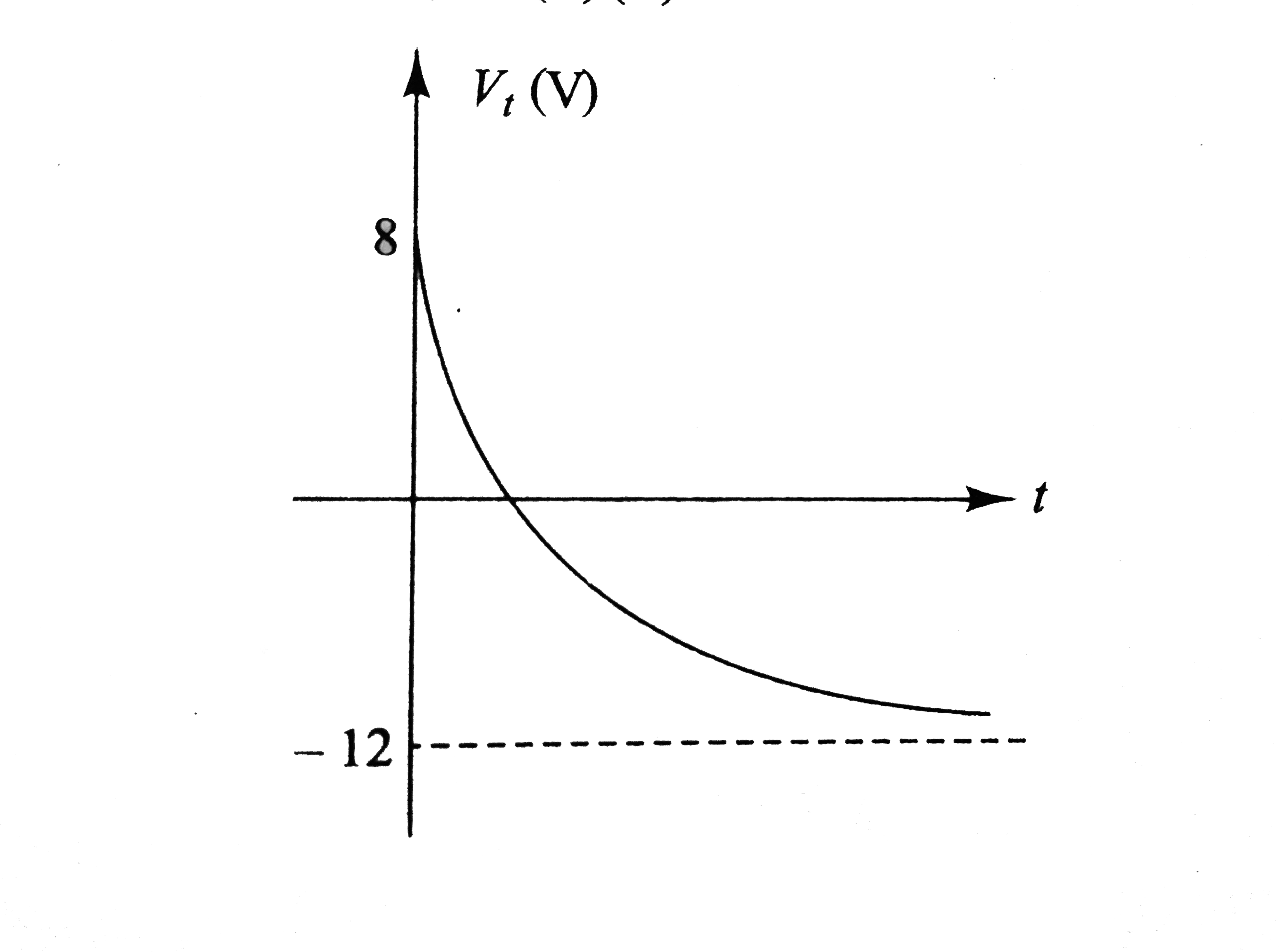
`V_(AC) = (20e^(-2t) - 12) V`
At `t = 0`, `V_(AC) = 8V`
At `t = oo`, `V_(AC) = - 12 V`
Therefore, `V_(AC)` decrease exponentially from `8 V` to `12 V`.
Similarly, we have from `A` to `B`
`V_(A) - i_(1)R_(1) + V_(C) = V_(B)`
`V_(AB) = V_(A) - V_(B) = i_(1)R_(1) - V_(C)`
Substituting the values, we have
`V_(AB)=^((10e^(-2t)))(2)-3e^(-2t)`
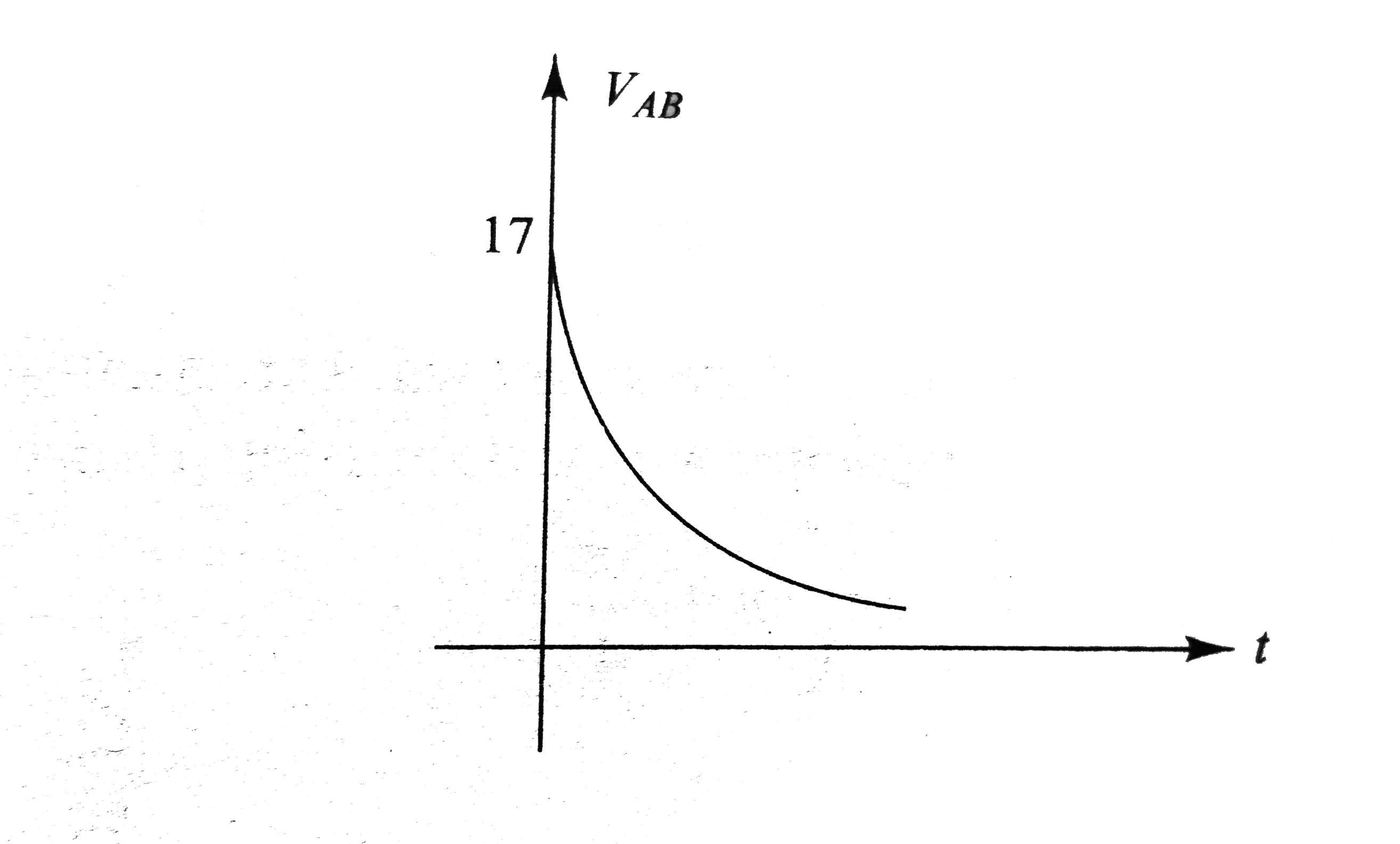
`V_(AB) =^(17e^(-2t))V`
Thus, `V_(AB)` decreases exponentially from `17 V` to `0`.
As we move from `C` to `D`,
`V_(C) - i_(2)R_(2) - V_(L) = V_(D)`
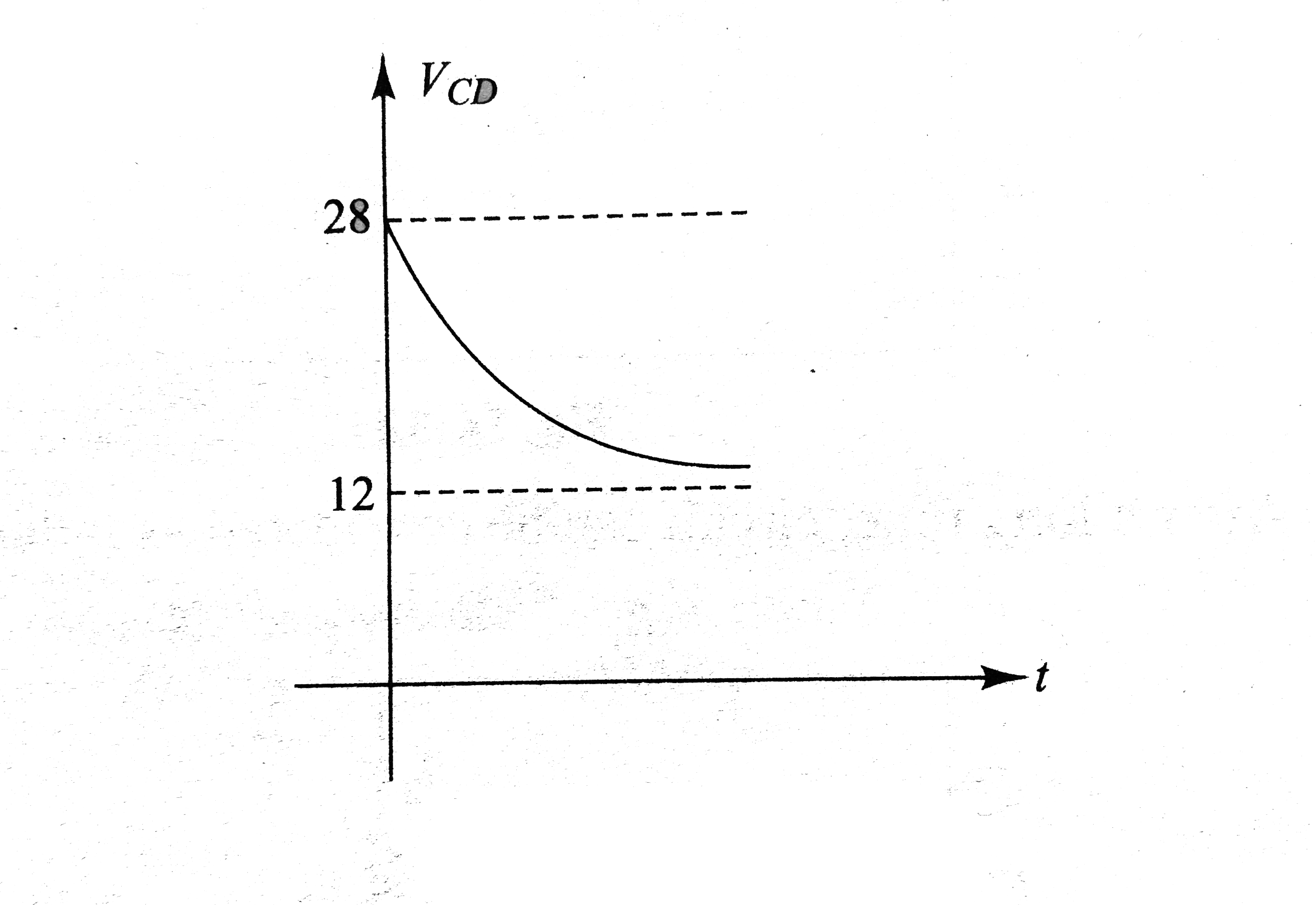
`V_(CD)= V_(C) - V_(D) = i_(2)R_(2) + V_(L)`
Substituting the values we have,
`V_(CD)= (4)(3) + 16e^(-2t)`

`V_(AD) = (12 + 16e^(-2t))V`
At `t = 0, V_(CD) = 28 V`
and at `t = oo, V_(CD) = 12 V`
i.e., `V_(CD)` decreases exponentially from `28 V` to `12 V`.
Promotional Banner

Topper's Solved these Questions

  • INDUCTANCE

    CENGAGE PHYSICS ENGLISH|Exercise Exercises (integer)|8 Videos
  • INDUCTANCE

    CENGAGE PHYSICS ENGLISH|Exercise Archives (fills In The Blanks)|3 Videos
  • INDUCTANCE

    CENGAGE PHYSICS ENGLISH|Exercise Exercises (assertion-reasoning)|2 Videos
  • HEATING EFFECT OF CURRENT

    CENGAGE PHYSICS ENGLISH|Exercise Thermal Power in Resistance Connected in Circuit|27 Videos
  • MAGNETIC FIELD AND MAGNETIC FORCES

    CENGAGE PHYSICS ENGLISH|Exercise Multiple Correct Answer type|2 Videos

Similar Questions

Explore conceptually related problems

In Fig i_(1) = 10e^(-2t) A , i_(2) = 4 A , and V_(C) = 3e^(-2t) V . The variation of potential difference across C and D(V_(CD)) with time can be expressed as

Potential difference across AB , i.e., V_(A)-V_(B) is

In the Figure shown i_1=10e^(-2t) A, i_2=4A and V_C=3e^(-2t)V . Determine a. i_L and V_L b. V_(ac), V_(ab), V_(cd)

In the figure shown i=10e^(-4t) A. Find V_L and V_(ab)

In the figure shown i=10e^(-4t) A. Find V_L and V_(ab)

In the figure shown i=10e^(-4t) A. Find V_L and V_(ab)

Potential difference between points A and B (i.e. V_(A) - V_(B) ) is -----

in a series LCR circuit, what is the phase difference between V_(L) and V_(C) where V_(L) is the potential difference across the inductor and V_(C) is the potential difference across the capacitor?

In the circuit shown in fig. E_(1)=3V, E_(2)= 2V, E_(3)= 1V, R=r_(1)=r_(2)=r_(3)= 1 ohm . Find the potential difference between the points A and B and the currents through each branch.

In the circuit shows in Fig. , E = 10 V , R_(1) = 5 Omega , R_(2) = 10 Omega , and L = 5 H . For the two separate conditions, (i) switch S is just closed and (ii) switch S is closed for a long time, calculate a. current i_(1) through R_(1) , b. current i_(2) through R_(2) , c. current i through the switchs, d. the potential difference across R_(2) , e. the potential difference across L , f. di_(2)//dt .

CENGAGE PHYSICS ENGLISH-INDUCTANCE-Exercises (linked Compreshension)
  1. In Fig i(1) = 10e^(-2t) A, i(2) = 4 A, and V(C) = 3e^(-2t) V. The...

    Text Solution

    |

  2. In the Figure shown i1=10e^(-2t) A, i2=4A and VC=3e^(-2t)V. Determine...

    Text Solution

    |

  3. In Fig i(1) = 10e^(-2t) A, i(2) = 4 A, and V(C) = 3e^(-2t) V. th...

    Text Solution

    |

  4. In the Figure shown i1=10e^(-2t) A, i2=4A and VC=3e^(-2t)V. Determine...

    Text Solution

    |

  5. In Fig i(1) = 10e^(-2t) A, i(2) = 4 A, and V(C) = 3e^(-2t) V. Th...

    Text Solution

    |

  6. In the circuit shows (Fig.) switches S(1) and S(3) have been closed fo...

    Text Solution

    |

  7. In the circuit shows (Fig.) switches S(1) and S(3) have been closed fo...

    Text Solution

    |

  8. In the circuit shows (Fig.) switches S(1) and S(3) have been closed fo...

    Text Solution

    |

  9. In the given (Fig.) all the symbols have their usual meanings. At t = ...

    Text Solution

    |

  10. In the given (Fig.) all the symbols have their usual meanings. At t = ...

    Text Solution

    |

  11. In the circuit shows in Fig E = 15 V, R(1) = 1Omega, R(2) = 1 Omega, R...

    Text Solution

    |

  12. In the circuit shows in Fig E = 15 V, R(1) = 1Omega, R(2) = 1 Omega, R...

    Text Solution

    |

  13. In the circuit shows in Fig E = 15 V, R(1) = 1Omega, R(2) = 1 Omega, R...

    Text Solution

    |

  14. In the given at t = 0, switch S is closed. The current through th...

    Text Solution

    |

  15. In the given at t = 0, switch S is closed. The energy stored in t...

    Text Solution

    |

  16. In the given at t = 0, switch S is closed. The energy stored in t...

    Text Solution

    |

  17. In Fig. there is a frame consisting of two square loops having resist...

    Text Solution

    |

  18. In Fig. there is a frame consisting of two square loops having resist...

    Text Solution

    |

  19. In Fig. there is a frame consisting of two square loops having resist...

    Text Solution

    |

  20. there in no current part of this circuit for time t lt o. Switch S is ...

    Text Solution

    |