Home
Class 12
PHYSICS
In the circuit shows (Fig.) switches S(1...

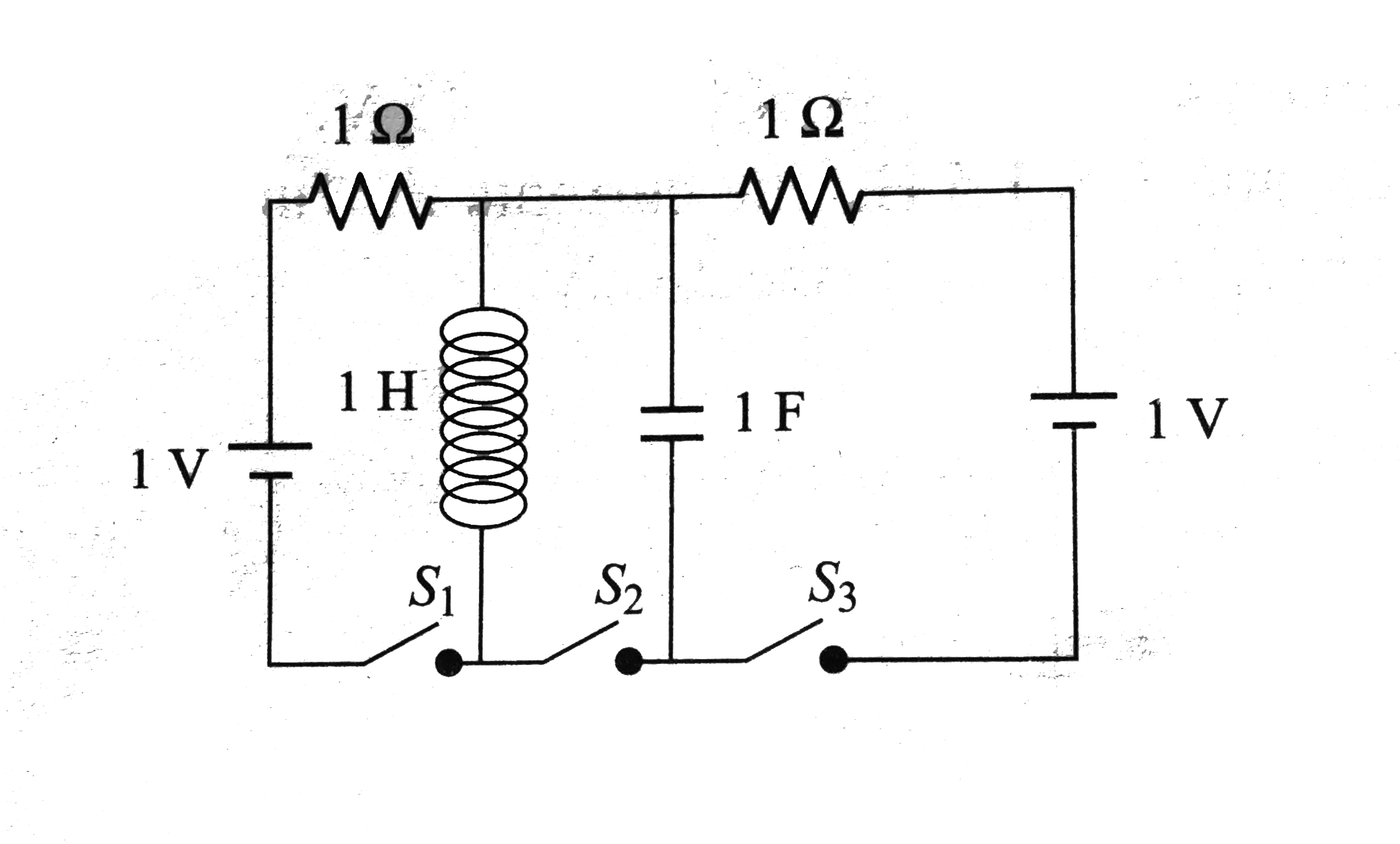
In the circuit shows (Fig.) switches `S_(1)` and `S_(3)` have been closed for `1 s` and `S_(2)` remained open. Just after `1 s`, switch `S_(2)` is closed and `S_(1)` and `S_(3)` are opened. Find after that instant `(t = 0)`:

the maximum charge on the capacitor

A

`sqrt(3) (1 + (1)/(e))`

B

`sqrt(3) (1 - (1)/(e))`

C

`sqrt(2) (1 + (1)/(e))`

D

`sqrt(2) (1 - (1)/(e))`

Text Solution

Verified by Experts

The correct Answer is:
D

`S_(1)` and `S_(2)` are closed for `1 s`.
Charge on capacitor,
`q = CE (1 - e^(-t//RC)) = 1 - (1)/(e)` (i)
The current in inductor,
`I = (E)/(R ) (1 - e^(-t//RC)) = 1 - (1)/(e)`(ii)
Now `S_(1)` and `S_(3)` are opened and `S_(2)` is closed,
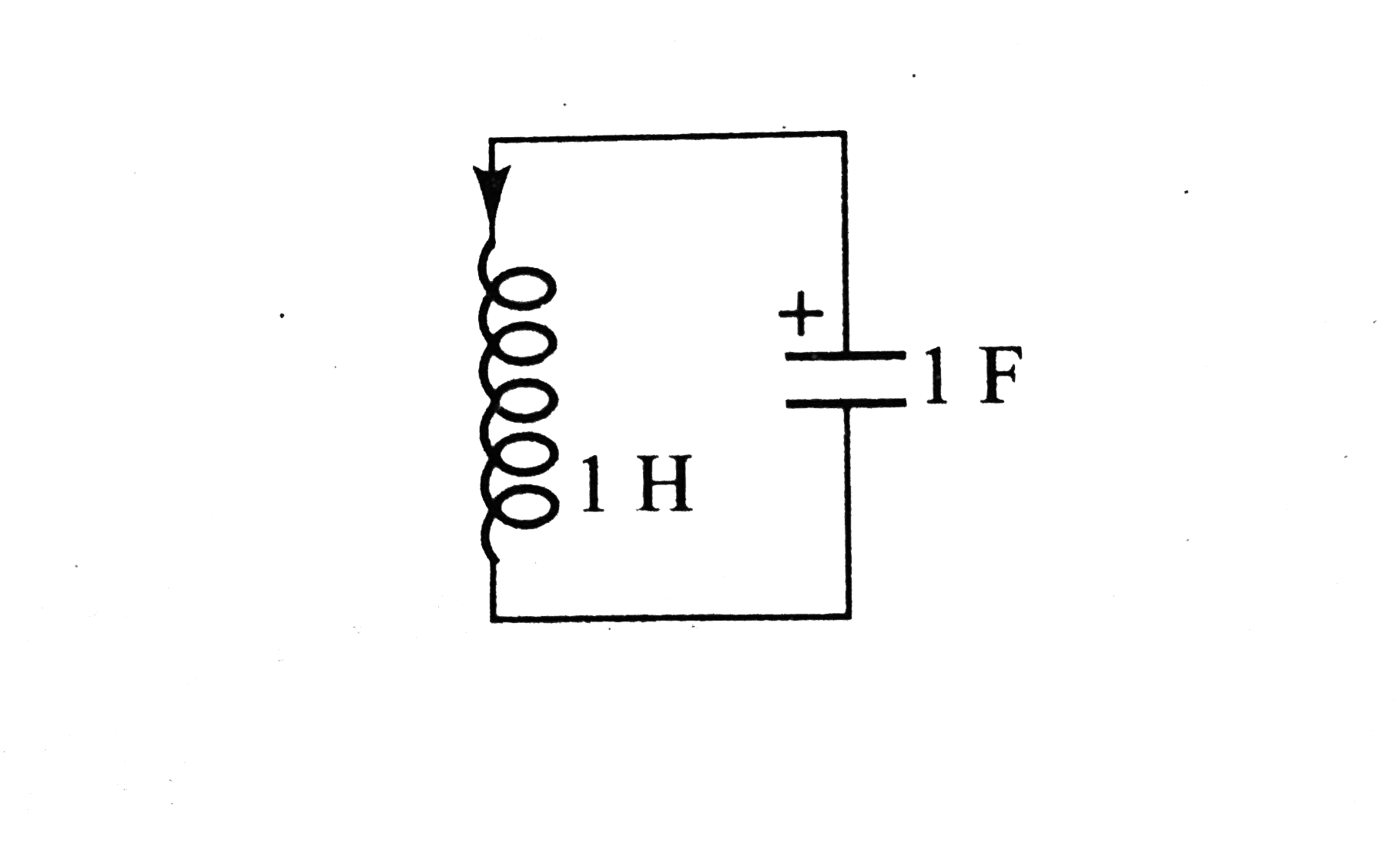
It is `LC` circuit,
`q = q_(max) sin (omegat + phi)` (iii)
`I = (q_(max)) omega cos(omegat + phi)` (iv)
As total energy (Magnetic + electrical) is constant
`(1)/(2) LI_(max)^(2) = (1)/(2)(q_(max)^(2))/(C) = (1)/(2) LI^(2) + (1)/(2) (q^(2))/(C)` (v)
`q_(max) = sqrt(2) (1 - (1)/(e))` (vi)
`I_(max) = sqrt(2) (1 - (1)/(e))` (vii)
From (iii) at `t = 0`, we get
`(1 - (1)/(e)) = sqrt(2) (1 - (1)/(e)) sin phi rArr = (pi)/(4)` or `(3pi)/(4)`
After closing `S_(2)`, circuit will be as shows. Direction of current shows that charge on capacitor will be decreaseing. Hence `phi = 3 pi//4`
`q = sqrt(2)(1 - (1)/(e)) sin(omegat + (3pi)/(4))`
where, `omega = (1)/(sqrt(LC)) = 1`
`q = sqrt(2) (1 - (1)/(e))sin(t + (3pi)/(4))`
Promotional Banner

Topper's Solved these Questions

  • INDUCTANCE

    CENGAGE PHYSICS ENGLISH|Exercise Exercises (integer)|8 Videos
  • INDUCTANCE

    CENGAGE PHYSICS ENGLISH|Exercise Archives (fills In The Blanks)|3 Videos
  • INDUCTANCE

    CENGAGE PHYSICS ENGLISH|Exercise Exercises (assertion-reasoning)|2 Videos
  • HEATING EFFECT OF CURRENT

    CENGAGE PHYSICS ENGLISH|Exercise Thermal Power in Resistance Connected in Circuit|27 Videos
  • MAGNETIC FIELD AND MAGNETIC FORCES

    CENGAGE PHYSICS ENGLISH|Exercise Multiple Correct Answer type|2 Videos

Similar Questions

Explore conceptually related problems

In the circuit shows (Fig.) switches S_(1) and S_(3) have been closed for 1 s and S_(2) remained open. Just after 1 s , switch S_(2) is closed and S_(1) and S_(3) are opened. Find after that instant (t = 0) : the maximum current in the circuit containing inductor and capacitor (only S_(2) is closed)

In the circuit shows (Fig.) switches S_(1) and S_(3) have been closed for 1 s and S_(2) remained open. Just after 1 s , switch S_(2) is closed and S_(1) and S_(3) are opened. Find after that instant (t = 0) : the charge on the upper plate of the capacitor as a funtion of time

In the circuit shown switches S_(1) and S_(2) have been closed for 1 sec and S_(2) remained open.Just after 1 second is over switch S_(2) is closed and S_(1),S_(3) are opened.Find after that instant The charge on the upper plate of the capacitor as function of time taking the instant of switching on of S_(2) and switching off all time switches to be t=0 is q=x xx10^(-2)cos (t+pi/4) .Findout value of x .

In the circuit shown in the figure, if switches S_(1) and S_(2) have been closed for a long time, then charge on the capacitor.

In a circuit S_(1) remains closed for a long time and S_(2) remain open. Now S_(2) is closed and S_(1) is opened. Find out the di//dt in the right loop just after the moment.

In a circuit S_(1) remains closed for a long time and S_(2) remain open. Now S_(2) is closed and S_(1) is opened. Find out the di//dt in the right loop just after the moment.

In the circuit shown, S_(2) is closed first and is kept closed for a long time. Now S_(1) is closed. Just after that instant the current through S_(1) is

In the circuits shows in S_(1) and S_(2) are switches. S_(2) remains closed for a long time and S_(1) is opened. Now S_(1) is also closed. Just after S_(1) is closed, find the potential difference (V) across R and di//dt (with sign) in L .

In the circuit shown, when switch S_(1) is closed and S_(2) is open, the ideal voltmeter shows a reaiding of 18 V . When switch S_(2) is closed and S_(1) is open, the reading of voltmeter is 24 V . When S_(1) and S_(2) both are closed, the voltmeter reading will be

Find the charge flown when the switch S is closed.

CENGAGE PHYSICS ENGLISH-INDUCTANCE-Exercises (linked Compreshension)
  1. In Fig i(1) = 10e^(-2t) A, i(2) = 4 A, and V(C) = 3e^(-2t) V. Th...

    Text Solution

    |

  2. In the circuit shows (Fig.) switches S(1) and S(3) have been closed fo...

    Text Solution

    |

  3. In the circuit shows (Fig.) switches S(1) and S(3) have been closed fo...

    Text Solution

    |

  4. In the circuit shows (Fig.) switches S(1) and S(3) have been closed fo...

    Text Solution

    |

  5. In the given (Fig.) all the symbols have their usual meanings. At t = ...

    Text Solution

    |

  6. In the given (Fig.) all the symbols have their usual meanings. At t = ...

    Text Solution

    |

  7. In the circuit shows in Fig E = 15 V, R(1) = 1Omega, R(2) = 1 Omega, R...

    Text Solution

    |

  8. In the circuit shows in Fig E = 15 V, R(1) = 1Omega, R(2) = 1 Omega, R...

    Text Solution

    |

  9. In the circuit shows in Fig E = 15 V, R(1) = 1Omega, R(2) = 1 Omega, R...

    Text Solution

    |

  10. In the given at t = 0, switch S is closed. The current through th...

    Text Solution

    |

  11. In the given at t = 0, switch S is closed. The energy stored in t...

    Text Solution

    |

  12. In the given at t = 0, switch S is closed. The energy stored in t...

    Text Solution

    |

  13. In Fig. there is a frame consisting of two square loops having resist...

    Text Solution

    |

  14. In Fig. there is a frame consisting of two square loops having resist...

    Text Solution

    |

  15. In Fig. there is a frame consisting of two square loops having resist...

    Text Solution

    |

  16. there in no current part of this circuit for time t lt o. Switch S is ...

    Text Solution

    |

  17. there in no current part of this circuit for time t lt o. Switch S is ...

    Text Solution

    |

  18. there in no current part of this circuit for time t lt o. Switch S is ...

    Text Solution

    |

  19. Two capacitors of capacitance C and 3C are charged to potential differ...

    Text Solution

    |

  20. Two capacitors of capacitance C and 3C are charged to potential differ...

    Text Solution

    |

