Home
Class 11
PHYSICS
Eleven identical rods are arranged as sh...


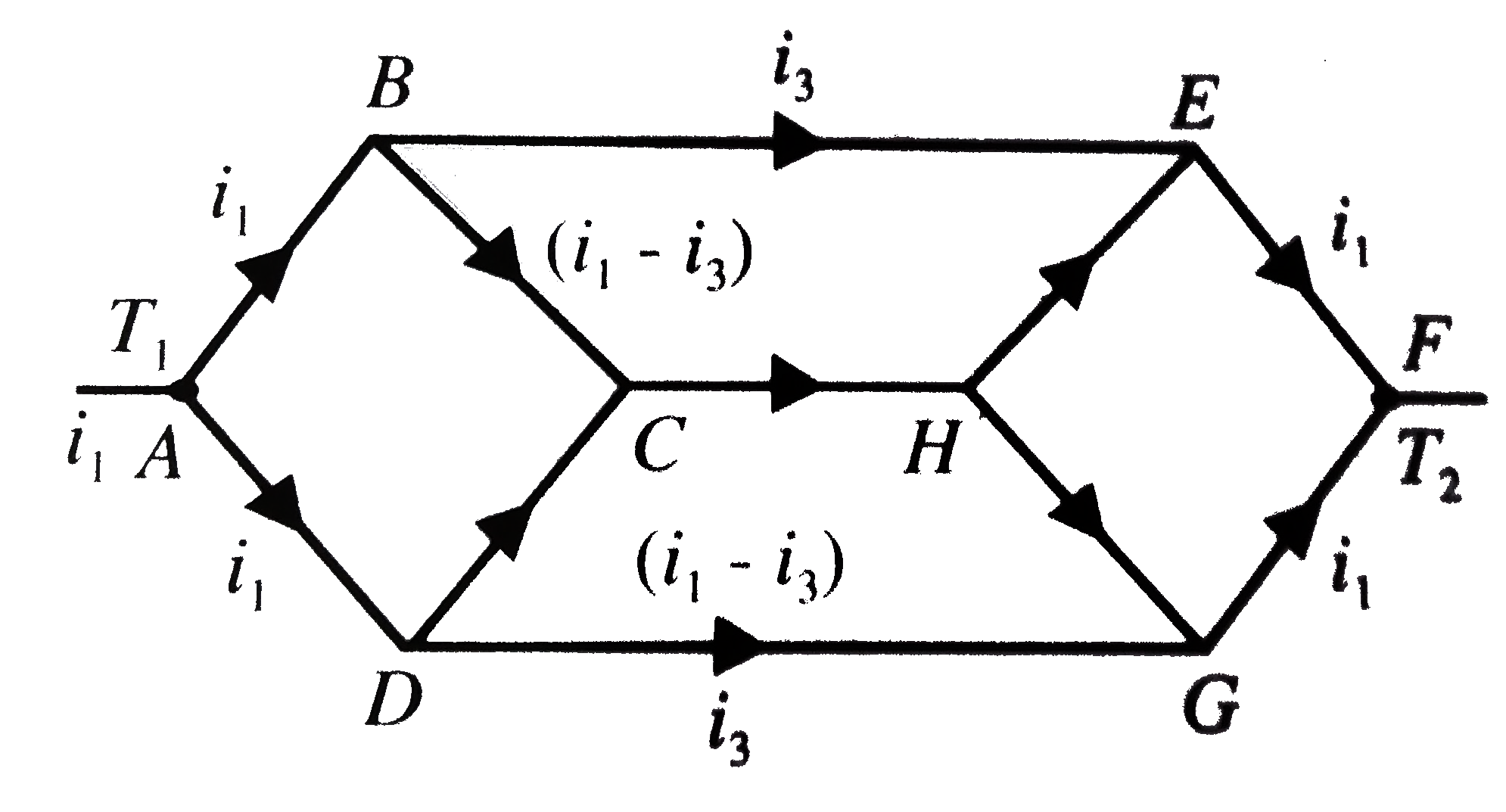
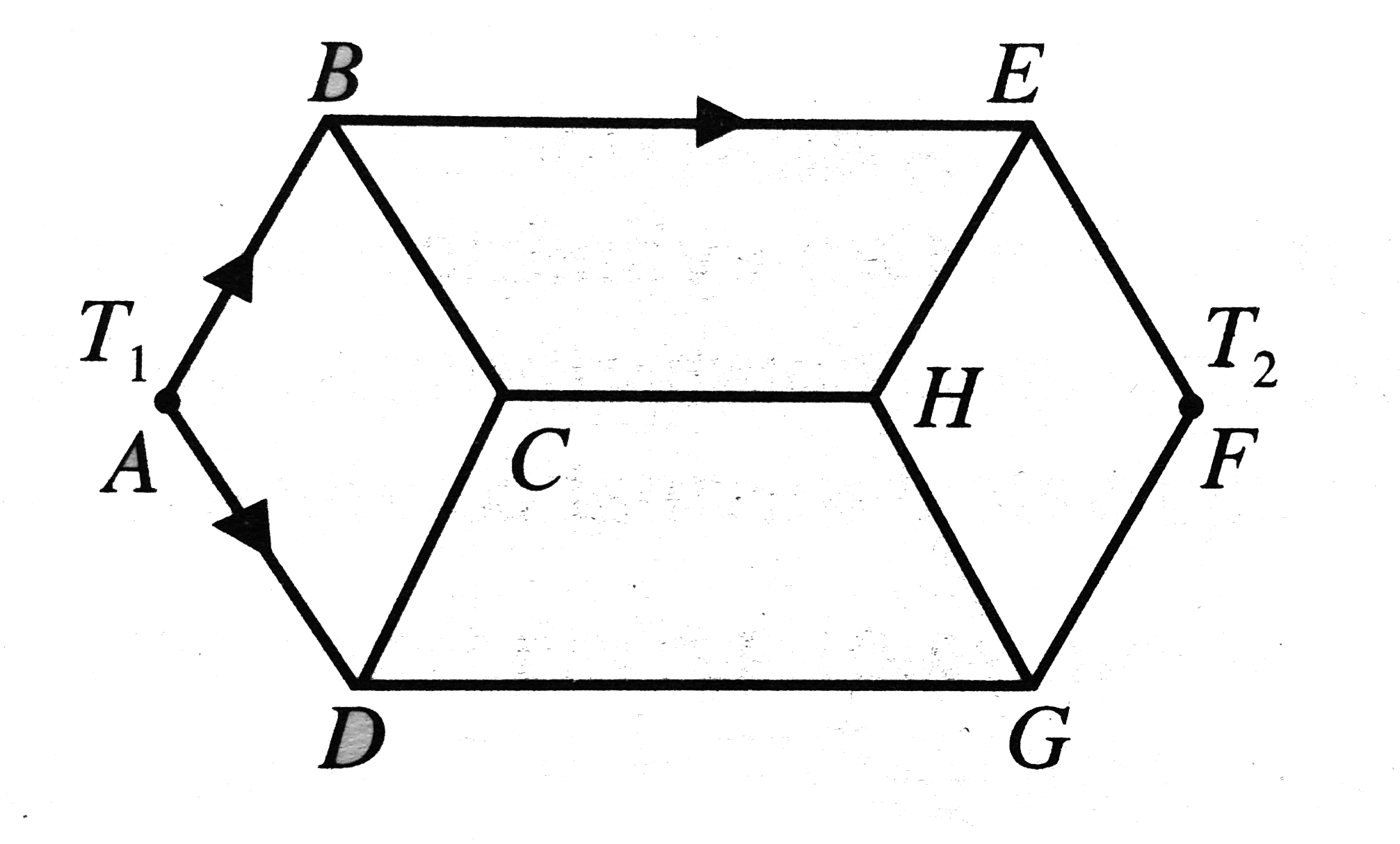
Eleven identical rods are arranged as shown in Fig. Each rod has length `l`, cross sectional area A and thermal conductivity of material k. Ends A and F are maintained at temperatures `T_1` and `T_2(ltT_1)`, respectively. If lateral surface of each rod is thermally insulated, the rate of heat transfer `((dQ)/(dt))` in each rod is

A

`((dQ)/(dt))_(AB)=((dQ)/(dt))_(CD)`

B

`((dQ)/(dt))_(BE)=(2)/(7)((T_1-T_2)KA)/(l)`

C

`((dQ)/(dt))_(CH)ne((dQ)/(dt))_(DG)`

D

`((dQ)/(dt))_(BC)=((dQ)/(dt))_(DC)`

Text Solution

Verified by Experts

The correct Answer is:
B, C, D


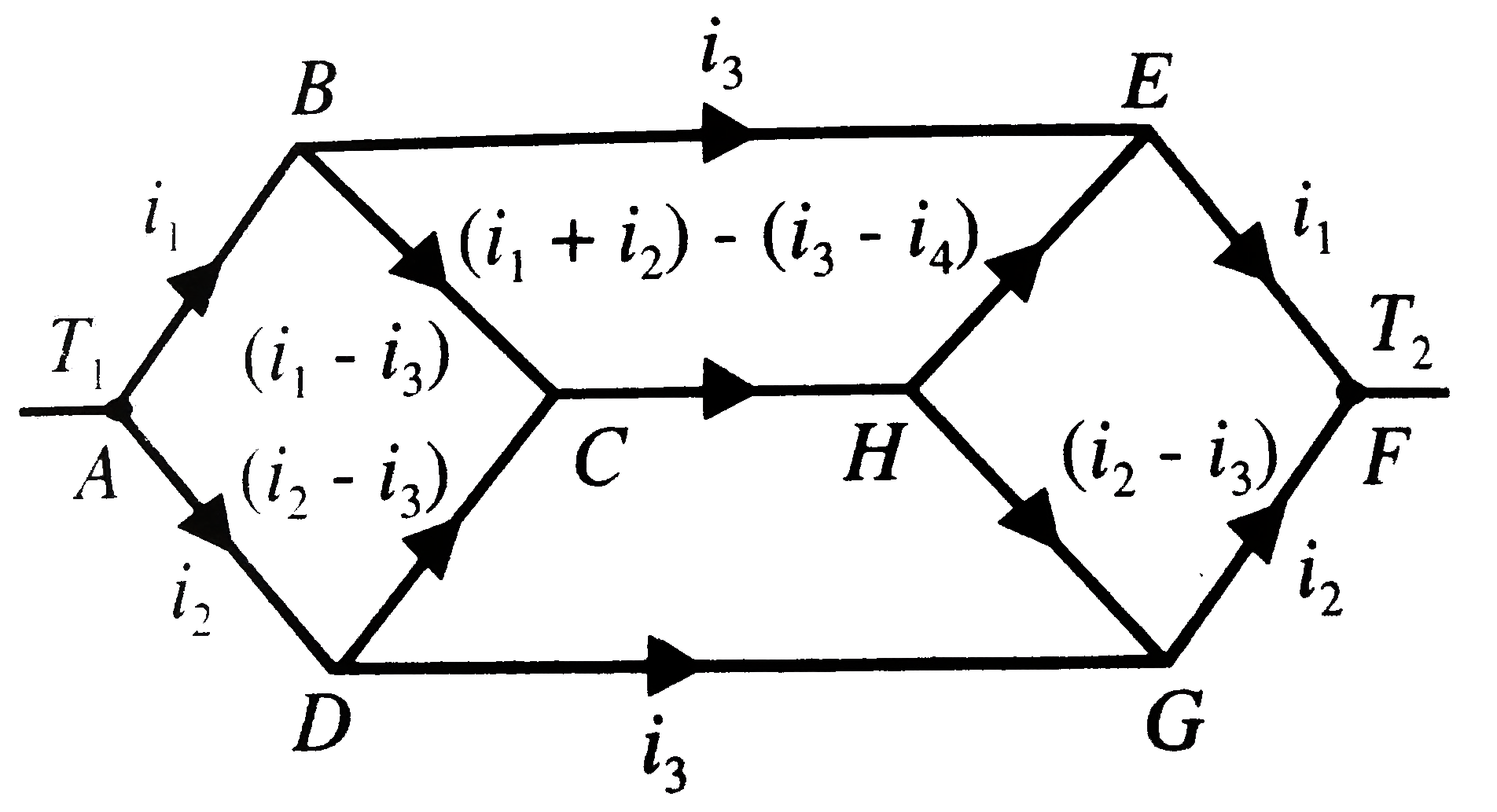
Resistance of each rod `R=(l)/(kA)`
In steady state `T_B=T_D`
`T_E=T_G`
Thermal current `((dQ)/(dt))=i`
`i_1R+i_3R+i_1R=(T_1-T_2)`
`2i_1+i_3=((T_1-T_2))/(R )` ..(i)
`2i_1+i_3=(T_1-T_2)/( R)` .(ii)
`i_1=i_2`
For the path ABCHGF
`i_1R+(i_1-i_3)R+2(i_1+i_3)R+(i_1-i_3)R+i_1R=(T_1-T_2)`
`6i_i-4i_3=((T_1-T_2))/(R )=2i_i+i_3` .(iv)
`4i_i=5i_3impliesi_3=(4)/(5)i_i` .(v)
From eqs (ii) and (v)
`2i_i+(4)/(5)i_1=((T_1-T_2))/(R )`
`(14i_i)/(5)=((T_1-T_2))/(R )`
Equivalent thermal resistance `((T_1-T_2))/(2i_i)=(7)/(5)R`
`((dQ)/(dt))_(AB)=i_1=(5(T_1-T_2)KA)/(14l)`
`((dQ)/(dt))_(BE)=(2)/(7)((T_1-T_2)KA)/(l)`
`((dQ)/(dt))_(BC)=((T_1-T_2)KA)/(14l)`
`((dQ)/(dt))_(CH)=((T_1-T_2)KA)/(7l)`
Promotional Banner

Topper's Solved these Questions

  • CALORIMETRY

    CENGAGE PHYSICS ENGLISH|Exercise Comprehension|30 Videos
  • CALORIMETRY

    CENGAGE PHYSICS ENGLISH|Exercise Integer|8 Videos
  • CALORIMETRY

    CENGAGE PHYSICS ENGLISH|Exercise Single Correct|148 Videos
  • BASIC MATHEMATICS

    CENGAGE PHYSICS ENGLISH|Exercise Exercise 2.6|20 Videos
  • CENTRE OF MASS

    CENGAGE PHYSICS ENGLISH|Exercise INTEGER_TYPE|1 Videos

Similar Questions

Explore conceptually related problems

Four identical rods AB, CD, CF and DE are joined as shown in figure. The length, cross-sectional area and thermal conductivity of each rod are l, A and K respectively. The ends A, E and F are maintained at temperature T_(1) , T_(2) and T_(3) respectively. Assuming no loss of heat to the atmosphere, find the temperature at B .

Four identical rods AB, CD, CF and DE are joined as shown in figure. The length, cross-sectional area and thermal conductivity of each rod are l, A and K respectively. The ends A, E and F are maintained at temperature T_(1) , T_(2) and T_(3) respectively. Assuming no loss of heat to the atmosphere, find the temperature at B.

All the rods have same conductance 'K' and same area of cross section ' A' . If ends A and C are maintained at temperature 2T_(0) and T_(0) respectively then which of the following is // are correct?

Five rods of same material and same cross-section are joined as shown. Lengths of rods ab, ad and bc are l, 2l and 3l respectively. Ends a and c are maintained at temperatures 200^(@)C and 0^(@)C respectivelly. For what length x of rod dc there will be no heat flow through rod bd ?

A rod of length l and cross sectional area A has a variable conductivity given by K=alphaT , where alpha is a positive constant T is temperatures in Kelvin. Two ends of the rod are maintained at temperatures T_1 and T_2(T_1gtT_2) . Heat current flowing through the rod will be

As shown in Fig. AB is rod of length 30 cm and area of cross section 1.0 cm^2 and thermal conductivity 336 SI units. The ends A and B are maintained at temperatures 20^@C and 40^@C , respectively .A point C of this rod is connected to a box D, containing ice at 0^@C through a highly conducting wire of negligible heat capacity. The rate at which ice melts in the box is (assume latent heat of fusion for ice L_f=80 cal//g )

As shown in Fig. AB is rod of length 30 cm and area of cross section 1.0 cm^2 and thermal conductivity 336 SI units. The ends A and B are maintained at temperatures 20^@C and 40^@C , respectively .A point C of this rod is connected to a box D, containing ice at 0^@C through a highly conducting wire of negligible heat capacity. The rate at which ice melts in the box is (assume latent heat of fusion for ice L_f=80 cal//g )

Two rods P and Q of equal lengths have thermal conductivities K_(1) and K_(2) and cross-sectional areas A_(1) and A_(2) respectively. If the temperature difference across the ends of each rod is the same, then the condition for which the rate of flow of heat through each of them will be equal, is

Two rods A and B are of equal length. Each rod has its ends at temperatures T_1 and T_2 . What is the condition that will ensure equal rate of flow of heat through the rods A and B ?

Two rods of similar area of cross section and length are joined as shown in the figure. The ratio of their thermal conductivity is 2:3. The free ends are maintained at 100^(@)C and 0^(@)C respectivley. THE temperature at junction in steady state is

CENGAGE PHYSICS ENGLISH-CALORIMETRY-Multiple Correct
  1. During the melting of a slab of ice at 273K at atmospheric pressure,

    Text Solution

    |

  2. The temperature drop through a two layer furnace wall is 900^(@)C. Eac...

    Text Solution

    |

  3. The ends of a metal rod are kept at temperatures theta1 and theta2 wit...

    Text Solution

    |

  4. Choose the correct statements from the following:

    Text Solution

    |

  5. Choose the correct statements from the following:

    Text Solution

    |

  6. When the temperature of a copper coin is raised by 80^@C, its diameter...

    Text Solution

    |

  7. A vessel is partly filled with liquid. When the vessel is cooled to a ...

    Text Solution

    |

  8. Two identical objects A and B are at temperatures TA and TB. Respectiv...

    Text Solution

    |

  9. Seven identical rods of material of thermal conductivity k are connect...

    Text Solution

    |

  10. A clock is calibrated at a temperature of 20^@C Assume that the penduu...

    Text Solution

    |

  11. A circular ring (centre O) of radius a, and of uniform cross section i...

    Text Solution

    |

  12. Eleven identical rods are arranged as shown in Fig. Each rod has lengt...

    Text Solution

    |

  13. A solid sphere and a hollow sphere of the same material and of equal r...

    Text Solution

    |

  14. A thin cylindrical metal rod is bent into a ring with a small gap as s...

    Text Solution

    |

  15. Statement I: Two solid cylindrical rods of identical size and differen...

    Text Solution

    |

  16. Statement I: As the temperature of the black body increases, the wavel...

    Text Solution

    |

  17. Statement I: The thermal resistance of a multiple later is equal to th...

    Text Solution

    |

  18. In natural convection, the fluid motion is caused due to density diffe...

    Text Solution

    |

  19. Statement I: The bulb of one thermometer is spherical while that of th...

    Text Solution

    |

  20. Statement I: The expanded length l of a rod of original length l0 is n...

    Text Solution

    |