Home
Class 11
PHYSICS
A layer of ice of 0^(@)C of thickness x(...

A layer of ice of `0^(@)C` of thickness `x_(1)` is floating on a pond. If the atmospheric temperature is `-7^(@)C`. Show that the time taken for thickness of the layer of ice to increase from `x_(1)` to `x_(2)` is given by
`t=(pL)/(2kT)(x(2)/(2)-x_(1)^(2))`
where p is the density of ice, k its thermal conductivity and L is the latent heat of fusion of ice.

Text Solution

Verified by Experts
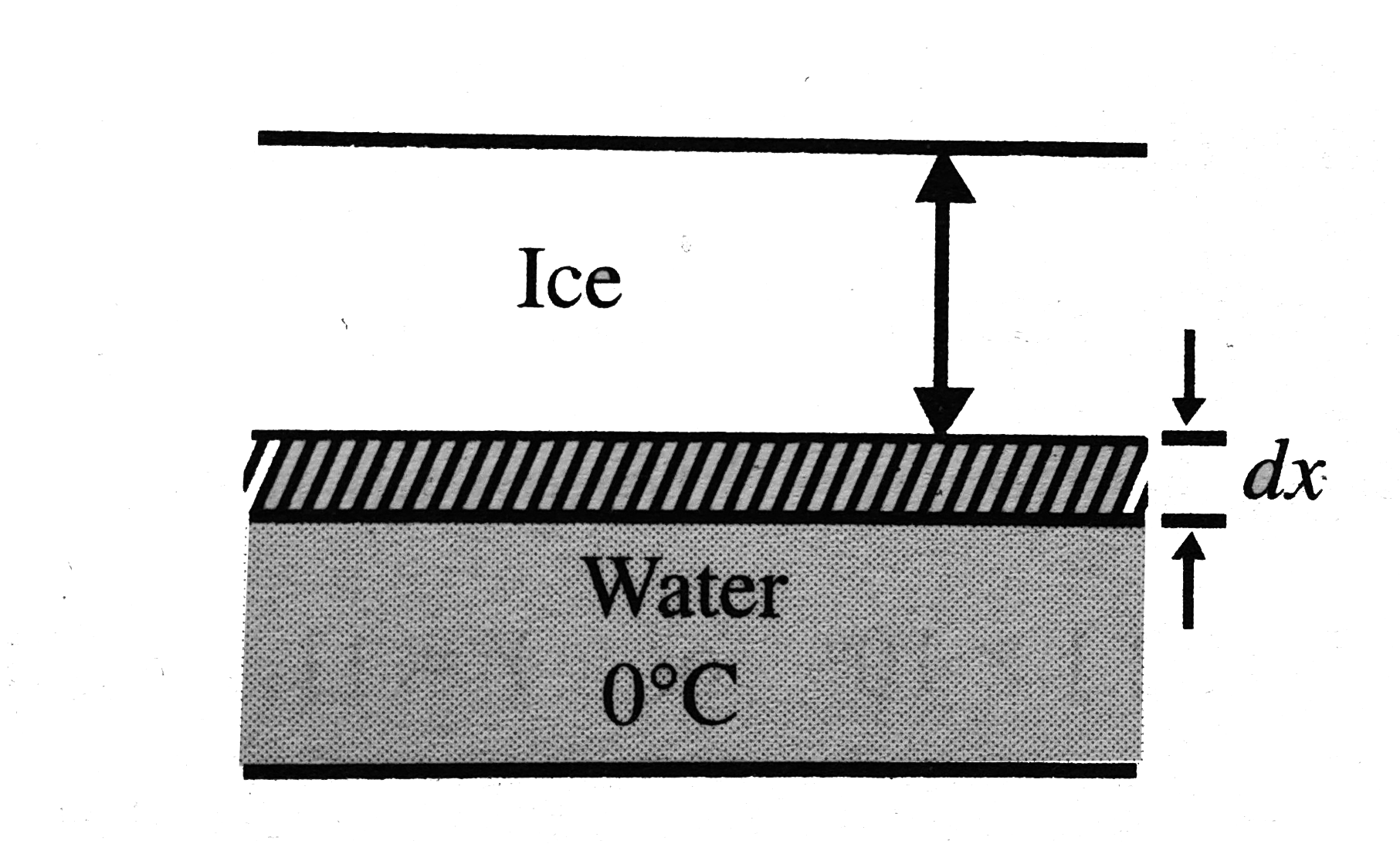
When the temperature of the air is less than `0^(@)C`, the cold air near the surface of the pond takes heat (latent) from the water which freezes in the fonm of layers. Consequently, the thickness of the ice layer keeps increasing with time. Let `x` be the thickness of the ice layer at a certain time. If the thickness is increased by dx in time dt, thn the amount of heat flowing through the salb in time dt is given by

Where A is the area of the layer of ice and `-7^(@)C` is the temperature of the surounding air. If dm is the mass of water frozen into ice, then `Q=dmxxL`. But `dm=Ap dx`, where p is the density of ice. Hence
`Q=Ap Ldx` (ii)
Equating (i) and (ii). we have
`(KATdt)/(x)=ApLdx` or `dt=(pL)/(kT)xds`
Integrating, we have
`underset(0)overset(t)intdt=(pL)/(kT)underset(x_(1))overset(x_(2))int` or `t=(pL)/(kT)|(x^(2))/(2)|_(x_(1))^(x_(2))=(pL)/(2kT)(x_(2)^(2)-x_(1)^(1))`
Promotional Banner

Topper's Solved these Questions

  • CALORIMETRY

    CENGAGE PHYSICS ENGLISH|Exercise Integer|8 Videos
  • BASIC MATHEMATICS

    CENGAGE PHYSICS ENGLISH|Exercise Exercise 2.6|20 Videos
  • CENTRE OF MASS

    CENGAGE PHYSICS ENGLISH|Exercise INTEGER_TYPE|1 Videos

Similar Questions

Explore conceptually related problems

Bottom of a lake is at 0^(@)C and atmospheric temperature is -20^(@)C . If 1 cm ice is formed on the surface in 24 h, then time taken to form next 1 cm of ice is

A layer of ice of thickness y is on the surface of a lake. The air is at a constant temperature -theta^@C and the ice water interface is at 0^@C . Show that the rate at which the thickness increases is given by (dy)/(dt) = (Ktheta)/(Lrhoy) where, K is the thermal conductivity of the ice, L the latent heat of fusion and rho is the density of the ice.

Ice starts forming in lake with water at 0^(@)C and when the atmospheric temperature is -10^(@)C . If the time taken for 1 cm of ice be 7 hours. Find the time taken for the thickness of ice to change from 1 cm to 2 cm

A pond has a layer of ice of thickness 0.25 m on its surface the temperature of the atmosphere is 10^(@) C . Find out the time required to increase the thickness of the layer of ice 0.5 "mm" . K of ice = 2 "Wm"^(-2) "K"^(-1) . Density of ice = 900 "kg m"^(-3) latent heat of fusion of ice = 336 "KJ kg"^(-1) .

On a cold winter dry, the temperature of atmosphere is -T^(@)C . The cylindrical dram shown is made of insultating material and it contains water at 0^(@)C . If L is latent heat of fusion of ice, rho is density of ice and K_(R) is thermal conductivity of ice, the time taken for total mass of water to freeze is

A lake surface is exposed to an atmosphere where the temperature is lt 0^(@)C . If the thickness of the ice layer formed on the surface grows form 2cm to 4cm in 1 hour. The atmospheric temperature, T_(a) will be- (Thermal conductivity of ice K = 4 xx 10^(-3) cal//cm//s//.^(@)C , density of ice = 0.9 gm//ice. Latent heat of fustion of ice = 80 cal//m . Neglect the change of density during the state change. Assume that the water below the ice has 0^(@) temperature every where)

The thickness of ice on a Jake is 6 cm and the temperature of air is - 10^(@) C . At what rate is the thickness of ice increasing ? Thermal conductivity of ice = 2 "Wm"^(-1) "K"^(-1) . Density of ice = 920 "kg m"^(3) , specific latent heat of ice = 336 "KJ kg"^(-1)

A slab of stone of area of 0.36 m^(2) and thickness 0.1 m is exposed on the lower surface to steam at 100^(@)C . A block of ice at 0^(@)C rests on the upper surface of the slab. In one hour 4.8 kg of ice is melted. The thermal conductivity of slab is (Given latent heat of fusion of ice = 3.63 xx 10^(5) J kg^(-1) )

One end of a brass rod of length 2.0 m and cross section 1cm^2 is kept in steam at 100^@C and the other end in ice at 0^@C . The lateral surface of the rod is covered by heat insulator. Determine the amount of ice melting per minute. Thermal conductivity of brass is 110 W//m-K and specific latent heat of fusion of ice is 80 cal//g .

One side of an iron plate one metre square is kept at 100°C and the other side is at 0°C. The thickness of the plate is 1 cm. If all the heat conducted across the plate in one minute is used in melting ice, calculate the amount of ice so melted. Thermal conductivity of iron = 0.162 in C.G.S. unit L.H. of fusion of ice = 80 cal/gm.

