Home
Class 11
PHYSICS
The variation of temperature of a materi...

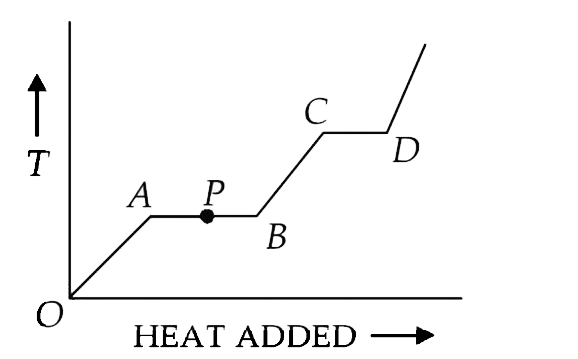
The variation of temperature of a material as heat is given to it at a constant rate is shown in the figure. The material is in solid state at the point O. The state of the material at the point P is…..

Text Solution

Verified by Experts

`AB` represents a process when physical state changes from solid to liquid and the temperature remains unchaged. Since `P` is a point between `A` and `B` the material is partly solid and partly liquid.
Promotional Banner

Topper's Solved these Questions

  • ARCHIVES 1 VOLUME 6

    CENGAGE PHYSICS ENGLISH|Exercise True/False|7 Videos
  • ARCHIVES 1 VOLUME 6

    CENGAGE PHYSICS ENGLISH|Exercise Single Correct|54 Videos
  • ARCHIVES 2 VOLUME 6

    CENGAGE PHYSICS ENGLISH|Exercise Integer|4 Videos

Similar Questions

Explore conceptually related problems

When a ferromagnetic material is heated above its Curie temperature , the material

What is a fuse ? Name the material of fuse. State one characteristic of the material used for fuse.

A solid material is supplied with heat at a constant rate. The temperature of the material is changing with the heat input as shown in the graph in figure. Study the graph carefully and answer the following questions: (i) What do the horizontal regions AB and CD represent? (ii) If CD is equal to 2AB, what do you infer? (iii) What does the slope of DE represents? (iv) The slope of OAgtthe slope of BC . What does this indicate?

The variation of vapour pressure of different liquids with temperature is shown in figure Calculate graphically boiling points of liquids A and B.

A solid material is supplied heat at a constant rate. The temperature of material is changing with heat input as shown in the figure. What does the slope of DE represent ?

The rate of flow of heat through 12 identical conductors made of same material is shown in the figure. Then, which of the following is correct ?

The figure shown is part of the circuit at steady state The potential of point P is :

When we raise the temperature of a body, the molecules and atoms move with greater kinetic enery. Assume that "the temperature" is the manifestation of only the kinetic energy is atomic and subatomic levels and no mass change (excess//defect) occurs due to heating. Now a solid material is supplied with heat at a constant rate. The temperature of the material is changing with the heat input as shown in the graph. BC and DE are parallel to the Heat-input axis In BC and DE

When we raise the temperature of a body, the molecules and atoms move with greater kinetic enery. Assume that "the temperature" is the manifestation of only the kinetic energy is atomic and subatomic levels and no mass change (excess//defect) occurs due to heating. Now a solid material is supplied with heat at a constant rate. The temperature of the material is changing with the heat input as shown in the graph. BC and DE are parallel to the Heat-input axis In AB , CD and EF , the energy of the system increases. Here "energy" refers to

When we raise the temperature of a body, the molecules and atoms move with greater kinetic enery. Assume that "the temperature" is the manifestation of only the kinetic energy is atomic and subatomic levels and no mass change (excess//defect) occurs due to heating. Now a solid material is supplied with heat at a constant rate. The temperature of the material is changing with the heat input as shown in the graph. BC and DE are parallel to the Heat-input axis In which of the following phase the assumption made in the above comprehension is most precise ?
