Home
Class 11
PHYSICS
Two light spring of force constants k(1)...

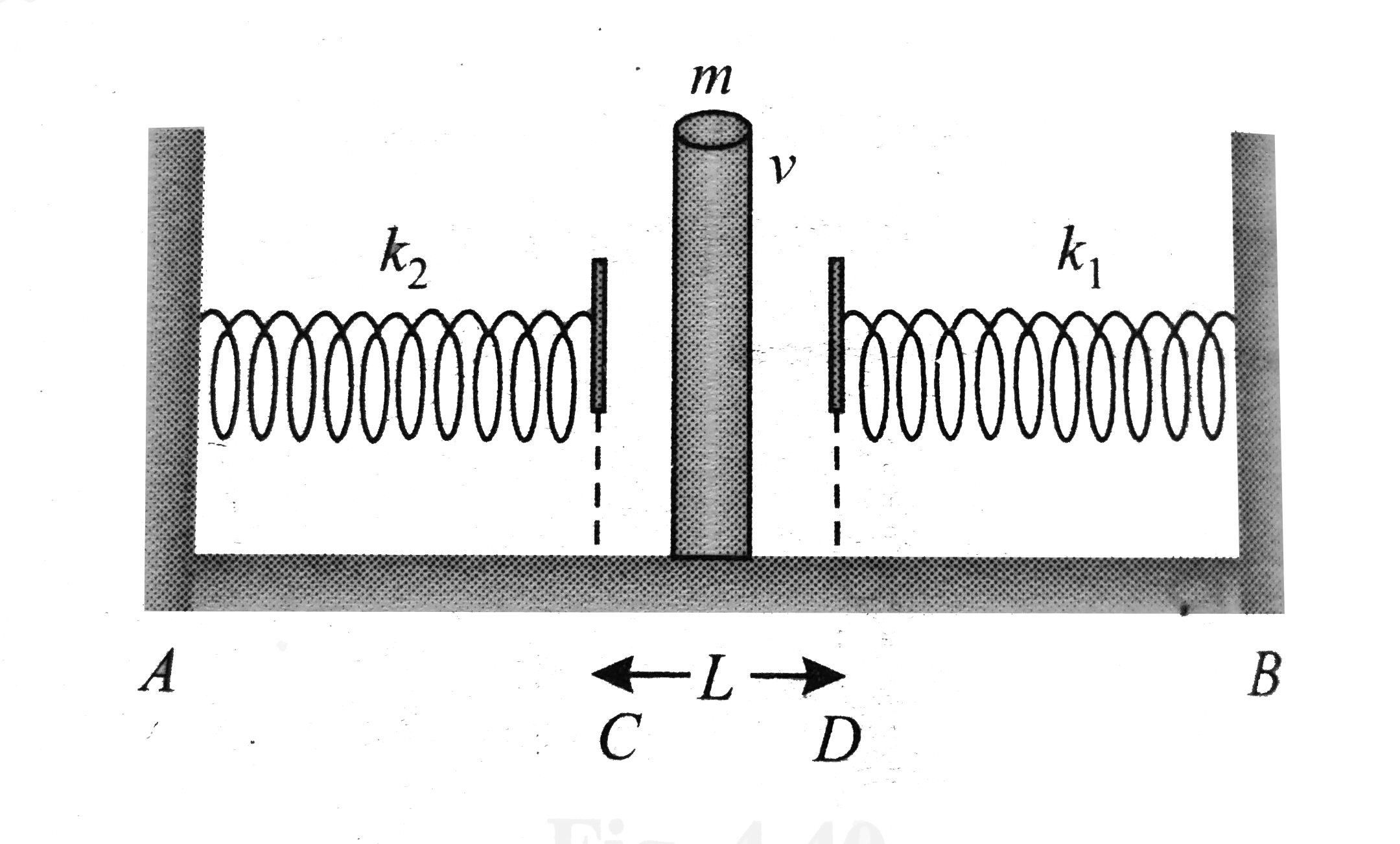
Two light spring of force constants `k_(1) and k_(2)` and a block of mass m are in the line AB on a smooth horizontal table such that one end of each spring is fixed on right supports and the other end is free as shown in figure

The distance CD between the free ends of the spring is `60 cm`. If the block `(k_(1) = 1.8 N//m, k_(2) = 3.2 N//m and m = 200g)`. Is the motion simple harmonic?

Text Solution

Verified by Experts

When the block touches `D`, it will compress the spring and its `KE` will be converted into elastic energy of the spring. The compressed spring will push the block to `D` with same speed so time taken by the block to move from D towards B and back to D will be
`t_(1) = (T_(2))/(2) = pi sqrt((m)/(k_(1))) = pi sqrt((0.2)/(3.2)) = (pi)/(4) s`
Moreover during complete oscllation between `A and b` block moves the distance `CD` twice with uniform velocity `v` once from `C to D` and again from D to C. So
`T_(1) = (2 L)/(v) = (2 xx 0.6)/(1.2) = 1 s`
`T = t_(1) + t_(2) + t_(3) = pi ((1)/(3) + (1)/(4)) + 1 = 2.82 s`
Now a motion is simple harmonic only and only if throughout the motion `F = - k x`. Here between `C and D, F = 0 (asv = consrtant)`, the motion is not simple harmonic but oscillatory.
Promotional Banner

Topper's Solved these Questions

  • LINEAR AND ANGULAR SIMPLE HARMONIC MOTION

    CENGAGE PHYSICS ENGLISH|Exercise Solved Example|15 Videos
  • LINEAR AND ANGULAR SIMPLE HARMONIC MOTION

    CENGAGE PHYSICS ENGLISH|Exercise Exercise 4.1|23 Videos
  • KINETIC THEORY OF GASES AND FIRST LAW OF THERMODYNAMICS

    CENGAGE PHYSICS ENGLISH|Exercise Interger|11 Videos
  • MISCELLANEOUS KINEMATICS

    CENGAGE PHYSICS ENGLISH|Exercise Interger type|3 Videos

Similar Questions

Explore conceptually related problems

Two light spring of force constants k_(1) and k_(2) and a block of mass m are in one line AB on a smooth horizontal table such that one end of each spring is fixed on rigid supports and the other end is free as shown in the figure. The distance CD between the spring is 60cm . If the block moves along AB with a velocity 120 cm//s in between the springs, calculate the period of oscillation of the block. (take k_(1) = 1.8 N//m , k_(2) = 3.2 N//m , m = 200 g )

A block of mass m moving with velocity v_(0) on a smooth horizontal surface hits the spring of constant k as shown. The maximum compression in spring is

Two identical springs of spring constant k are attached to a block of mass m and to fixed supports as shown in the figure. The time period of oscillation is

As shown in the figure, two light springs of force constant k_(1) and k_(2) oscillate a block of mass m. Its effective force constant will be

A block of mass m, lying on a smooth horizontal surface, is attached to a spring (of negligible mass) of spring constant k. The other end of the spring is fixed, as shown in the figure. The block is initally at rest in its equilibrium position. If now the block is pulled withe a constant force F, the maximum speed of the block is :

A block of mass m, attacted to a string of spring constant k, oscillates on a smooth horizontal table. The other end of the spring is fixed to a wall. The block has a speed v when the spring is at its natural length. Before coming to an instantaneous rest. If the block moves a distance x from the mean position, then

A block of mass m compresses a spring iof stifffness k through a distacne l//2 as shown in the figure .If the block is not fixed to the spring the period of motion of the block is

One end of a spring of force constant k is fixed to a vertical wall and the other to a blcok of mass m resting on a smooth horizontal surface. There is another wall at distance x_(0) from the block. The spring is then compressed by 2x_(0) and released. The time taken to strike the wall is

One end of a spring of force constant k is fixed to a vertical wall and the other to a blcok of mass m resting on a smooth horizontal surface. There is another wall at distance x_(0) from the block. The spring is then compressed by 2x_(0) and released. The time taken to strike the wall is

Two springs are in a series combination and are attached to a block of mass 'm' which is in equilibrium. The spring constants and extension in the springs are as shown in the figure. Then the force exerted by the spring on the block is :
