Home
Class 11
PHYSICS
figure shown a partical mass m = 100g at...

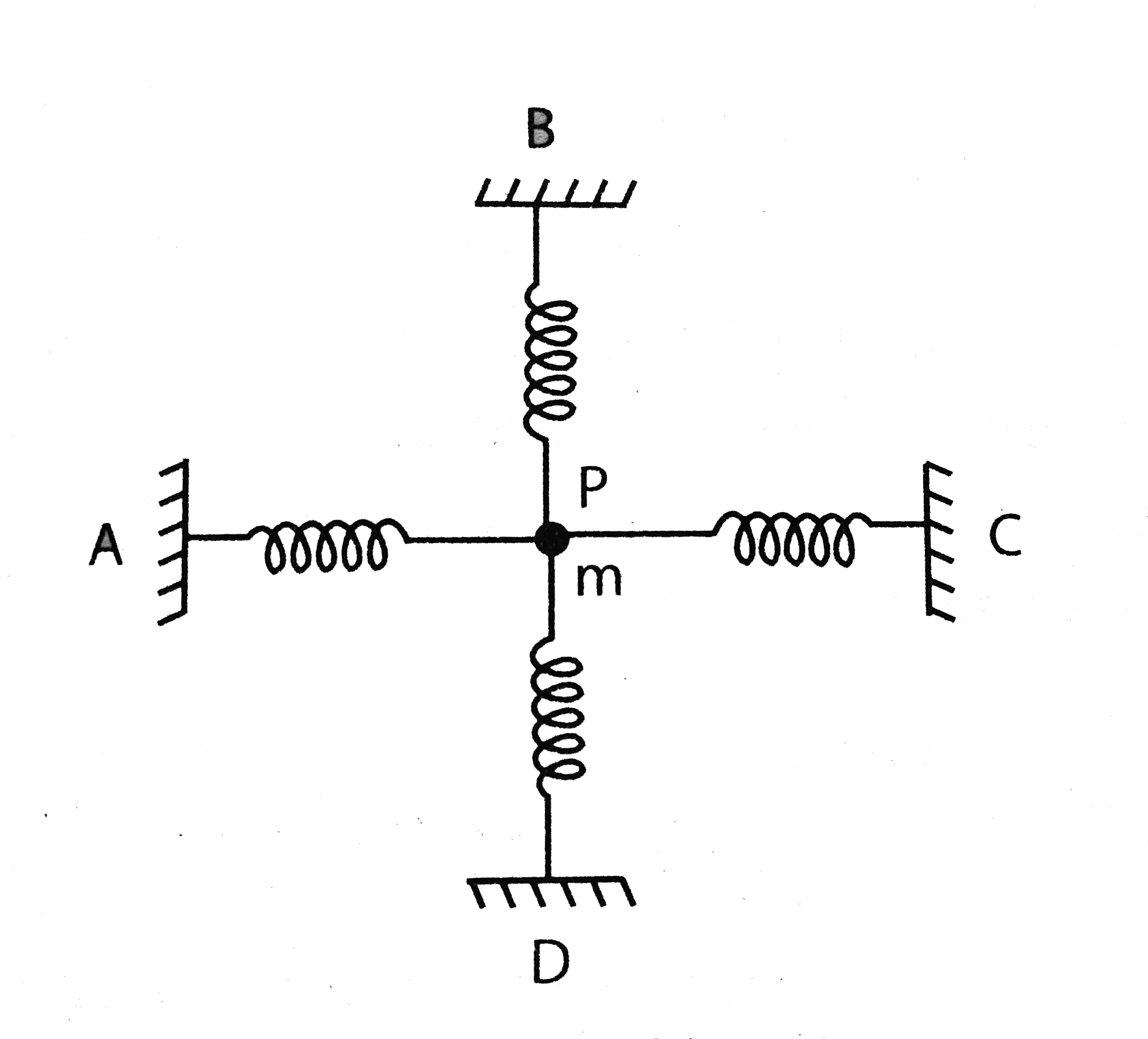
figure shown a partical mass `m = 100g` attaches with four identical spring , each of length `l = 10 cm` . Initial tension in each spring is `F_(0) = 25 N`. Neglecting gravity , Calculate the period of small oscillation of the article along a line perpendicular to the plane of the figure .

Text Solution

Verified by Experts
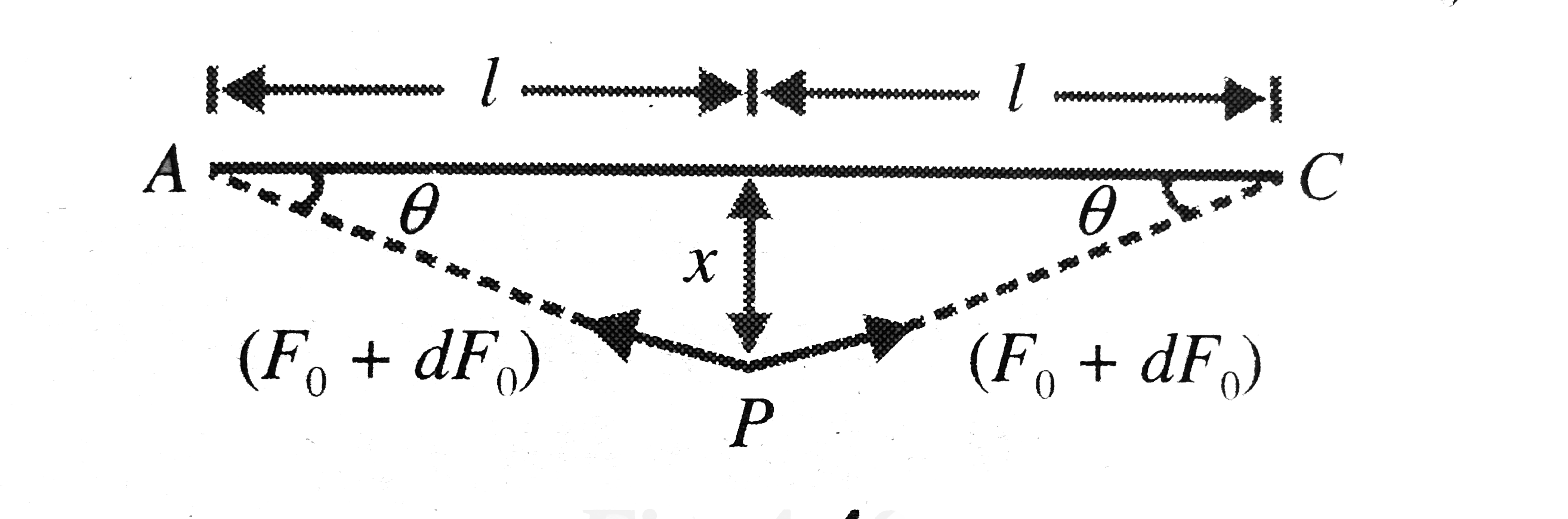
Let tha prtical be displaced singhtly through x along a line normal to the plane of figure . Then each spring is further elongated . Since , springs are indentical , therefore increase in tension of each spring will be the same. Let this increase be `df_(0)`

First consider force exerted by spring `AP and CP` only as shown in figure
Restoring force produced by these two spring `= (F_(0) + dF_(0)) 22 sin theta`.
Since x is very small, hterefore , `sin theta = x ll`.
Neglecting produced of veru small quantities, restoring force produced by these two springs `= 2 F_(0) x ll`
Similarly, resorting force produced by two remaining springs `BP and DP` will also be equal to `(2 F_(0) x ll)`
Resultant resoring force.
`F = 2 xx ((2 F_(0) x)/(l)) = (4F_(0))/(l) x`
Restoring acceleration is directly proportinal to displacement `x`, therefore ,the partical executes SHM
Its period `T = 2 pi sqrt(("displacement")/("acceleration"))`
`= 2 pi sqrt((ml)/(4 F_(0))) = pi sqrt((ml)/(4 F_(0)) = 0.02 pi s`
Promotional Banner

Topper's Solved these Questions

  • LINEAR AND ANGULAR SIMPLE HARMONIC MOTION

    CENGAGE PHYSICS ENGLISH|Exercise Solved Example|15 Videos
  • LINEAR AND ANGULAR SIMPLE HARMONIC MOTION

    CENGAGE PHYSICS ENGLISH|Exercise Exercise 4.1|23 Videos
  • KINETIC THEORY OF GASES AND FIRST LAW OF THERMODYNAMICS

    CENGAGE PHYSICS ENGLISH|Exercise Interger|11 Videos
  • MISCELLANEOUS KINEMATICS

    CENGAGE PHYSICS ENGLISH|Exercise Interger type|3 Videos

Similar Questions

Explore conceptually related problems

Figure shows a particle mass m = 100g attaches with four identical spring , each of length l = 10 cm . Initial tension in each spring is F_(0) = 25 N . Neglecting gravity , Calculate the period of small oscillation of the particle along a line perpendicular to the plane of the figure .

A ball of mass, m is attractive to two springwhich are already stretched so that each pulls on to ball with a force F. length of each spring . In this Determine the period of small oscillations of the ball in a difference perpendicular of length of psirng. Difference of the mass of spring and gravity .

A particle of mass 'm' is attached to three identical springs A,B and C each of force constant 'K' as shown in figure. If the particle of mass 'm' is pushed slightly against the spring 'A' and released the period of oscillations is

A particle of mass 'm' is attached to three identical springs A,B and C each of force constant 'K' as shown in figure. If the particle of mass 'm' is pushed slightly against the spring 'A' and released the period of oscillations is

A particle of mass m is attached with three springs A,B and C of equal force constancts k as shown in figure. The particle is pushed slightly against the spring C and released. Find the time period of oscillation. .

A solid cylinder of mass M = 10kg and cross - sectional area A = 20cm^(2) is suspended by a spring of force contant k = 100 N//m and hangs partically immersed in water. Calculate the period of small oscillation of the cylinder.

A particle of mass m is attached to three springs A,B and C of equal force constants k as shown in figure. If the particle is pushed slightly against the spring C and released, find the time period of oscillation.

A mass of 1.5 kg is connected to two identical springs each of force constant 300 Nm^(-1) as shown in the figure. If the mass is displaced from its equilibrium position by 10cm, then the period of oscillation is

In the figure, a block of mass m is rigidly attached to two identical springs of stiffness k each. The other ends of the springs are connected to the fixed wall. When the block is in equilibrium, length of each spring is b, which is greater than the natural length of the spring. The time period of the oscillation of the block if it is displaced by small distance perpendicular to the length of the springs and released. Space is gravity free.

A uniform disc of mass m is attached to a spring of spring constant k as shown in figure and there is sufficient friction to prevent slipping of disc. Time period of small oscillations of disc is:

