Home
Class 11
PHYSICS
Find the time period of m if pulley P is...

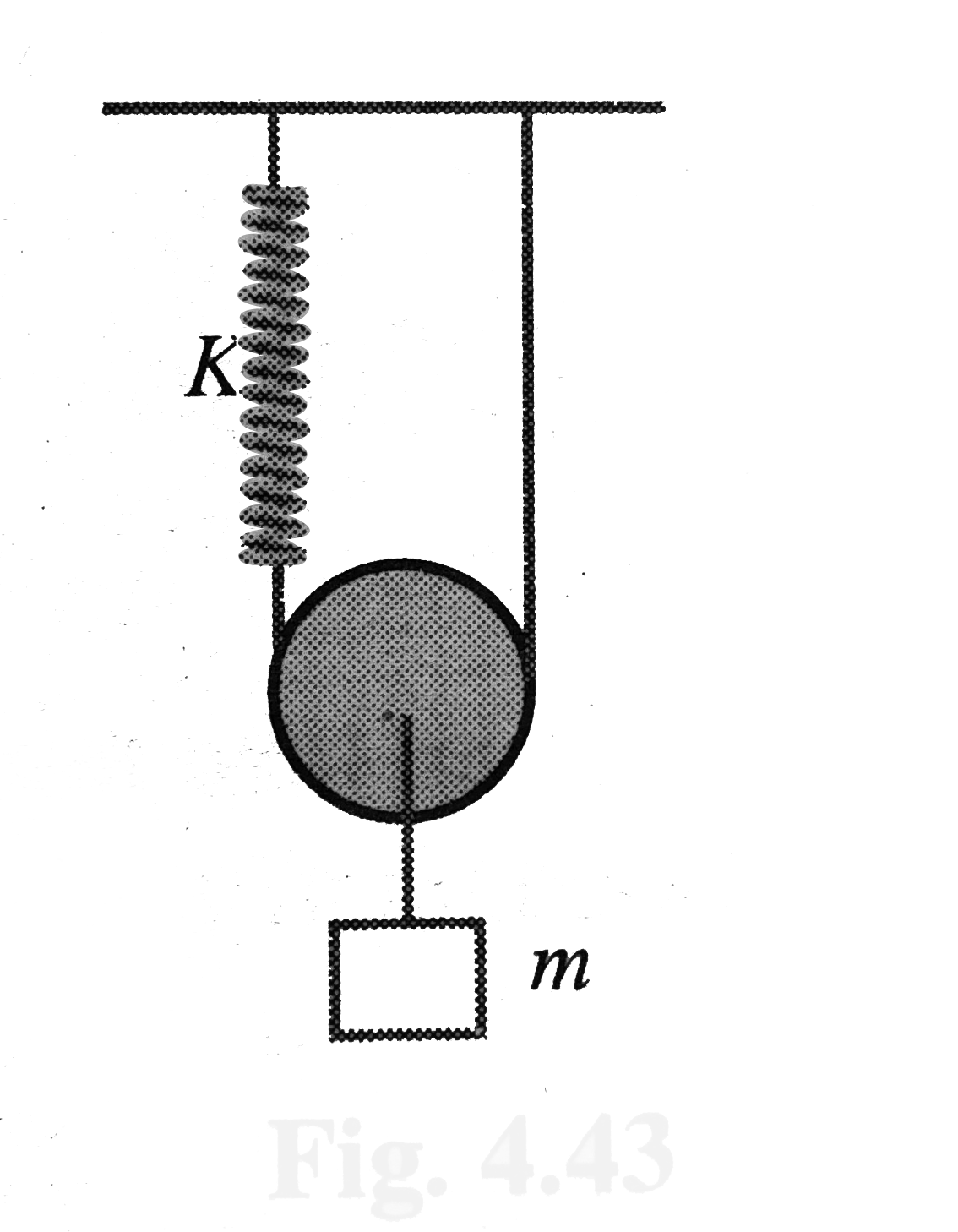
Find the time period of `m` if pulley `P` is light and small.

Text Solution

Verified by Experts
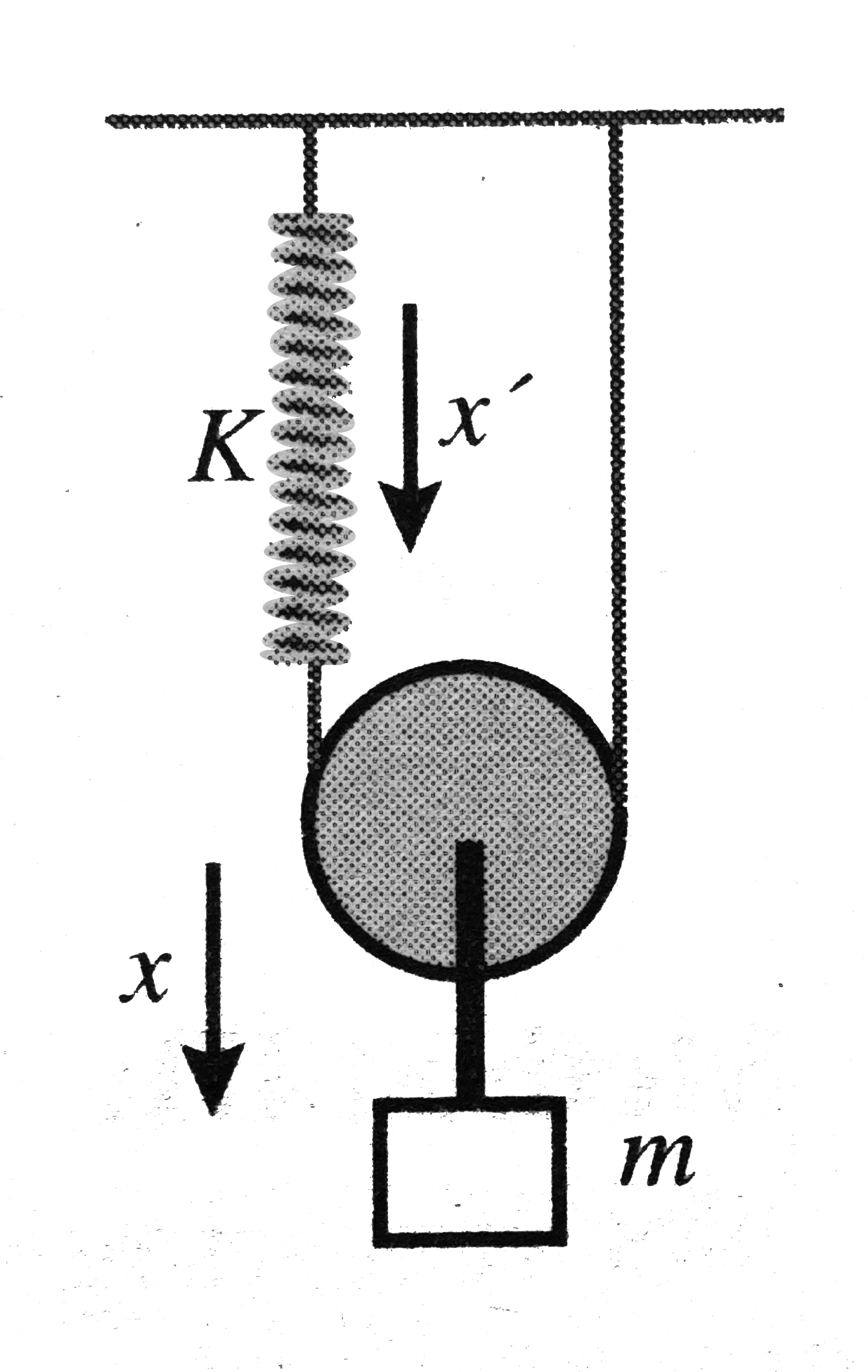
Let the displacement of block at any time be x and stretch of spring be x,, then
`(x' + 0)/(2) = x' = 2x`

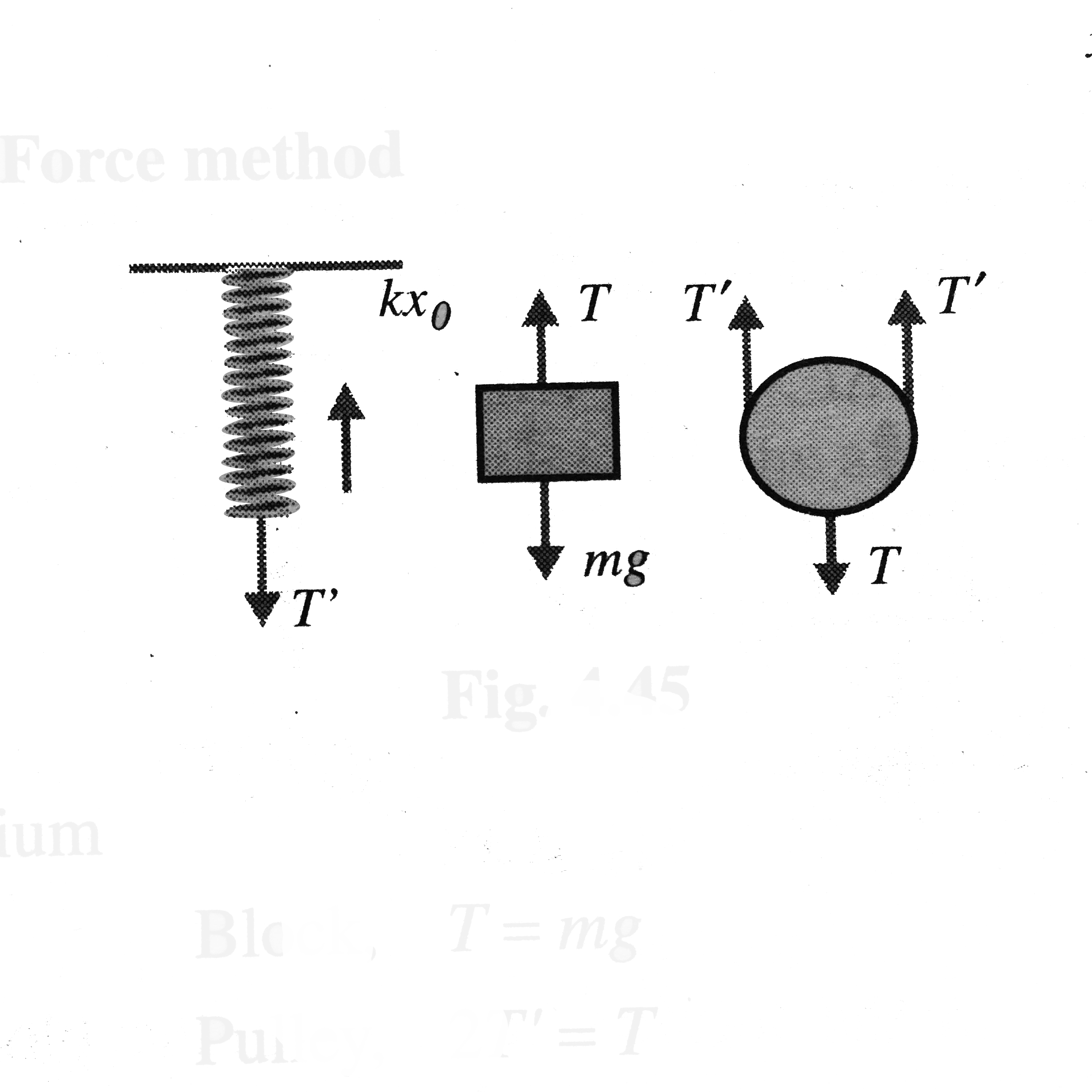
Method I: force method

At equailibrum
`Block, T = m g` (i)
pulley, `2 T = T` (ii)
Spring, `kx_(0) = mg`
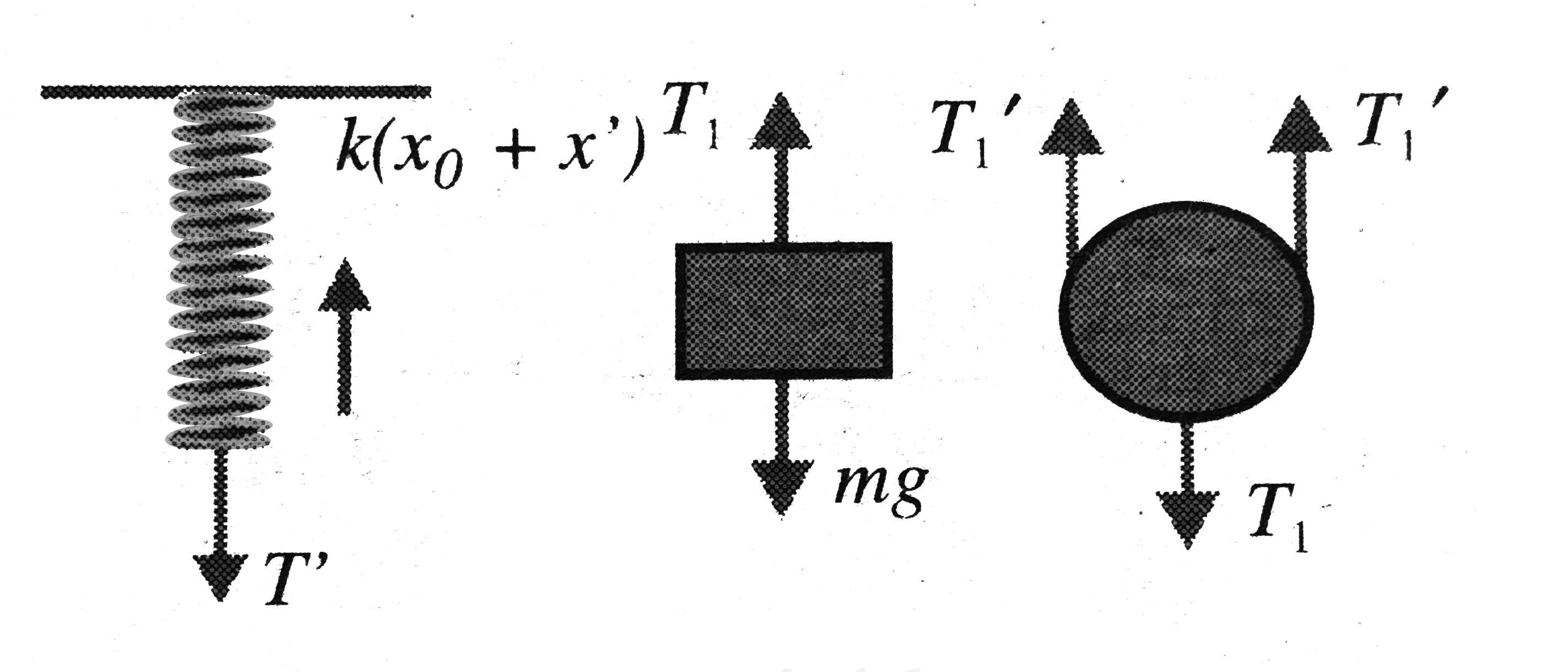
Let the block is further displaced by small amount released.
Equation of motion at any time

`T_(1) - mg = ma`
`2 T_(1) - mg = ma` (ii)
`2K (x_(0) + x') - mg = ma` (iii) From Eqs, (iii)and (iv)
`2 Kx' = ma implies a = (2 Kx')/(m) = ((4 k)/(m)) x implies ((4 k)/(m)) x`
`omega^(2) = (4 k)/(m) implies omega = sqrt ((4 k)/(m))`
Method II : Energy method
`(1)/(2) m v^(2) + (1)/(2) k (x_(0) + x')^(2) - mg x =` constant
`(1)/(2) m 2 v a + (1)/(2) k 2 (x_(0) + x') (dx')/(dt) - mg (dx)/(dt) = 0`
`mva + k (x_(0) + x') (dx')/(dt) - mg v = 0`
`mv a + k (x_(0) + 2 x') 2 v - mg v= 0`
`ma + 2 k (x_(0) + 2 x') - mg v = 0`
`ma + 4 k x = 0` (as `mg = 2 Ks_(0))`
`a = - ((4 K)/(m)) x, implies omega = sqrt((4k)/(m))`
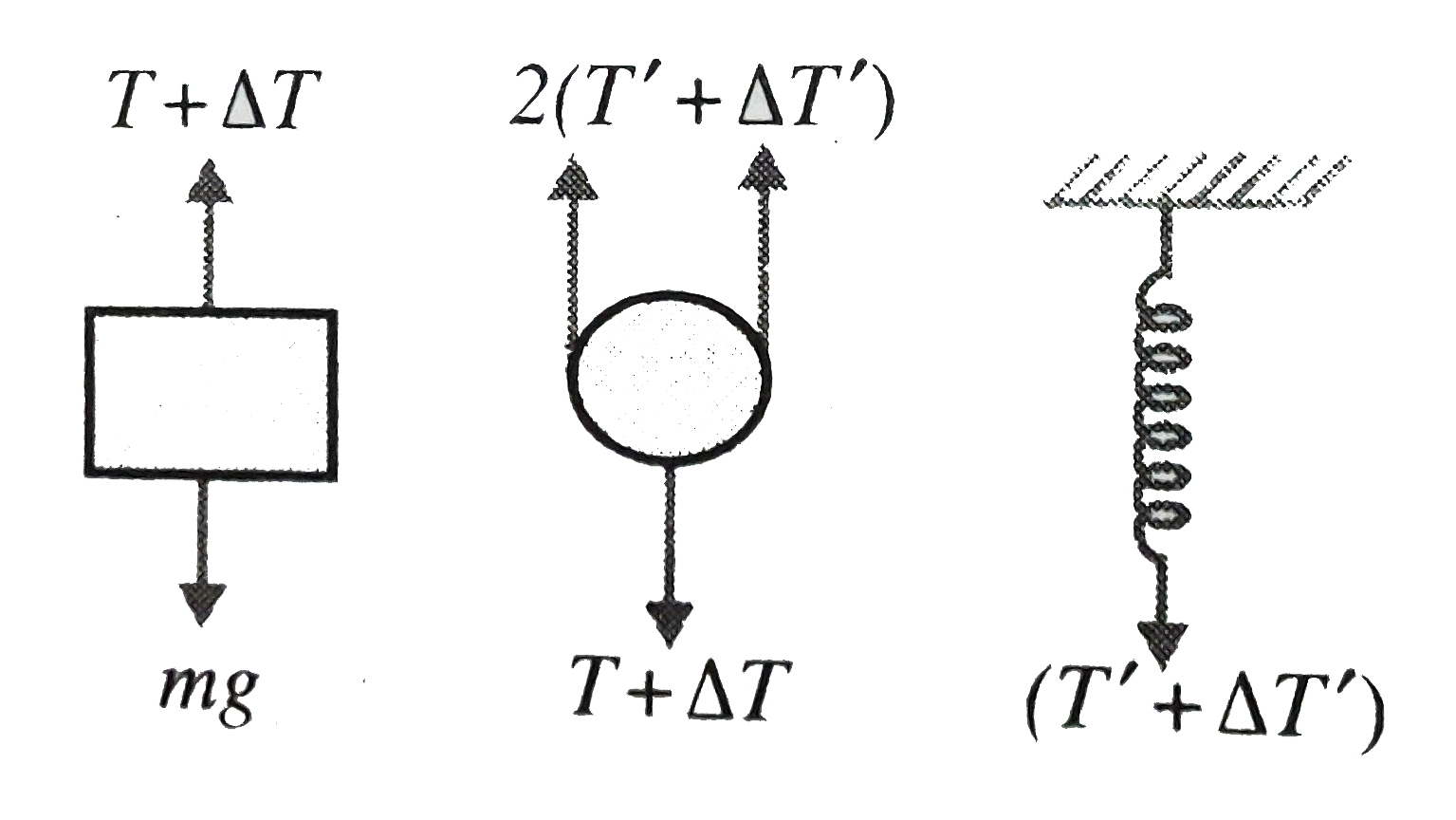
Method IIi : Net resoting force on `m` = Net increase in tension string connecting `m` and pulley `= Delta T`

. If increase in the tension connecting the block and the pulley is `Delta T`, then increase in the tension connecting spring and pulley will be `Delta T = Delta T//2`
. If x is the displacement of the block beyond equalibrium position, then aditional stretch of spring will be `x = 2 x`
`Delta T = ma impliesDelta T = ma`
`2kx' = 4 kx`
`a = - ((4k)/(m)) x implies omega = sqrt((4k)/(m))`
Promotional Banner

Topper's Solved these Questions

  • LINEAR AND ANGULAR SIMPLE HARMONIC MOTION

    CENGAGE PHYSICS ENGLISH|Exercise Solved Example|15 Videos
  • LINEAR AND ANGULAR SIMPLE HARMONIC MOTION

    CENGAGE PHYSICS ENGLISH|Exercise Exercise 4.1|23 Videos
  • KINETIC THEORY OF GASES AND FIRST LAW OF THERMODYNAMICS

    CENGAGE PHYSICS ENGLISH|Exercise Interger|11 Videos
  • MISCELLANEOUS KINEMATICS

    CENGAGE PHYSICS ENGLISH|Exercise Interger type|3 Videos

Similar Questions

Explore conceptually related problems

The ear ring of a lady shown in figure has a 3 cm long light suspension wire. A. Find the time period of small oscillations if the lady is standing on the ground. b. The lady now sits in a merry go round moving at 4ms^-1 in a circle of radius 2 m. find the time period of small oscillation of the ear ring.

In the following arrangements, bock is slightly displaced vertically down from its equilibrium position and released. Find time period of vertical oscillations. The pulley is light.

Consider a block symmetrically attached to two identical massless springs by means of strings passing over light frictionless pulleys as shown. In the equilibrium position extension in the springs is x_(0) . Find the time period of small vertically oscillations of the blocks.

Two point masses m_(1) and m_(2) are fixed to a light rod hinged at one end. The masses are at distances l_(1) and l_(2) repsectively from the hinge. Find the time period of oscillation (small amplitude) of this system in seconds if m_(1) = m_(2), l_(1) = 1m, l_(2) = 3m . If the time period is xpi , then find x .

Find the time period of the motion of the particle shown in figure. Neglected small effect of the bend near the bottom.

Consider the situation shown in the figure. A mass is hanging from a inextensible string which is passing over a pulley. The pulley itself is attached to a massless spring of stiffness k as shown in the figure. Find the time period of vertical oscillations of mass m if pulley is slightly displaced from its mean position. Assume that string does not slip over pulley.

The time period of small oscillations of mass m :-

Find the time period of oscillation of block of mass m. Spring, and pulley are ideal. Spring constant is k.

A uniform solid sphere of mass 'm' and radius R is in equilibrium on an inclined plane by the action of the light spring of stiffness k, gravity and on it. If the angle of inclination of the plane is 60^(@) , then find the time period of oscillation for small displancement.

A small block oscillates back and forth on a smooth concave surface of radius 1 m . Find the time period of small oscillations.(Take g=π^2ms^(-2) )