Home
Class 11
PHYSICS
Two identical balls A and B eavh of mass...

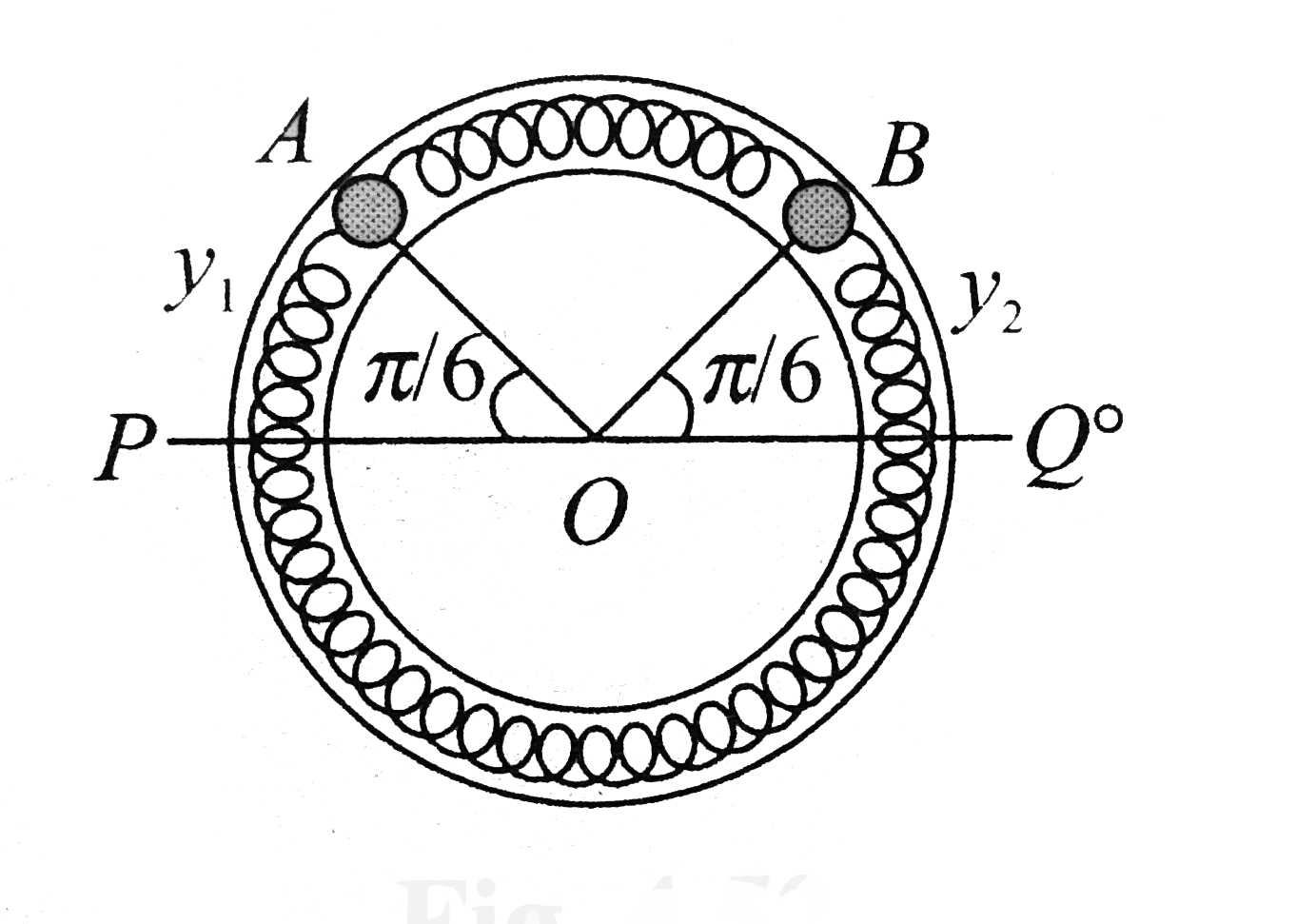
Two identical balls `A and B` eavh of mass `0.1 kg` are attached to two identical mass less is springs. The spring-mass system is consetrained to move inside a right smooth pipe bent in the form of a circle as shown in figure . The pipe is fixed in a horigental plane. The center of the balls can move in a circle of radius `0.06 m`. Each spring has a natural length of `0.06 pi m` and force constant `0.1 N//m`. Initially, both the balls are displaced bu an angle `theta = pi//6` dadius withrespect to diameter PQ of the circle and released from rest.
a. Calculate the frequency of oscillation of the ball B.
b. What is the total energy of the system ?
c. Find the speed of the bal A when A and B are at the two ends of the diameter PQ.

Text Solution

Verified by Experts

a.As here two masses `A and B` are connected by two sprins , this problem is equivelent to the oscillation of a reduced mass `m` by a spring of effective force constant `k_(eff)` given by
`m = (m_(1) m_(2))/(m_(1) + m_(2)) = (0.1 xx 0.1)/(0.1 + 0.1) = 0.5 kg`
and `k_(eff) = k_(1) + k_(2) = 0.1 + 0.1 = 0.2 N/m`
So `f = (1)/(2 pi) sqrt((k_(eq)/(m)) = (1)/(2 pi) sqrt((0.20)/(0.05)) = (1)/(pi) Hz`
b. As here one spring is compresent while the other is atreched by same amount (say y) and balls are at rest at `A and B`, so
`E = (1)/(2) k_(1) y^(2) + (1)/(2)k_(2) y^(2) = k y^(2)` `[as k_(1) = k_(2)]`
But from above figure
`y = y_(1) + y_(2) = R theta_(1) + R theta_(2) = 2 R theta`
`y = 2 xx 0.06 xx (pi//6) = 0.02 pi m`
So `E = (0.1) (0.02 theta)^(2) = 4 pi^(2) xx 10^(-5) J`
c. As at P and Q springs are ustertched so the whole energy becomes kinetic of the balls A and B, i.e.
`(1)/(2)m_(1) v_(1)^(2) + (1)/(2)m_(2) v_(2)^(2) = E = 4 pi^(2) xx 10^(-5) J`
Here `m_(1) = m_(2) = 0.1 kg` and `v_(1) = v_(2) = v`
So, ` 0.1 v^(2) = 4 pi^(2) xx 10^(-5), i.e. v = 2 pi xx 10^(-2) m//s`
Promotional Banner

Topper's Solved these Questions

  • LINEAR AND ANGULAR SIMPLE HARMONIC MOTION

    CENGAGE PHYSICS ENGLISH|Exercise Solved Example|15 Videos
  • LINEAR AND ANGULAR SIMPLE HARMONIC MOTION

    CENGAGE PHYSICS ENGLISH|Exercise Exercise 4.1|23 Videos
  • KINETIC THEORY OF GASES AND FIRST LAW OF THERMODYNAMICS

    CENGAGE PHYSICS ENGLISH|Exercise Interger|11 Videos
  • MISCELLANEOUS KINEMATICS

    CENGAGE PHYSICS ENGLISH|Exercise Interger type|3 Videos

Similar Questions

Explore conceptually related problems

Two identical balls A and B each of mass 0.1 kg are attached to two identical mass less is springs. The spring-mass system is constrained to move inside a right smooth pipe bent in the form of a circle as shown in figure . The pipe is fixed in a horizontal plane. The center of the balls can move in a circle of radius 0.06 m . Each spring has a natural length of 0.06 pi m and force constant 0.1 N//m . Initially, both the balls are displaced by an angle theta = pi//6 radians with respect to diameter PQ of the circle and released from rest. a. Calculate the frequency of oscillation of the ball B.

Two identical balls A and B each of mass 0.1 kg are attached to two identical mass less is springs. The spring-mass system is constrained to move inside a right smooth pipe bent in the form of a circle as shown in figure . The pipe is fixed in a horizontal plane. The center of the balls can move in a circle of radius 0.06 m . Each spring has a natural length of 0.06 pi m and force constant 0.1 N//m . Initially, both the balls are displaced by an angle theta = pi//6 radians with respect to diameter PQ of the circle and released from rest. a. Calculate the frequency of oscillation of the ball B. b. What is the total energy of the system ? c. Find the speed of the ball A when A and B are at the two ends of the diameter PQ.

Two identical blocks each of mass 1kg are joined together with a compressed spring. When the system is released the two blocks appear to be moving with unequal speeds in the opposite directions as shown in fig. Choose the correct statement -

A system of springs with their spring constants are as shown in figure. What is the frequency of oscillations of the mass m ?

Two masses of 1 kg and 5 kg are attached to the ends of a massless string passing over a pulley of negligible weight. The pulley itselt is attached to a light spring balance as shown in figure. The masses start moving during this interval, the readcing of spring balance will be-

Two masses of 1 kg and 5 kg are attached to the ends of a massless string passing over a pulley of negligible weight. The pulley itselt is attached to a light spring balance as shown in figure. The masses start moving during this interval, the readcing of spring balance will be-

A ball of mass m is released from A inside a smooth wedge of mass m as shown in figure. What is the speed of the wedge when the ball reaches point B?

Two identical blocks A and B of mass m joined together with a massless spring as shown in figure are placed on a smooth surface. If the block A moves with an acceleration a_0 , then the acceleration of the block B is

Two masses m and 2m are attached to two ends of an ideal spring as shown in figure. When the spring is in the compressed state, the energy of the spring is 60 J, if the spring is released, then at its natural length

A spring of force constant 1200Nm^(-1) is mounted on a horizontal table as shown in figure. A mass of 3.0kg is attached to the free end of the spring, pulled side ways to a distance of 2.0cm and released. Determing. (a) the frequency of oscillation of the mass. (b) the maximum acceleration of the mass. (c) the maximum speed of the mass.
