Home
Class 11
PHYSICS
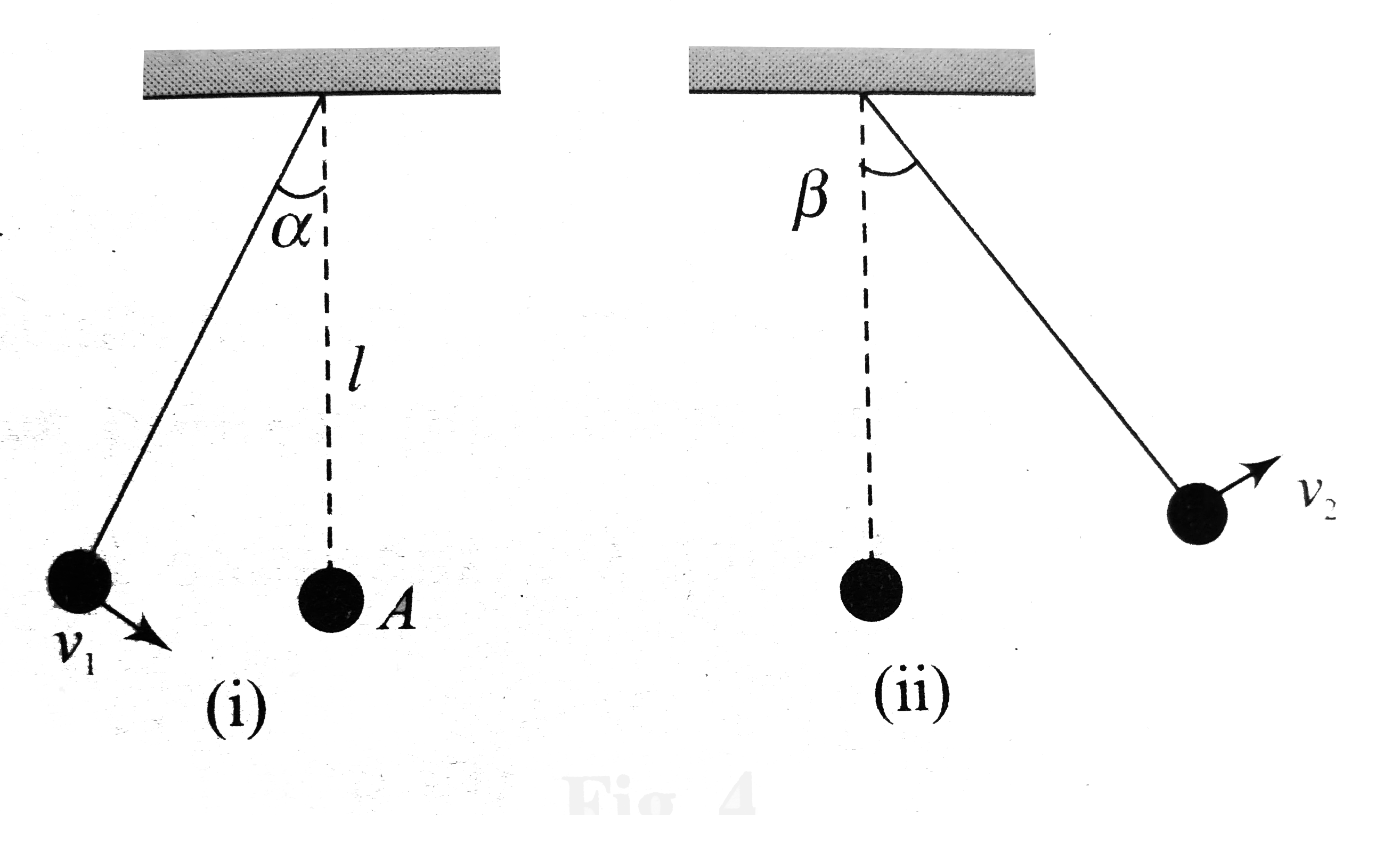
figure show the identical simple pan-del...

figure show the identical simple pan-delums of length. One is tilled at an angle `alpha` and imparted an initial velocity `v_(1)` towards mean possition and at a velocity `v_(2)` at an initial angular displacement `beta`. Find the phase difference in oscillations of these two pendulums

Text Solution

Verified by Experts
It is given that first pendulum bob is given a velocity `v_(1)` at a dislpacement `l alpha` from mean position , using the formula for velocity we can find the amplitude of its oscillation as
`V_(1) = omega sqrt(A_(1)^(2) - (l alpha)^(2))` [If `A_(1)`, is the amplitude of SHM of this As for simple pendulum `omega = sqrt((g)/(l))` we have
`V_(1)^(2) = (g)/(l) [(A_(1)^(2)) - (l alpha)^(2))]`
`A_(1) = sqrt(l^(2) alpha^(2) + v_(1)^(2)l)/(g)` (i)
Similarly if `A_(2)` is the amplitude of SHM of second pendlum bob we have
`V_(2) = omega sqrt(A_(1)^(2) - (l beta)^(2))`
or `A_(2) = sqrt((l^(2) beta^(2) + (v_(2)^(2)l)/(g))` (ii)
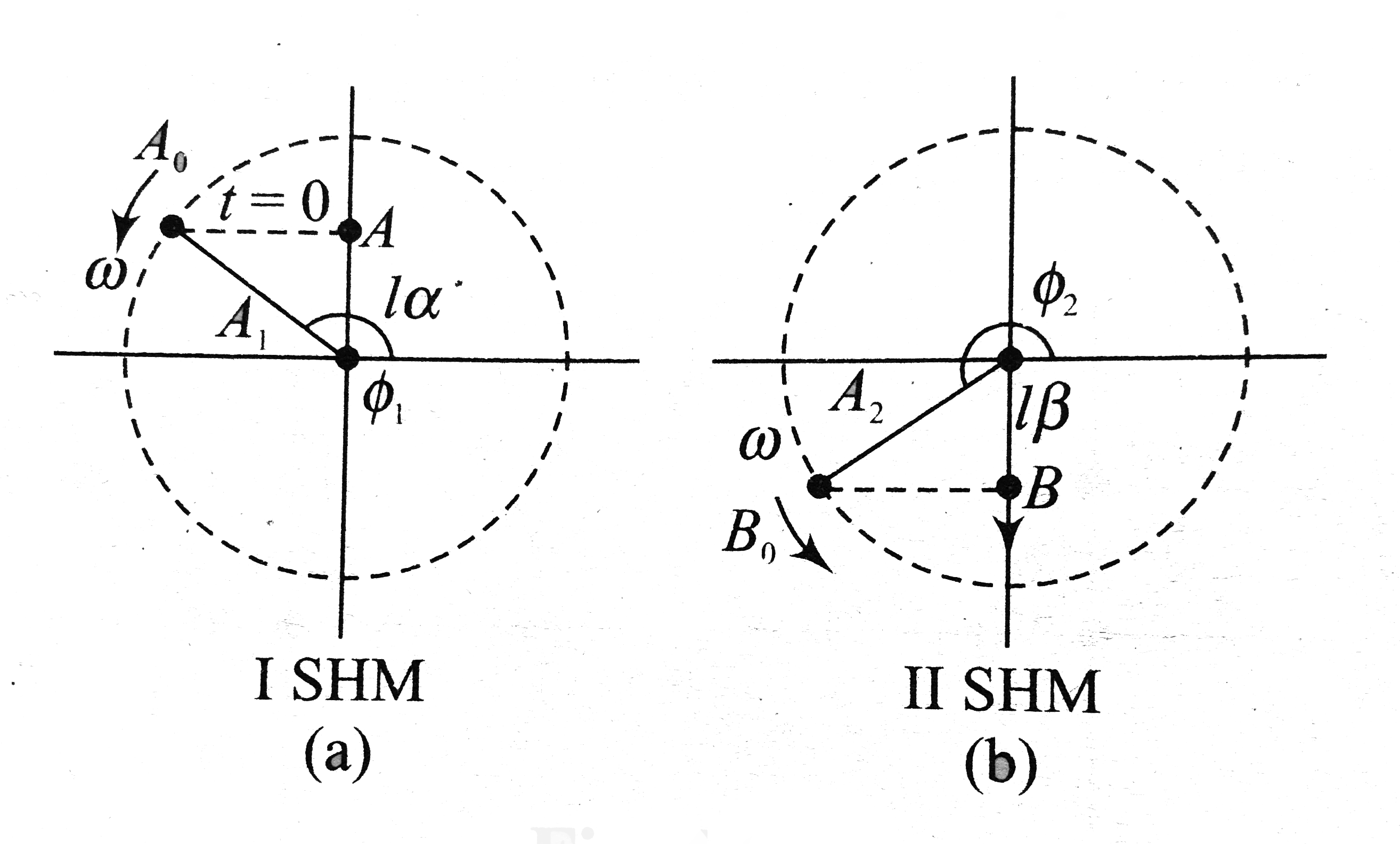
Now we repersent the two SHMs by circular motion representation as shown in figure

In first pendulum at `t = 0` the bob is thrown from a displacement `l alpha` from mean position with a velocity `v_(1)` towards mean position . As it is moving towards mean position in figure (a) , we consider the corresponding circular motion particle `A_(0)` of the bob A is second quarant, as the referance direction of `omega` we consider anticlockwise. As shown in figure initial phase of bob A is given as
`phi_(1) = pi - sin^(-1) ((l alpha)/(A_(1)))` (iii)
Similarly for second pendulum bob B, its corresponding circular motion partical `B_(0) at t = 0` is consider as shown in figure (b) its initial base is given as
`phi_(2) = sin^(-1) ((l beta)/(A_(2)))` (iv)
As both the pandulum are identical, their angular frequency for SHM must be same , so their phase difference can be given as
`Delta phi = phi_(2) - phi_(1) sin^(-1) ((l beta)/(A_(2))) + sin^(-1) ((l alpha)/(A_(1))) - pi`
Promotional Banner

Topper's Solved these Questions

  • LINEAR AND ANGULAR SIMPLE HARMONIC MOTION

    CENGAGE PHYSICS ENGLISH|Exercise Solved Example|15 Videos
  • LINEAR AND ANGULAR SIMPLE HARMONIC MOTION

    CENGAGE PHYSICS ENGLISH|Exercise Exercise 4.1|23 Videos
  • KINETIC THEORY OF GASES AND FIRST LAW OF THERMODYNAMICS

    CENGAGE PHYSICS ENGLISH|Exercise Interger|11 Videos
  • MISCELLANEOUS KINEMATICS

    CENGAGE PHYSICS ENGLISH|Exercise Interger type|3 Videos

Similar Questions

Explore conceptually related problems

If the second pendulum bob is thrown at velocity v_(2) at an angle beta from mean position, but on other side of mean position , find the phase diffrence in the two SHMs now as show in the figure.

Let there are three equal masses situated at the vertices of an equilateral triangle, as shown in Fig. Now particle A starts with a velocity v_(1) towards line AB , particle B starts with the velocity v_(2) , towards line BC and particle C starts with velocity v_(3) towards line CA . Find the displacement of the centre of mass of the three particles A, B and C after time t . What would it be if v_(1)=v_(2)=v_(3) ?

Two particles A and B are situated at a distance d = 2m apart. Particle A has a velocity of 10 m//s at an angle of 60^@ and particle B has a velocity v at an angle 30^@ as shown in figure. The distance d between A and B is constant. the angular velocity of B with respect to A is : .

Two identical pendulums oscillate with a constant phase difference (pi)/(4) and same amplitude. If the maximum velocity of one is v, the maximum velocity of the other will be.

The rod of length l=1 m rotates with an angular velocity omega=2 rads^(-1) an the point P moves with velocity v=1ms^(-1) and acceleration a=1ms^(-2) . Find the velocity and acceleration of Q .

Figure shown a spring block system hanging in equilibrium. The block of system is pulled down by the distance x and imparted a velocity v in downward direction as shown in figure. Find the time it will take to reach its mean position. Also find the maximum distance to which if will move before returning back towards mean position.

Power of the only force acting on a particle of mass m=1 kg moving in straight line depends on its velocity as P=v^(2) where v is in m/s and P is in watt. If initial velocity of the particle is 1m/s, then the displacement of the particle in ln2 second will be :

A bar of mass mand length I moves on two frictionless parallel rails in the presence of a uniform magnetic field directed into the plane of the paper. The bar is given an initial velocity v_(i) to the right and released. Find the velocity of bar, induced emfacross the bar und the current in the circuit as a function of time.

Two identical simple pendulums A and B are fixed at same point. They are displaced by very small angles alpha and beta ( beta gt alpha) and released from rest. Find the time after which B reaches its initial position for the first time. Collisions are elastic and length of strings is l .

Assertion : The average velocity of a particle having initial and final velocity v_(1) and v_(2) is v_(1)+v_(2)//2 . Reason : If r_(1) and r_(2) be the initial and final displacement in time t, then v_(av)=(r_(1)-r_(2))/(t) .

