Home
Class 11
PHYSICS
A uniform plank of mass m, free to move...

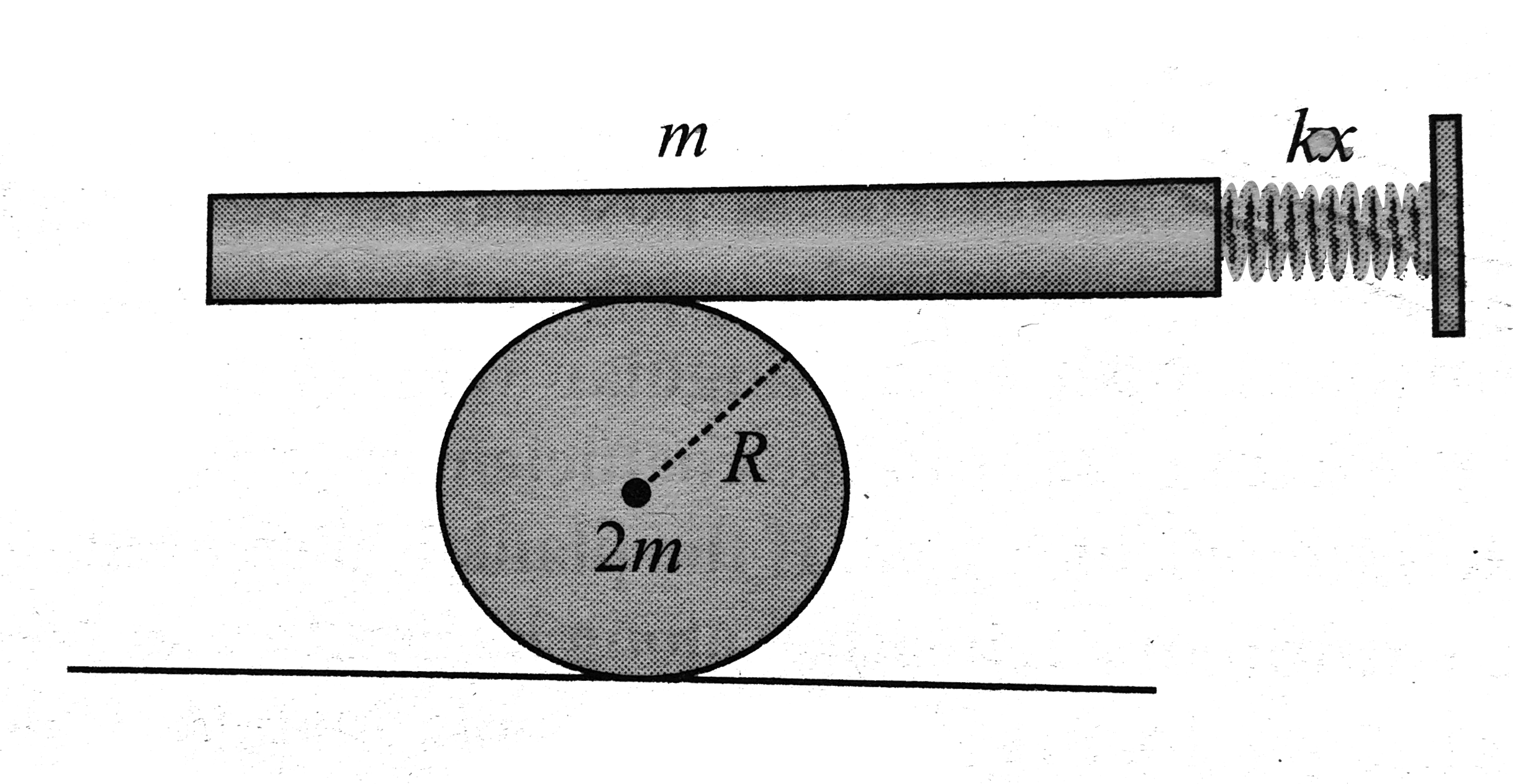
A uniform plank of mass m, free to move in the horizontal direction only , is placed at the top of a solid cylinder of mass `2 m` and radius R. The plank is attached to a fixed wall by mean of a light spring constant k. There is no slipping between the cylinder and the planck , and between the cylinder and the ground. Find the time period of small oscillation of the system.

Text Solution

Verified by Experts
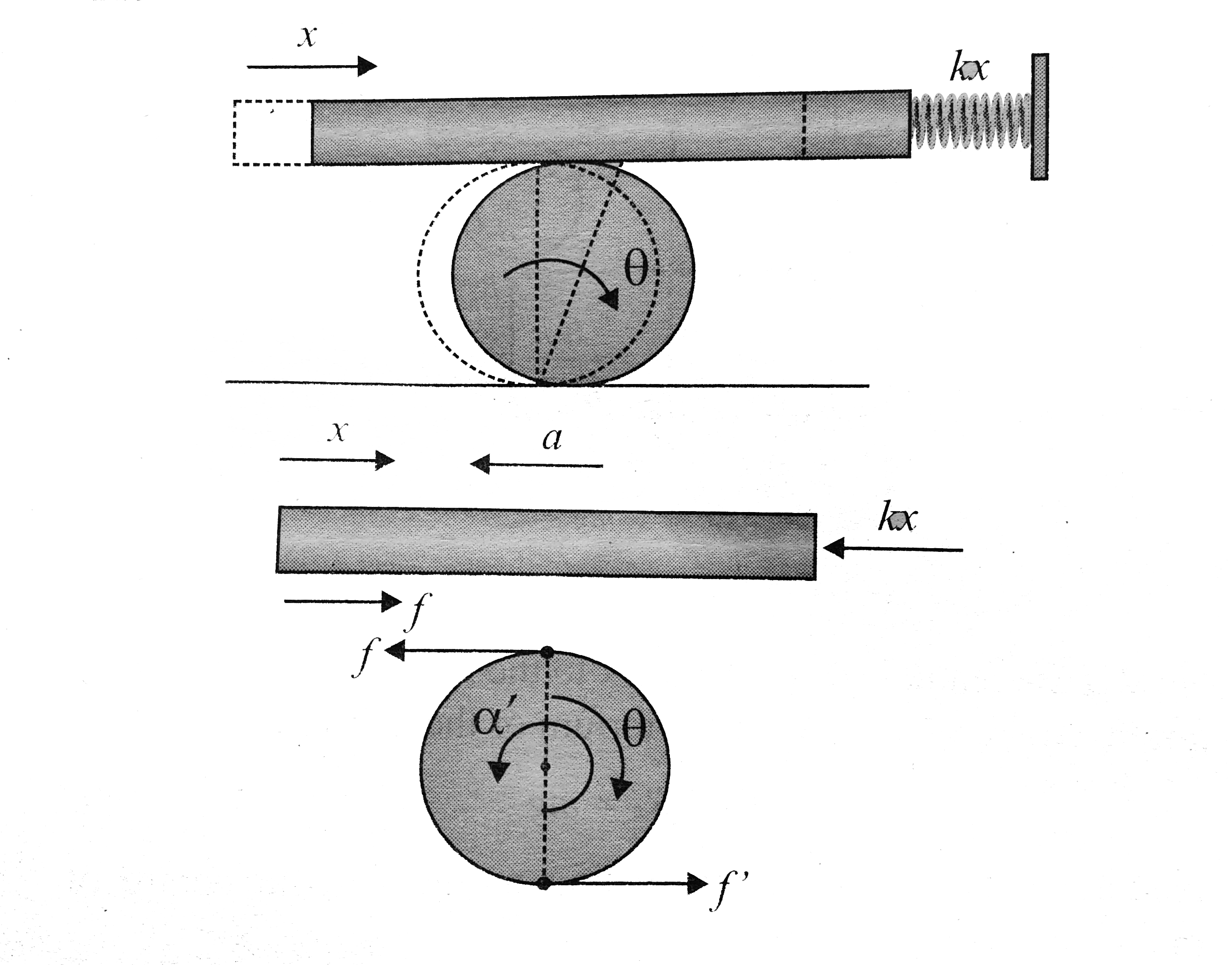
Method 1: When the plank is displaced slightly (say x) from equilibrium , as there is no sliding at any surface , the friction will be of static nature . As cylinder is rolling we can take the motion of the cylinder as pure rotation about point of contact.
Free body diagrams of plank and cylinder

Equation of motion for plank
`kx - f = m(a)`
Writing torque equation to cylinder about plank of contact
`f - (2 R) = i_(p). alpha [(1)/(2) (2m) R^(2) + 2m R^(2)] alpha`
`= 3 mR^(2) alpha`
or `f = (3)/(2) m Ra`
As cylinder is rolling we can write, the acceleration of topmost point of cylinder (or plank)
`a = alpha (2 R) implies alpha R = (a)/(2)`
Substituting the value of (iii) and (ii), we get `f = (3)/(4) ma`
Now, from Eqs (i) and (iv),
`kx - ((3)/(4) ma) = ma`
`implies a = (4 k)/(7 m) x`
Wtiting above equation with proper vector relation
`bar a = - ((4 k)/(7 m)) bar x`
Comparing with stander equation `bar a = - omega^(2) bar x`
which gives `omega^(2) = (4 k)/(7 m) or T = pi sqrt ((7m)/(k))`
Method 2: Suppose that the plank is displaced from its equilibrium position by x at time t , the center of the cylinder is therefore , displaced by `x//2`.
Therefore the mechanical energy of the system is given by
`E = KE ("plank") + PE ("spring") + KE ("cylinder")`
`= (1)/(2) mv^(2) + (1)/(2)kx^(2) + (1)/(2) I_(p) omega^(2)`
`I_(P) = I_(G) + (2 m) R^(2) = (1)/(2) (2 m) R^(2) + (2 m) R^(2)`
`= 3 mR^(2)`
As cylinder is rolling velocity of center of cylinder will be half of the velocity of the plank (top most point of the cylinder)
`nu_(cylinder) = (nu)/(2) = omega R implies omega = (nu)/(2 R)`
Substituting the value of `omega` in Eq. (i) we get
`E = (1)/(2) mv^(2) + (1)/(2)kx^(2) + (1)/(2) (3 m R^(2)) ((nu)/(2 R))`
`= (1)/(2) mv^(2) + (1)/(2)kx^(2) + (3)/(8)mv^(2)`
`= (7)/(8) mv^(2) + (1)/(2)kx^(2)`
Differentiating Eq. (ii) w.r.t. time
`(dE)/(dt) = 0 = (7)/(8) m.2v ((d nu)/(dt)) + k.2x, ((dx)/(dt)`
`= (7)/(8) mnu. a + kx. nu`
Here `(7)/(4) ma + kx = 0 or a = - (4 k)/(7 m) x`
Comparing with `a = - omega^(2) x implies T = 2 pi sqrt((7m)/(4k)) = pi sqrt((7m)/(k))`
Method 3: we can write Eq (ii)as `E = nu^(2) + (4k)/(7m) s^(2) = `constant
as total energy of sysytem performing SHM is constant. Comparing with standard equation `nu^(2) + omega^(2) x^(2) = constant`
which gives `omega^(2) = (4k)/(7m) or T = pi sqrt ((7m)/(k))`
Promotional Banner

Topper's Solved these Questions

  • LINEAR AND ANGULAR SIMPLE HARMONIC MOTION

    CENGAGE PHYSICS ENGLISH|Exercise Exercise 4.1|23 Videos
  • LINEAR AND ANGULAR SIMPLE HARMONIC MOTION

    CENGAGE PHYSICS ENGLISH|Exercise Exercise 4.2|23 Videos
  • LINEAR AND ANGULAR SIMPLE HARMONIC MOTION

    CENGAGE PHYSICS ENGLISH|Exercise Single correct anwer type|14 Videos
  • KINETIC THEORY OF GASES AND FIRST LAW OF THERMODYNAMICS

    CENGAGE PHYSICS ENGLISH|Exercise Interger|11 Videos
  • MISCELLANEOUS KINEMATICS

    CENGAGE PHYSICS ENGLISH|Exercise Interger type|3 Videos

Similar Questions

Explore conceptually related problems

A cylinder of mass M and radius R lies on a plank of mass M as shown. The surface between plank and ground is smooth, and between cylinder and plank is rough. Assuming no slipping between cylinder and plank, the time period of oscillation (When displaced from equilibrium) of the system is

A uniform cylinder of mass m and radius R is in equilibrium on an inclined by the action of a light spring of stiffnesk, gravity and reaction force acting on it .If the angle of inclination of the plane is phi , find the angular frequency of small oscillation of the cylinder

A solid sphere of mass m and radius R is placed over a plank of same mass m . There is sufficient friction between sphere and plank to prevent slipping. Force of friction between sphere and plank is

Find the moment of inertia of a solid cylinder of mass M and radius R about a line parallel to the axis of the cylinder and on the surface of the cylinder.

A solid cylinder of mass M and radius R rolls without slipping down an inclined plane making an angle 6 with the horizontal. Then its acceleration is.

A solid cylinder of mass M and radius R rolls without slipping down an inclined plane of length L and height h . What is the speed of its center of mass when the cylinder reaches its bottom

A uniform solid cylinder of mass m and radius R is placed on a rough horizontal surface. A horizontal constant force F is applied at the top point P of the cylinder so that it start pure rolling. The acceleration of the cylinder is

Find the acceleration of the cylinder of mass m and radius R and that of plank of mass M placed on smooth surface if pulled with a force F as shown in figure. Given that sufficient friction is present between cylinder and the plank surface to prevent sliding of cylinder.

A uniform solid cylinder having mass M and radius R is pulled by a horiozntal force F acting through the center as shown. The cylinder rolls to the right without slipping. What is the magnitude of the force of friction between the cylinder and the ground?

A bullet of mass m moving with a velocity of u just grazes the top of a solid cylinder of mass M and radius R resting on a rough horizontal surface as shown and is embedded in the cylinder after impact. Assuming that the cylinder rolls without slipping, find the angular velocity of the cylinder and the final velocity of the bullet.

