Home
Class 11
PHYSICS
The pulley shown in figure has a moment ...

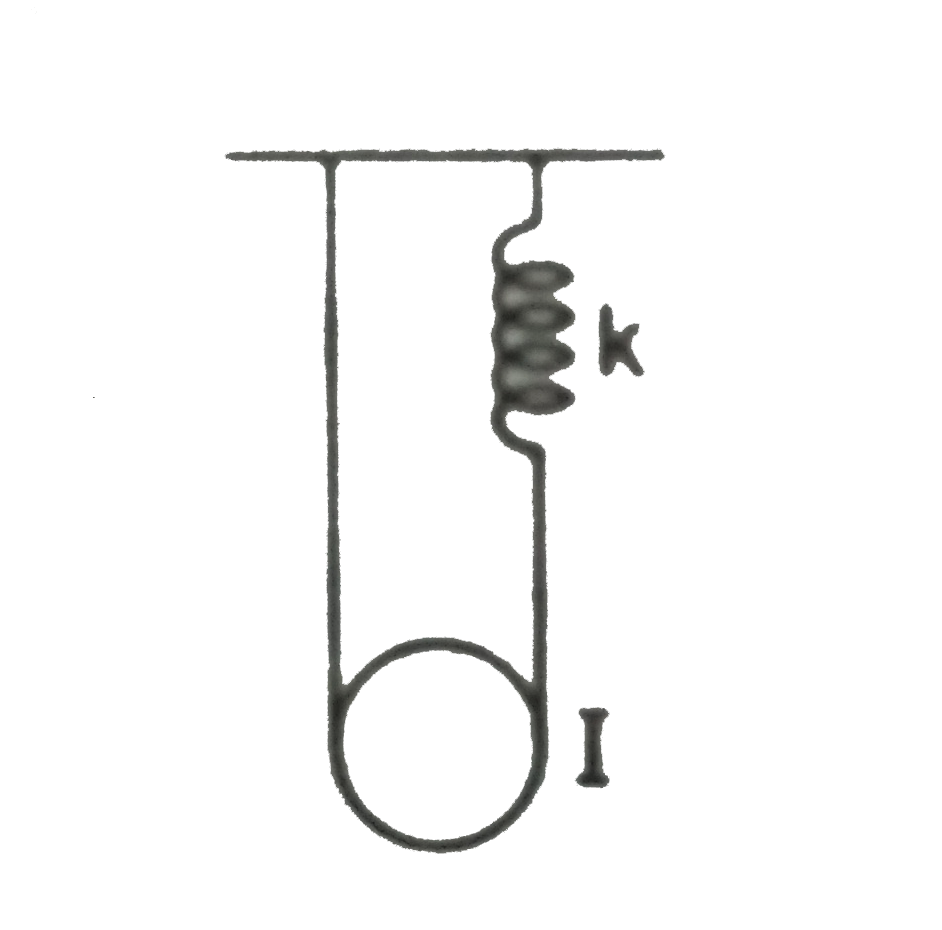
The pulley shown in figure has a moment of inertias I about its xis and mss m. find the tikme period of vertical oscillastion of its centre of mass. The spring has spring constant k and the string does not slip over the pulley.

Text Solution

Verified by Experts

For rotatiobnal equation the tension in spring on both sides must be same .
Let T be the tension in the string in equilibrium position and `l_(0)` the extension of spring . Then for equilibrum of any part of spring on RHS.
`2 T = mg implies2 k l_(0) = mg or l_(0) = (mg)/(2 K)`
For translational equation of pulley `l_(0) = (mg)/(2 K)`
Thus when pulley attains equilibrium , the spring is streched by a distance
`l_(0) = (mg)/(2 K)` (i)
Now suppose that the pulley is down a little and released. The pulley starts up and down oscillation . Let y be instant neous displacement of center of pulley from equilibrium. Then total increase in length of (string + spring) is `2y` (y to the left of pulley and y to the right).
As steing is inextensible, total extension of spring is `2 y`.
As pulley also ratates energy of system is
`E = (1)/(2) l omega^(2) + (1)/(2) m v^(2) - mgy + (1)/(2) K (l_(0) + 2 y)^(2)`
But `omega = (v)/( r)`
`E = (1)/(2) l (v^(2))/( r^(2)) + (1)/(2) K (l_(0) + 2 y)^(2)`
`= (1)/(2) ((l)/r^(2) + m) v^(2) = mgy + (1)/(2) K (l_(0) + 2 y)^(2)`
Asd total energy is constant (system is conservative)
`(dE)/(dt) = 0`
` (1)/(2) ((l)/r^(2) + m) 2v (dv)/(dt) - mg (dv)/(dt) + (1)/(2) K 2 (l_(0) + 2 y) , 2 (dy)/(dt) = 0`
and `(dy)/(dt) = v and (dv)/(dt) = acceleration a`
and `l_(0) = (mg)/(2K)`
we get `((l)/r^(2) + m) a - mg + 2 K ((mg)/(2 k) + 2y) = 0`
`a prop - y` (ii)
As `a prop - y`, motion of pulley is SHM.
Standard equiation of SHM
`a = - omega^(2) y`
Comparing Eqs, (ii) and (iii), `omega^(2) = (4 k)/((l)/r^(2) + m)`
time period.
`T = (2 pi)/(omega) = 2 pi sqrt({{(l)/(r^(2)) + m)/(4K)}} = pi sqrt({{m + (l)/(r^(2)))/(K)}}`
Promotional Banner

Topper's Solved these Questions

  • LINEAR AND ANGULAR SIMPLE HARMONIC MOTION

    CENGAGE PHYSICS ENGLISH|Exercise Exercise 4.1|23 Videos
  • LINEAR AND ANGULAR SIMPLE HARMONIC MOTION

    CENGAGE PHYSICS ENGLISH|Exercise Exercise 4.2|23 Videos
  • LINEAR AND ANGULAR SIMPLE HARMONIC MOTION

    CENGAGE PHYSICS ENGLISH|Exercise Single correct anwer type|14 Videos
  • KINETIC THEORY OF GASES AND FIRST LAW OF THERMODYNAMICS

    CENGAGE PHYSICS ENGLISH|Exercise Interger|11 Videos
  • MISCELLANEOUS KINEMATICS

    CENGAGE PHYSICS ENGLISH|Exercise Interger type|3 Videos

Similar Questions

Explore conceptually related problems

The pulley shown in figure has a moment of inertias I about its axis and mass m. find the time period of vertical oscillation of its centre of mass. The spring has spring constant k and the string does not slip over the pulley.

The pulley shown in figure has a moment of inertia I about it's axis and its radius is R. Find the magnitude of the acceleration of the two blocks. Assume that the string is light and does not slip on the pulley.

Find the time period of oscillation of block of mass m. Spring, and pulley are ideal. Spring constant is k.

Figure shows two blocks of masses m and M connected by a string passing over a pulley. The horizontal table over which the mass m slides is smooth. The pulley has a radius r and moment of inertia I about its axis and it can freely rotate about this axis. Find the acceleration of the mass M assuming that the string does not slip on the pulley.

Consider the situation shown in the figure. A mass is hanging from a inextensible string which is passing over a pulley. The pulley itself is attached to a massless spring of stiffness k as shown in the figure. Find the time period of vertical oscillations of mass m if pulley is slightly displaced from its mean position. Assume that string does not slip over pulley.

In the situation as shown in figure time period of small vertical oscillation of block will be - (String, springs and pulley are ideal)

The pulley shown in figure has a radius 10 cm and moment of inertia 0.5 kg-m^2 about its axis. Assuming the inclined planes to be frictionless, calculate the acceleration of the 4.0 kg block.

Two masses M and m are connect by a light string gong over a pulley of radis r. The pulley is free to rotate about its axis which is kept horizontal. The moment of inertia of the pulley about the axis is I. The system is releaed from rest. Find the angular momentum fo teh system when teh mass Mhas descended through a height h. The string does not slip over the pulley.

In the arrangement shown in the diagram, pulleys are small and springs are ideal. k_(1)=k_(2)=k_(3)=k_(4)=10Nm^(-1) are force constants of the springs and mass m=10kg. If the time period of small vertical oscillations of the block of mass m is given by 2pix seconds, then find the value of x.

The pulley shown in figure has a radius of 20 cm and moment of inertial 0.2 kg-m^2. The string going over it is attached at one end to a vertical sprign of spring constant 50 N/m fixed from below and supports a 1 kg mas at other end. The system is released from rest with the spring at its natural length. Find the speed of the block when it has desceds through 10 cm. Take g=10 m/s^2 .
