Home
Class 11
PHYSICS
A 2kg mass is attached to a spring of f...

A `2kg ` mass is attached to a spring of force constant `600 N//m` and rests on a smooth horizontal surface. A second mass of `1kg` slides along the surface toward the first at `6m//s`.
(a) Find the amplitude of oscillation if the masses make a perfectly inelastic collision and remain together on the spring. what is the period of oscillation ?
(b) Find the amplitude and period of oscillation if the collision is perfectly elastic.
( c) For each case , write down the position `x` as a function of time `t` for the mass attached to the spring, assuming that the collision occurs at time `t = 0`. What is the impulse given to the `2kg mass in each case ?

Text Solution

Verified by Experts
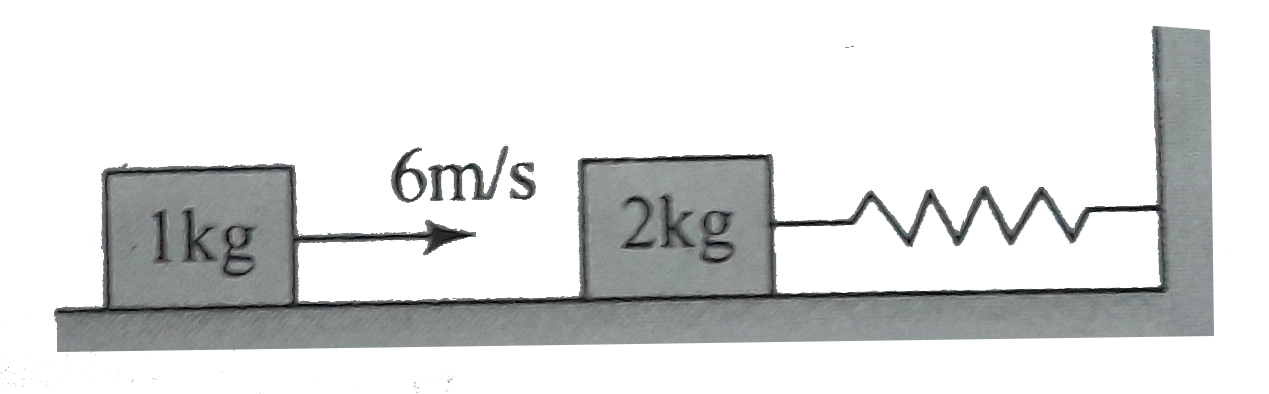
a. From conservation of liner momentum.
`1 xx 6 = (1 + 2)nu`
`:. Nu = 2m//s`
Now from conservation of mechanical energy.
`(1)/(2) mv^(2) = (1)/(2) kA^(2)`
`A = (sqrt((m)/(k))) nu = (sqrt((3)/(600))) xx 2`
or `A = 0.141 m = 14.1 cm`
`T = 2 pi sqrt((m)/(k)) = 2 pi sqrt((3)/(600)) = 0.44 s`

b. For perfectly elastic collision:
`nu_(2)' = ((m_(2) - m_(1))/(m_(1) + m_(2))) nu_(2) + ((2 m_(1))/(m_(1) + m_(2))) nu_(1)`
or `nu_(2)' = ((2 xx 1)/(1 + 2)) xx 6 = 4m//s`
`A = (sqrt((m)/(k)) nu_(2) = ((2)/(600))^(1//2) xx 4`
or `A = 0.23 m = 23 cm`
`T = 2 pi sqrt((m)/(k)) = 2 pi sqrt ((2)/(600)) = 0.36 s`
c. In the first case, `omega = (2 pi)/(T) = (2 pi)/(0.44) = 14.28 rad//s`
and amplitude `A = 14.1 cm`
`x = A sin omega t = (14.1 cm) sin (14.28 t)`
In the second case, `omega = (2 pi)/(T) = (2 pi)/(0.36) = 17.45 rad//s`
and amplitude `A = 23 cm`
`x = 23 sin (17.45 t) cm`
Impulase, `J = Delta P = 2 xx 2 = 4 N-s` in the first case and `4xx 2 = 8N-s` in the second case.
Promotional Banner

Topper's Solved these Questions

  • LINEAR AND ANGULAR SIMPLE HARMONIC MOTION

    CENGAGE PHYSICS ENGLISH|Exercise Exercise 4.1|23 Videos
  • LINEAR AND ANGULAR SIMPLE HARMONIC MOTION

    CENGAGE PHYSICS ENGLISH|Exercise Exercise 4.2|23 Videos
  • LINEAR AND ANGULAR SIMPLE HARMONIC MOTION

    CENGAGE PHYSICS ENGLISH|Exercise Single correct anwer type|14 Videos
  • KINETIC THEORY OF GASES AND FIRST LAW OF THERMODYNAMICS

    CENGAGE PHYSICS ENGLISH|Exercise Interger|11 Videos
  • MISCELLANEOUS KINEMATICS

    CENGAGE PHYSICS ENGLISH|Exercise Interger type|3 Videos

Similar Questions

Explore conceptually related problems

a block of mass 0.1 kg attached to a spring of spring constant 400 N/m pulled horizontally from x=0 to x_1 =10 mm. Find the work done by the spring force

A block of mass 0.2 kg is attached to a mass less spring of force constant 80 N/m as shown in figure. Find the period of oscillation. Take g=10 m//s^(2) . Neglect friction

A block of mass 0.2 kg is attached to a mass less spring of force constant 80 N/m as shown in figure. Find the period of oscillation. Take g=10 m//s^(2) . Neglect friction

A mass M is attached to a horizontal spring of force constant k fixed one side to a rigid support as shown in figure. The mass oscillates on a frictionless surface with time period T and amplitude A. When the mass M is in equilibrium position, another mass m is gently placed on it. When will be the new amplitude of ocillation?

A solid sphere of mass m is attached to a light spring of force constant k so that it can roll without slipping along a horizontal surface. Calculate the period of oscillation made by sphere.

Spring of spring constant 1200 Nm^(-1) is mounted on a smooth fricationless surface and attached to a block of mass 3 kg . Block is pulled 2 cm to the right and released. The angular frequency of oscillation is

The period of oscillation of mass M suspended from a spring of negligible mass is T. If along with it another mass M is also suspended, the period of oscillation will now be

A particle of mass 3 kg , attached to a spring with force constant 48Nm^(-1) execute simple harmonic motion on a frictionless horizontal surface. The time period of oscillation of the particle, is seconds , is

A block of mass m suspended from a spring of spring constant k . Find the amplitude of S.H.M.

Find the time period of oscillation of block of mass m. Spring, and pulley are ideal. Spring constant is k.

