Home
Class 11
PHYSICS
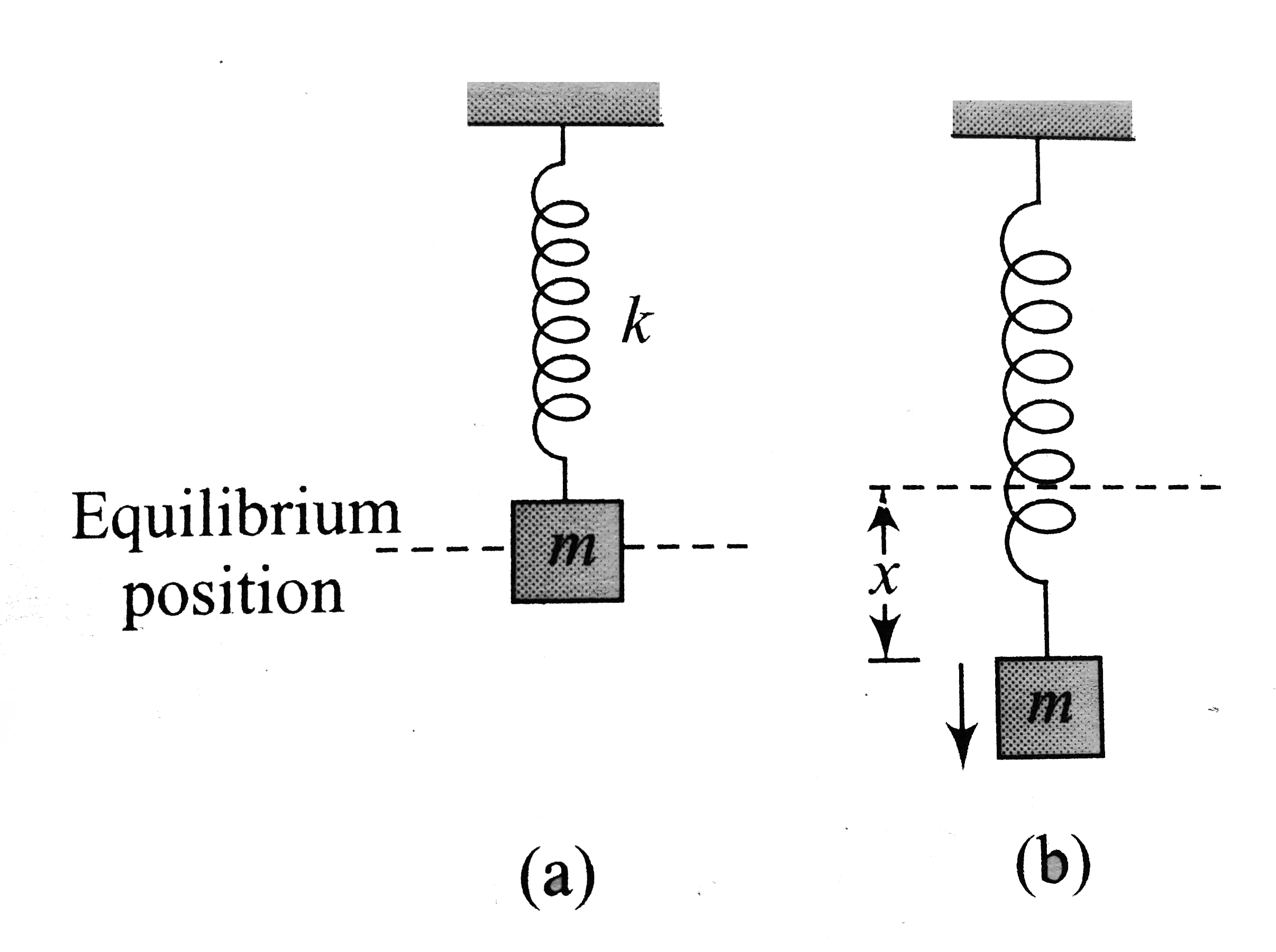
Figure shown a spring block system hangi...

Figure shown a spring block system hanging in equilibrium. The block of system is pulled down by the distance x and imparted a velocity v in downward direction as shown in figure. Find the time it will take to reach its mean position. Also find the maximum distance to which if will move before returning back towards mean position.

Text Solution

Verified by Experts
As shown in figure (b), when the block is pulled down by a distance x and throwndownward , it will start executting SHM. It will go further to a distance A (amplitude) from mean possion before returning back v at a displacement x from its mean position as
`v = omega sqrt(A^(2) - x^(2))`
or `v^(2) = (k)/(m) (A^(2) - x^(2))`
[as for spring block system `omega = sqrt((k)/(m)) ` ltbr or `A = sqrt((mv^(2))/(k) + x^(2)))`
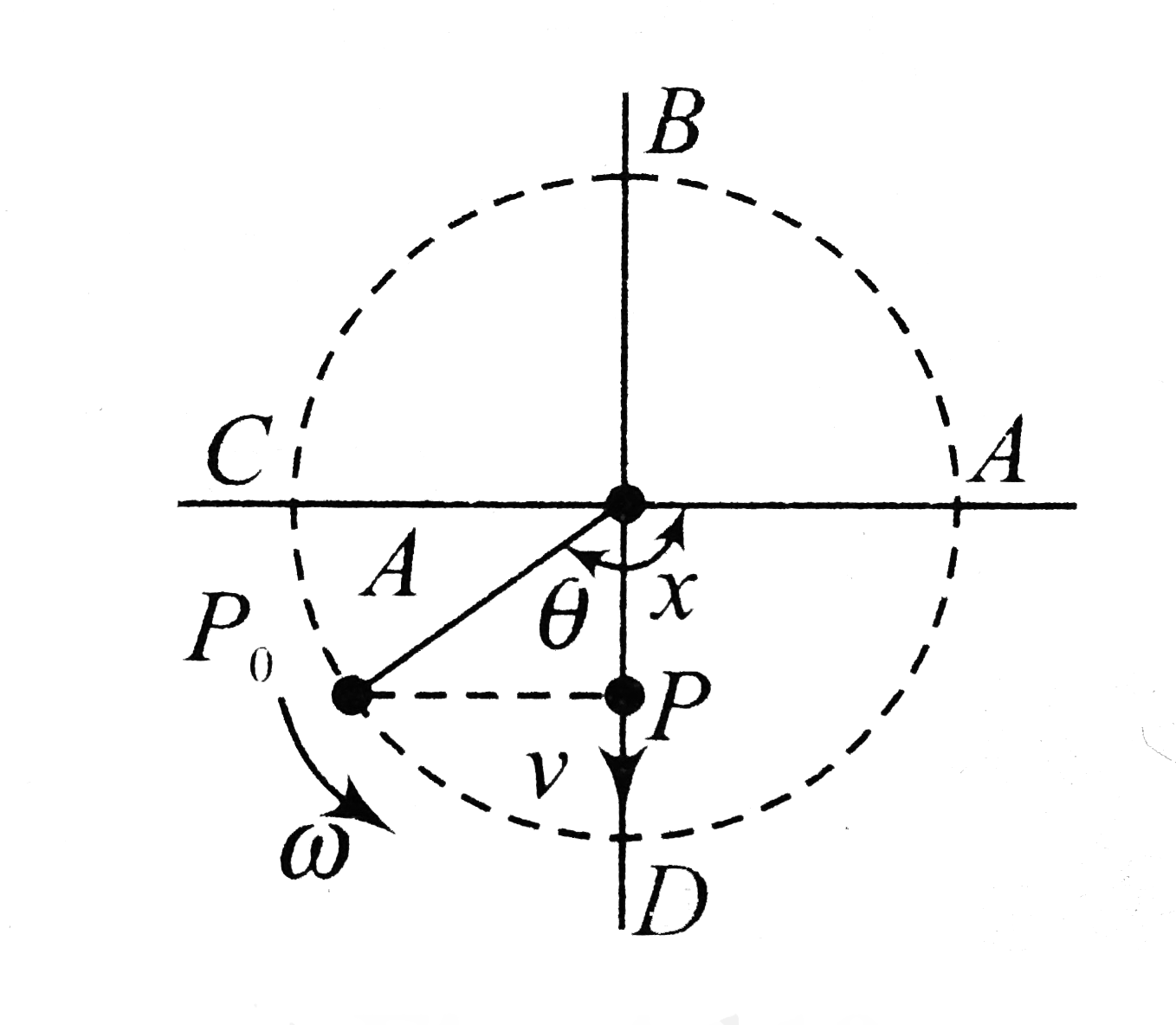
Now timeof motion of bob can be obtained by circular motion representation of the respectiveSHM is shown in figure at `t = 0 At t = 0`, block P is at a distance x force its mean position in downward direction and it is moving downwards so we can sider its corresponding circular motion partical in III quadrant as shown in reference angular velocity . We consider P will reach its mean position when partical `P_(0)` reaches position A by traversing an angle `theta` as shown in the figure.

Thus it will take a time gives as `t = (theta)/(omega) = (pi - sin^(-1) ((x//A)/(sqrt((k)/(m))))`
or `t = sqrt((m)/(k)) [pi - sin^(-1) ((x)/(sqrt((mv^(2))/(k) + x^(2))))]`
The maximum distance to which block will move from its initial position is `A - x` as it gas upto its lower exterme at a distance equal to its amplitude A after to mean position.
Promotional Banner

Topper's Solved these Questions

  • LINEAR AND ANGULAR SIMPLE HARMONIC MOTION

    CENGAGE PHYSICS ENGLISH|Exercise Exercise 4.1|23 Videos
  • LINEAR AND ANGULAR SIMPLE HARMONIC MOTION

    CENGAGE PHYSICS ENGLISH|Exercise Exercise 4.2|23 Videos
  • LINEAR AND ANGULAR SIMPLE HARMONIC MOTION

    CENGAGE PHYSICS ENGLISH|Exercise Single correct anwer type|14 Videos
  • KINETIC THEORY OF GASES AND FIRST LAW OF THERMODYNAMICS

    CENGAGE PHYSICS ENGLISH|Exercise Interger|11 Videos
  • MISCELLANEOUS KINEMATICS

    CENGAGE PHYSICS ENGLISH|Exercise Interger type|3 Videos

Similar Questions

Explore conceptually related problems

Figure shown a spring block system hanging in equilibrium. If a velocity v_(0) is imparted to the block in downwards direction . Find the amplitude of SHM of the block and the time after which it will reach a point at half the amplitude of block

A spring block pendulum is shown in figure . The system is hanging in equilibrium. A bullet of mass m//2 moving at a speed u bites the block from downwards direction and gets embedded in it. Find the amplitude of oscillation of the block now.

Figure shown a block P of mass m resting on a smooth horizontal ground, attached to one and a spring of force constant k in netural length. If another block od same mass and moving with a velocity u towards right is placed on the block on which stick to it due to friction ,find the time it will take to reach its exterme position. Also find the amplitude of oscillation of the combined mass 2m .

A block of mass m is connected to a spring constant k and is at rest in equilibrium as shown. Now, the block is Displacement by h below its equilibrium position and imparted a speed v_0 towards down as shown in the Fig. As a result of the jerk, the block executes simple harmonic motion about its equilibrium position. Based on this information, answer the following question. Q. Find the time taken by the block to cross the mean position for the first time.

A block of mass m is moving with an initial velocity v_0 towards a stationary spring of stiffness k attached to the wall as shown in figure a. Find the maximum compression in the spring. b. Is the work done by the spring negative or positive?

Find the elastic potential energy stored in each spring shown in figure, when the block is in equilibrium. Also find the time period of vertical oscillation of the block.

Tow identical springs of spring constant k are attached to a block of mass m and to fixed supports as shown in figure. When the mass is displaced from equilibrum position by a distance x towards right, find the restoring force.

System is shown in the figure and man is pulling the rope from both sides with constant speed u find the speed of the block.

System is shown in the figure and man is pulling the rope from both sides with constant speed u find the speed of the block.

A block of mass m is connected to a spring constant k and is at rest in equilibrium as shown. Now, the block is Displacement by h below its equilibrium position and imparted a speed v_0 towards down as shown in the Fig. As a result of the jerk, the block executes simple harmonic motion about its equilibrium position. Based on this information, answer the following question. Q. Find the amplitude.

