Home
Class 11
PHYSICS
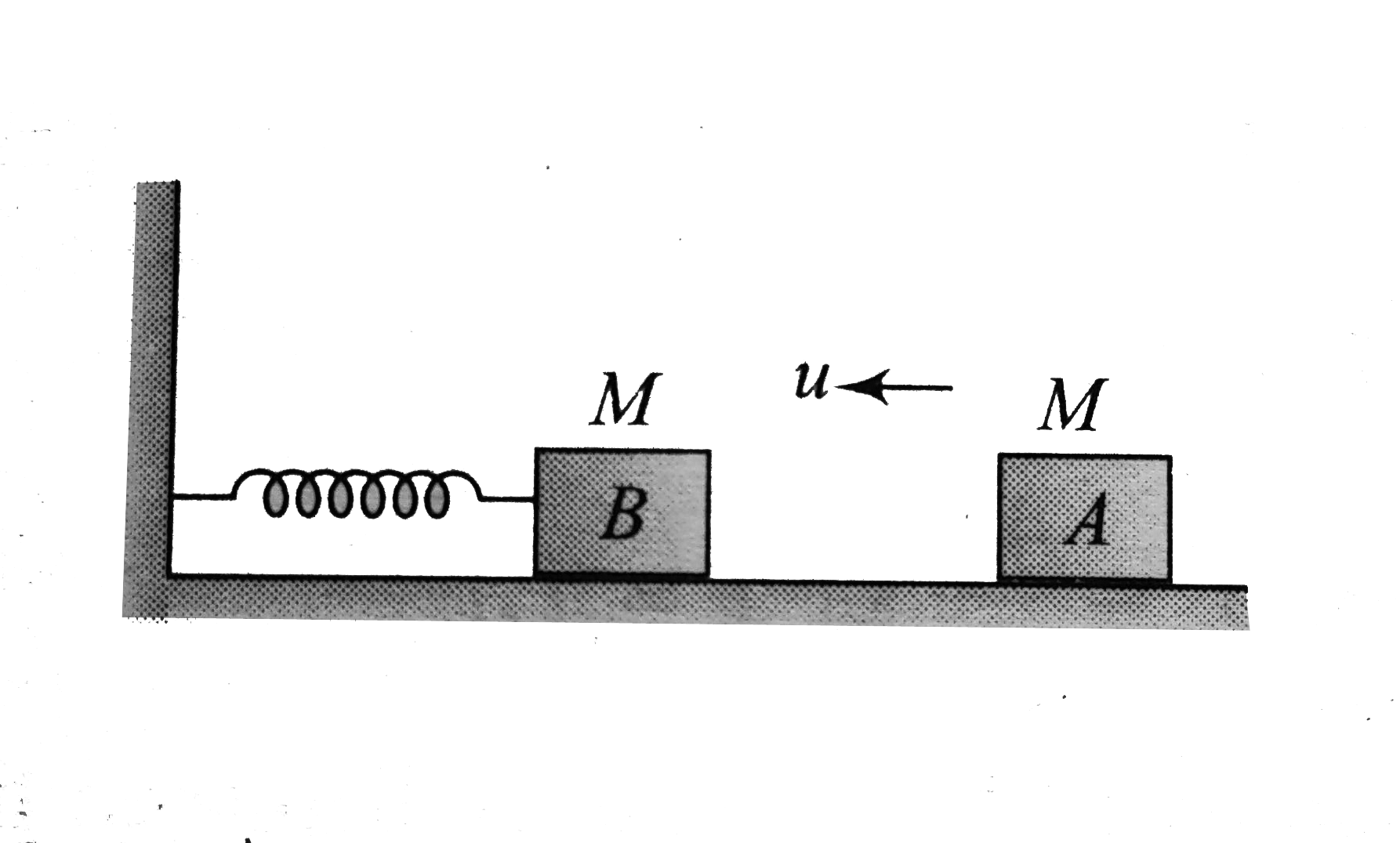
In the figure shown, the block A of mass...

In the figure shown, the block A of mass m collides with the identical block B and after collision they stick together. Calculate the amplitude of resulatant vibration.

Text Solution

Verified by Experts

Common velocity after collision`= (u)/(2)`
Hence, `K.E. = (1)/(2) (2 M) ((u)/(2))^(2) = (1)/(4) Mu^(2)`
It is also total energy of vibration because the string is unstretched at this moment, hence, if A is the amplitude , then
`(1)/(2) KA^(2) = (1)/(4) Mu^(2) or A = sqrt((M)/(2 K)) u`
Promotional Banner

Topper's Solved these Questions

  • LINEAR AND ANGULAR SIMPLE HARMONIC MOTION

    CENGAGE PHYSICS ENGLISH|Exercise Subjective|21 Videos
  • LINEAR AND ANGULAR SIMPLE HARMONIC MOTION

    CENGAGE PHYSICS ENGLISH|Exercise Single Correct|107 Videos
  • LINEAR AND ANGULAR SIMPLE HARMONIC MOTION

    CENGAGE PHYSICS ENGLISH|Exercise Exercise 4.1|23 Videos
  • KINETIC THEORY OF GASES AND FIRST LAW OF THERMODYNAMICS

    CENGAGE PHYSICS ENGLISH|Exercise Interger|11 Videos
  • MISCELLANEOUS KINEMATICS

    CENGAGE PHYSICS ENGLISH|Exercise Interger type|3 Videos

Similar Questions

Explore conceptually related problems

The left block in filgure collides inelastically with the right block and sticks to it. Find the amplitude of the resulting simple harmonic motion.

On a friction surface a block a mass M moving at speed v collides elastic with another block of same mass M which is initially at rest . After collision the first block moves at an angle theta to its initial direction and has a speed (v)/(3) . The second block's speed after the collision is

A ball of mass 0.50 kg moving at a speed of 5.0 m/s collides with another ball of mas 1.0 kg. After the collision the balls stick together ane remain motionless. What was the velocity of the 1.0 kg block before the collision?

A body of mass 10 kg and velocity 10 m/s collides with a stationary body of mass 5 kg . After collision both bodies stick to each other , velocity of the bodies after collision will be

A block having mass m collides with an another stationary block having mass 2m. The lighter block comes to rest after collision. If the velocity of first block is v, then the value is coefficient of restitution will must be

The track shown in the figure is frictionless. The block B of mass 4kg is lying at rest and block A of mass 2kg is pushed along the track with some speed. The collision between A and B is perfectly elastic. With that velocity should the block A start such that block B just reaches at point P ?

A bullet of mass m strikes a block of mass M . The bullet remains embedded in the block. Find the amplitude of the resulting SHM.

A block of mass M attached to the free end of a spring of force constant k is nounted on a smooth horizontal table as shown in figure. The block executes SHM with amplitude A and frequency f . If an object of mass m is put on it, when the block is passing through its equilibium position and the two move together ,then what is the new amplitude and frequency of vibration?

A moving block having mass m , collides with another stationary block having mass 4m . The lighter block comes to rest after collision. When the initial velocity of the block is v , then the value of coefficient of restitution ( e) will be

Figure shown a block of mass m placed on a smooth wedge of mass M. Calculate the minimum value of M' and tension in the string, so that the block of mass m will move vertically downwards with acceleration 10ms^(-2)

CENGAGE PHYSICS ENGLISH-LINEAR AND ANGULAR SIMPLE HARMONIC MOTION-Exercise 4.2
  1. A mass M attached to a spring oscillation with a period of 2 s. If the...

    Text Solution

    |

  2. A horizontal rod of mass m and length L is pivoted at one end The rod'...

    Text Solution

    |

  3. A pendulum has a period T for small oscillations. An obstacle is place...

    Text Solution

    |

  4. A horizontal spring block system of mass M executes simple harmonic mo...

    Text Solution

    |

  5. A spring of spring constant 200 N//m has a block of mass 1 kg hanging ...

    Text Solution

    |

  6. With the assumption of no slipping, determine the mass m of the block ...

    Text Solution

    |

  7. A simple pendulum of length l swimings from a small angle theta . Its ...

    Text Solution

    |

  8. A uniform rod of length l is pivoted distance x from the top of the ro...

    Text Solution

    |

  9. The period of oscillation of a spring pendulum is T. If the spring is ...

    Text Solution

    |

  10. A uniform stick of length l is hinged so as to rotated about a harmoni...

    Text Solution

    |

  11. A ball is released in a smooth dimetrical tunnel of earth a. After ...

    Text Solution

    |

  12. A body is in SHM with period T when oscillated from a freely suspended...

    Text Solution

    |

  13. A point mass m is supended at the end of a massless wire of length Lan...

    Text Solution

    |

  14. In the figure shown, the block A of mass m collides with the identical...

    Text Solution

    |

  15. Figure shown a block P of mass m resting on a smooth floor at a distan...

    Text Solution

    |

  16. Figure shown a block P of mass m resting on a smooth horizontal ground...

    Text Solution

    |

  17. Figure shown a spring block system hanging in equilibrium. If a veloci...

    Text Solution

    |

  18. Find the amplitude of the simple harmonic motion obtasined by combinin...

    Text Solution

    |

  19. x(1) = 3 sin omega t,x(2) = 4 cos omega t Find (i) amplitude of resu...

    Text Solution

    |

  20. A partical is subjucted to two simple harmonic motions x(1) = A(1) ...

    Text Solution

    |
