Home
Class 11
PHYSICS
One end of a spring of force constant K ...


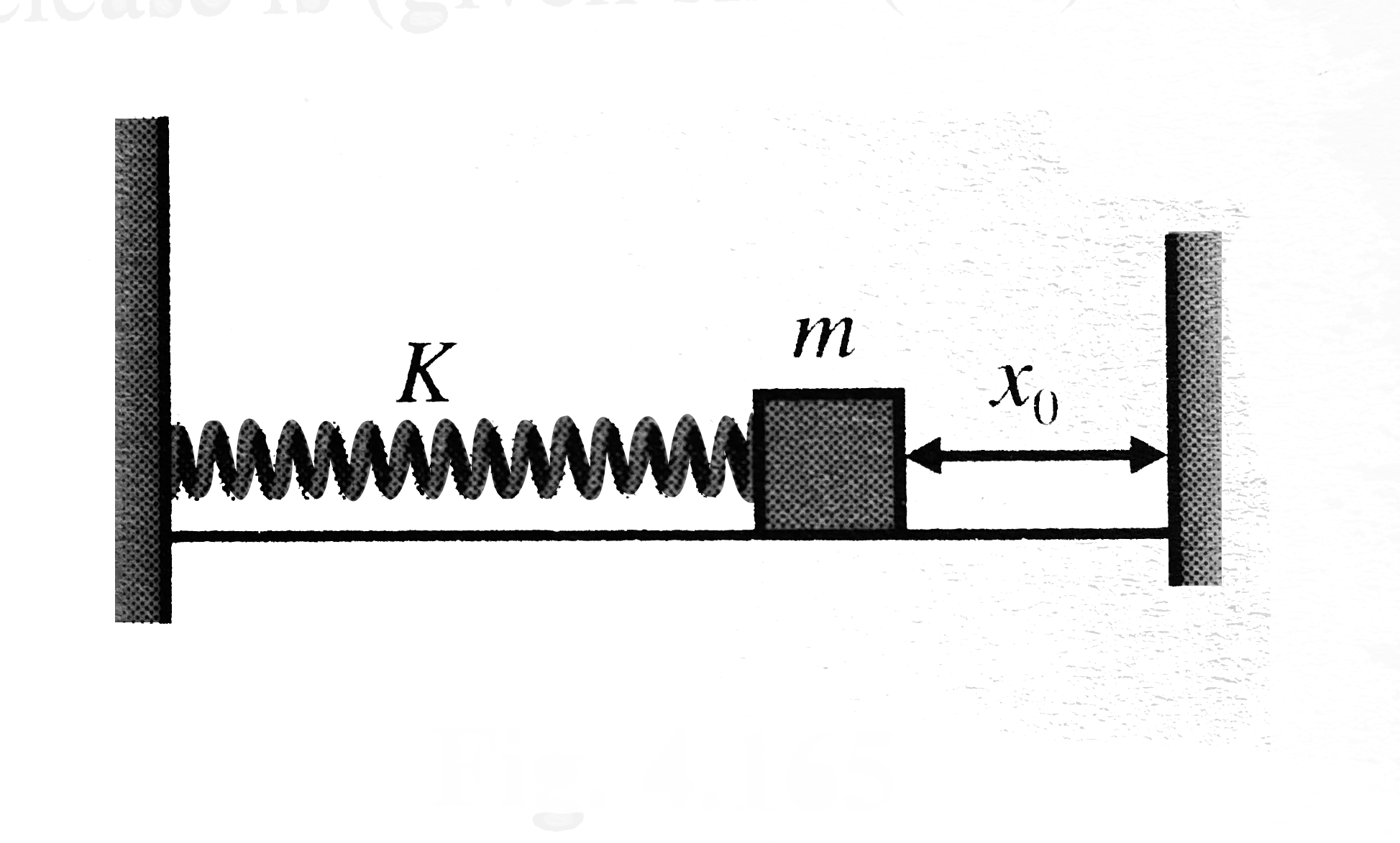
One end of a spring of force constant K is fixed to a vertical wall and the other to a body of mass m resting on a smooth horizontal surface. There is another wall at a distance `x_0` from the body. The spring is then compressed by `3x_0` and released. The time taken to strike the wall from the instant of release is (given `sin^-1((1)/(3))=((pi)/(9))`)

A

`(pi)/(6)sqrt((m)/(K))`

B

`(2pi)/(3)sqrt((m)/(K))`

C

`(pi)/(4)sqrt((m)/(K))`

D

`(11pi)/(18)sqrt((m)/(K))`

Text Solution

Verified by Experts

The correct Answer is:

D

When spring is compressed by `3x_0`. Amplitude `A=3x_0` The time taken from extreme compressed position to mean position `t_1=(T)/(4)`
If time taken `(t_2)` from mean position to `x=x_0` is given
`x=Asin(2pit_2)/(T)impliesx_0=3x_0sin(2pit_2)/(T)`
`sin((2pit_2)/(T))`
`T=(1)/(3)implies(2pit_2)/(T)=(pi)/(9)impliest_2=(T)/(18)`
`t_1+t_2=(T)/(4)+(T)/(18)=(11)(18)T=(11)/(18)2pisqrt((m)/(K))=(11)/(9)pisqrt((m)/(K))`
Promotional Banner

Topper's Solved these Questions

  • LINEAR AND ANGULAR SIMPLE HARMONIC MOTION

    CENGAGE PHYSICS ENGLISH|Exercise Multiple Correct|35 Videos
  • LINEAR AND ANGULAR SIMPLE HARMONIC MOTION

    CENGAGE PHYSICS ENGLISH|Exercise Assertion Reasoning|6 Videos
  • LINEAR AND ANGULAR SIMPLE HARMONIC MOTION

    CENGAGE PHYSICS ENGLISH|Exercise Subjective|21 Videos
  • KINETIC THEORY OF GASES AND FIRST LAW OF THERMODYNAMICS

    CENGAGE PHYSICS ENGLISH|Exercise Interger|11 Videos
  • MISCELLANEOUS KINEMATICS

    CENGAGE PHYSICS ENGLISH|Exercise Interger type|3 Videos

Similar Questions

Explore conceptually related problems

One end of a spring of force constant k is fixed to a vertical wall and the other to a blcok of mass m resting on a smooth horizontal surface. There is another wall at distance x_(0) from the block. The spring is then compressed by 2x_(0) and released. The time taken to strike the wall is

One end of a spring of force constant k is fixed to a vertical wall and the other to a blcok of mass m resting on a smooth horizontal surface. There is another wall at distance x_(0) from the block. The spring is then compressed by 2x_(0) and released. The time taken to strike the wall is

One end of a spring of force constant K is fixed to a vertical wall and other to a body of mass m resting on smooth horizontal surface. There is another wall at a distance of sqrt(3)x_(0) from the body. If all the collisions are elastic and spring is compressed by 2x_(0) and released, then the time period of oscillation is

One end of a light spring of spring constant k is fixed to a wall and the other end is tied to a block placed on a smooth horizontal surface. In a displacement, the work by the spring is 1/2kx^2 . The possible cases are

One end of a light spring of spring constant k is fixed to a wall and the other end is tied to a block placed on a smooth horizontal surface. In a displacment, the work done by the spring is +(1/2)kx^(2) . The possible cases are.

One end of a light spring of spring constant k is fixed to a wall and the other end is tied to a block placed on a smooth horizontal surface. In a displacement, the work done by the spring is +(1/2)kx^(2) . The possible cases are.

At the instant t=0 , a force F=kt (k is a constant) acts on a small body of mass m resting on a smooth horizontal surface. The time, when the body leaves the surface is

A spring having a spring constant k is fixed to a vertical wall as shown in Fig. A block of mass m moves with velocity v torards the spring from a parallel wall opposite to this wall. The mass hits the free end of the spring compressing it and is decelerated by the spring force and comes to rest and then turns the spring is decelerated by the spring force and comes to rest and then turns back till the spring acquires its natural length and contact with the spring is broken. In this process, it regains its angular speed in the opposite direction and makes a perfect elastice collision on the opposite left wall and starts moving with same speed as before towards right. The above processes are repeated and there is periodic oscillation. Q. What is the time period of oscillation ?

Two bars of masses m_1 and m_2 connected by a weightless spring of stiffness k , rest on a smooth horizontal plane. Bar 2 is shifted by a small distance x_0 to the left and released. The veloicyt of the centre of mass of the system when bar 1 breaks off the wall is

A spring having a spring constant k is fixed to a vertical wall as shown in Fig. A block of mass m moves with velocity v torards the spring from a parallel wall opposite to this wall. The mass hits the free end of the spring compressing it and is decelerated by the spring force and comes to rest and then turns the spring is decelerated by the spring force and comes to rest and then turns back till the spring acquires its natural length and contact with the spring is broken. In this process, it regains its angular speed in the opposite direction and makes a perfect elastice collision on the opposite left wall and starts moving with same speed as before towards right. The above processes are repeated and there is periodic oscillation. Q. What is the maximum compression produced in the spring?

CENGAGE PHYSICS ENGLISH-LINEAR AND ANGULAR SIMPLE HARMONIC MOTION-Single Correct
  1. A certain simple harmonic vibrator of mass 0.1 kg has a total energy o...

    Text Solution

    |

  2. A simple pendulum of length l and mass m is suspended in a car that is...

    Text Solution

    |

  3. One end of a spring of force constant K is fixed to a vertical wall an...

    Text Solution

    |

  4. A block P of mass m is placed on horizontal frictionless plane. A seco...

    Text Solution

    |

  5. A uniform stick of mass M and length L is pivoted its come its ends ar...

    Text Solution

    |

  6. A mass m is suspended from a spring of force constant k and just touch...

    Text Solution

    |

  7. A street car moves rectilinearly from station A to the next station B ...

    Text Solution

    |

  8. Two particles P and Q describes SHM of same amplitude a and frequency ...

    Text Solution

    |

  9. The velocity v of a particle of mass is moving along a straight line c...

    Text Solution

    |

  10. The osciallations represented by curve 1 in the graph are expressed by...

    Text Solution

    |

  11. Graph shows the x(t) curves for the three experiments involving a part...

    Text Solution

    |

  12. The acceleration of a particle is a = - 100x + 50. It is released from...

    Text Solution

    |

  13. In the above question, the speed of the particle at origin will be:

    Text Solution

    |

  14. A particle performs SHM of amplitude A along a straight line. When it ...

    Text Solution

    |

  15. A uniform pole length l = 2l, is laid on a smooth horizontal table as ...

    Text Solution

    |

  16. A small mass executes linear SHM about O with amplitude a and period T...

    Text Solution

    |

  17. The period of a particle executing SHM is 8 s . At t=0 it is at the me...

    Text Solution

    |

  18. A particle performs SHM with a period T and amplitude a. The mean velo...

    Text Solution

    |

  19. A graph of the square of the velocity against the square of the accele...

    Text Solution

    |

  20. A plank with a small block on top of it is under going vertical SHM. I...

    Text Solution

    |
