Home
Class 11
PHYSICS
A street car moves rectilinearly from st...

A street car moves rectilinearly from station A to the next station B (from rest to rest) with an acceleration varying according to the law `f = a-bx,` where a and b are constants and x is the distance from station A. The distance between the two stations and the maximum velocity are

A

`x=(2a)/(b)`,`v_(max)=(a)/(sqrtb)`

B

`x=(b)/(2a)`,`v_(max)=(a)/(b)`

C

`x=(a)/(2b)`,`v_(max)=(b)/(sqrta)`

D

`x=(a)/(b)`,`v_(max)=(sqrta)/(b)`

Text Solution

Verified by Experts

The correct Answer is:
A


For maximum velocity, acceleration should be zero.
i.e., `a-bx=0impliesx=(a)/(b)`
At `x=(a)/(b)`, the particle has its maximum velocity
`f=(vdv)/(dx)=a-bximplies(v^2)/(2)=ax-(bx^2)/(2)+c`
At `x=0`, `v=0impliesc=0`
`v_(max)=(a)/(sqrtb)`
Aslo, the velocity of the car should become zero at station B.
i.e., `ax-(bx^2)/(2)=0impliesx=0`,`x=((2a)/(b))`
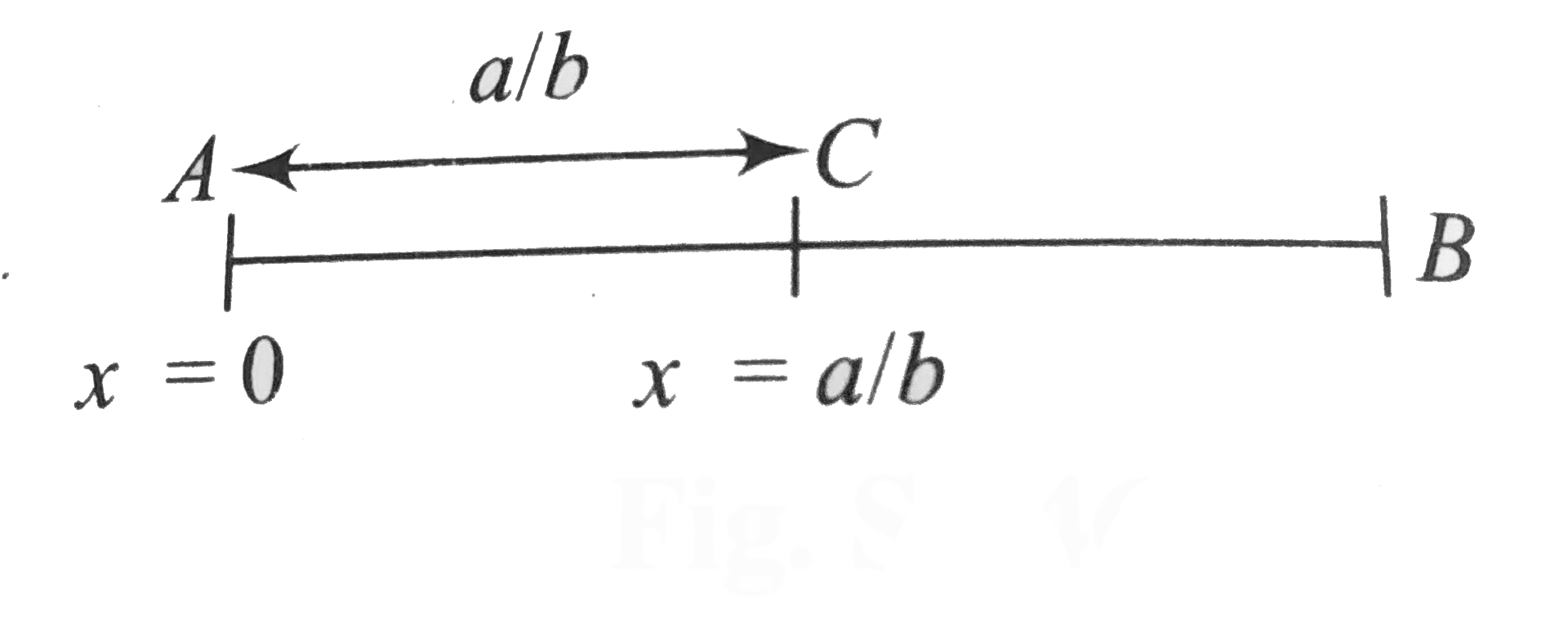
Therefore ditance between the two stations is `(2a)/(b)`. Alternate:`f=a-bx` means particle will do `SHM`. At mean position `f=0` `implies=(a)/(b)`
In the figure shown C is the mean position and A and B are extreme position Thus,
`x_(max)=(2a)/(b)` and `V_(max)=omegaA=sqrtb(a)/(b)=(a)/(sqrtb)`
Promotional Banner

Topper's Solved these Questions

  • LINEAR AND ANGULAR SIMPLE HARMONIC MOTION

    CENGAGE PHYSICS ENGLISH|Exercise Multiple Correct|35 Videos
  • LINEAR AND ANGULAR SIMPLE HARMONIC MOTION

    CENGAGE PHYSICS ENGLISH|Exercise Assertion Reasoning|6 Videos
  • LINEAR AND ANGULAR SIMPLE HARMONIC MOTION

    CENGAGE PHYSICS ENGLISH|Exercise Subjective|21 Videos
  • KINETIC THEORY OF GASES AND FIRST LAW OF THERMODYNAMICS

    CENGAGE PHYSICS ENGLISH|Exercise Interger|11 Videos
  • MISCELLANEOUS KINEMATICS

    CENGAGE PHYSICS ENGLISH|Exercise Interger type|3 Videos

Similar Questions

Explore conceptually related problems

A particle starts from point A moves along a straight line path with an acceleration given by a = p - qx where p, q are connected and x is distance from point A . The particle stops at point B. The maximum velocity of the particle is

A particle starts from rest. Its acceleration is varying with time as shown in the figure. When the particle comes to rest, its distance from its starting point is

The relation between time t and distance x is t = ax^(2)+ bx where a and b are constants. The acceleration is

A train takes 2 h to reach station B from station A, and then 3 h to return from station B to station A. The distance between the two stations is 200 km. Find : (i) the average speed, (ii) the average velocity of the train.

A particle starts from rest and moves with constant acceleration. Then velocity displacement curve is:

A body starts from rest and moves with a uniform acceleration. The ratio of the distance covered in the nth sec to the distance covered in n sec is

A particle starting from rest moves with constant acceleration. If it takes 5.0 s to reash the speed 18.0 km/h find a. the average velocity during this period, and b. the distance travelled by the particle during this period.

A body moves from rest with a constant acceleration. Which one of the following graphs represents the variation of its kinetic energy K with the distance travelled x?

A body moves from rest with a constant acceleration. Which one of the following graphs represents the variation of its kinetic energy K with the distance travelled x?

A bus starting from rest moves with a uniform acceleration of 0.1 m//s^(2) for 2 minutes. Find (a) the speed acquired, (b) the distance travelled.

CENGAGE PHYSICS ENGLISH-LINEAR AND ANGULAR SIMPLE HARMONIC MOTION-Single Correct
  1. A uniform stick of mass M and length L is pivoted its come its ends ar...

    Text Solution

    |

  2. A mass m is suspended from a spring of force constant k and just touch...

    Text Solution

    |

  3. A street car moves rectilinearly from station A to the next station B ...

    Text Solution

    |

  4. Two particles P and Q describes SHM of same amplitude a and frequency ...

    Text Solution

    |

  5. The velocity v of a particle of mass is moving along a straight line c...

    Text Solution

    |

  6. The osciallations represented by curve 1 in the graph are expressed by...

    Text Solution

    |

  7. Graph shows the x(t) curves for the three experiments involving a part...

    Text Solution

    |

  8. The acceleration of a particle is a = - 100x + 50. It is released from...

    Text Solution

    |

  9. In the above question, the speed of the particle at origin will be:

    Text Solution

    |

  10. A particle performs SHM of amplitude A along a straight line. When it ...

    Text Solution

    |

  11. A uniform pole length l = 2l, is laid on a smooth horizontal table as ...

    Text Solution

    |

  12. A small mass executes linear SHM about O with amplitude a and period T...

    Text Solution

    |

  13. The period of a particle executing SHM is 8 s . At t=0 it is at the me...

    Text Solution

    |

  14. A particle performs SHM with a period T and amplitude a. The mean velo...

    Text Solution

    |

  15. A graph of the square of the velocity against the square of the accele...

    Text Solution

    |

  16. A plank with a small block on top of it is under going vertical SHM. I...

    Text Solution

    |

  17. The potential energy of a harmonic oscillator of mass 2 kg in its mean...

    Text Solution

    |

  18. A spring mass system preforms S.H.M if the mass is doubled keeping amp...

    Text Solution

    |

  19. A particle of mass m moves in a one dimensional potential energy U(x)=...

    Text Solution

    |

  20. A particle of mass m moves in the potential energy U shoen above. The ...

    Text Solution

    |

