Home
Class 11
PHYSICS
Q. Statement I: Two cubical blocks of sa...


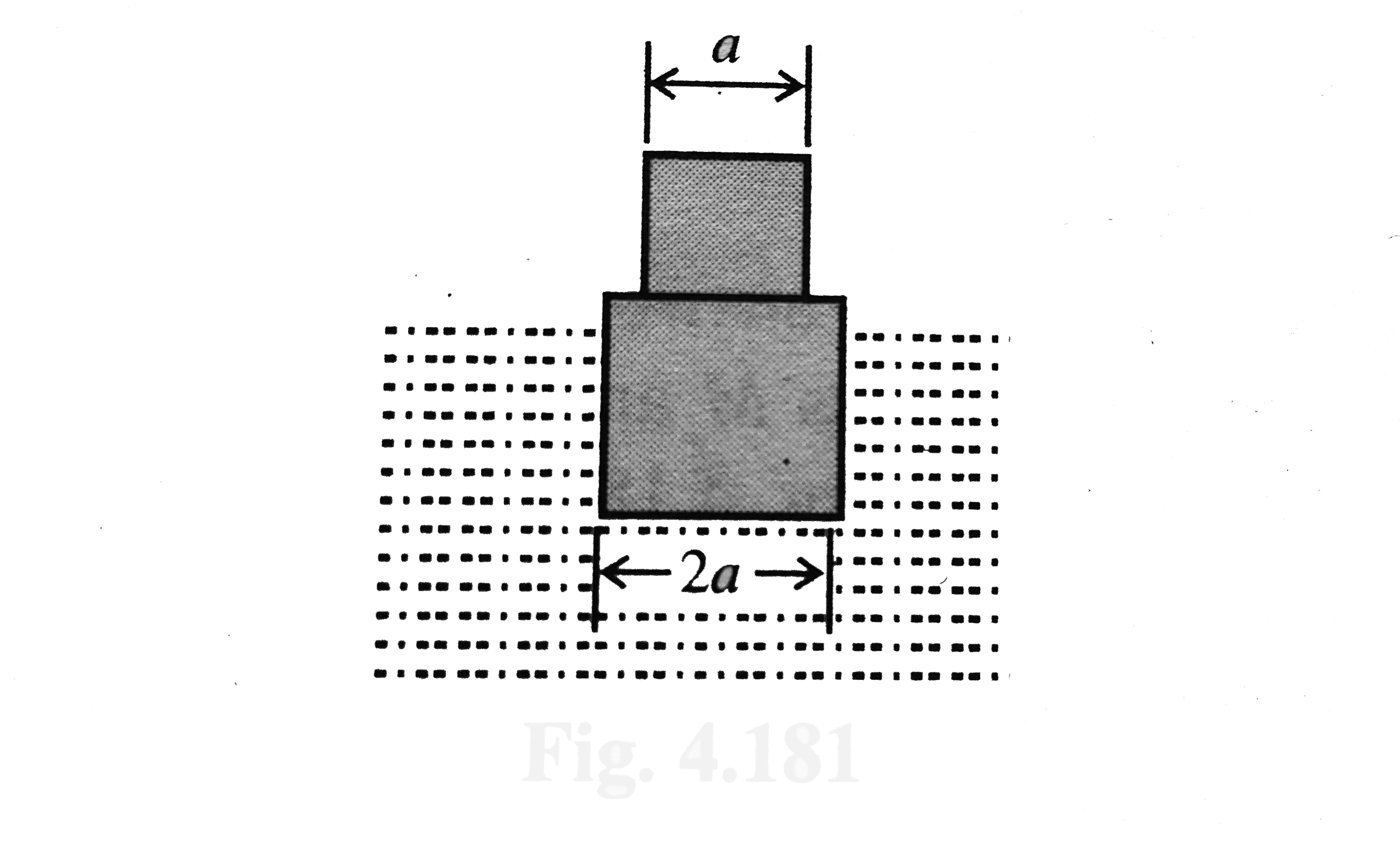
Q. Statement I: Two cubical blocks of same material and of sides a and 2a, respectively are attached rigidley and symmetrically to each other as shown. The system of two blocks is floating in water in such a way that upper surface of bigger blocks is just submerged in the water . If the system of blocks is displaced slightly in vertical directions, then the amplitude of oscillation on either side of equilibrium position would be different. Statement II: The force constant on two sides of equilibrium position in the above described situation is different.

A

Statement I is true statement II is true, Statement II is a correct explanation for Statement I.

B

Statement I is true statement II is true, Statement II is NOT a correct explanation for Statement I.

C

Statement I is true, Statement II is false

D

Statement I is false, Statement II is true

Text Solution

Verified by Experts

The correct Answer is:

A

Let us assume that density of material of cubes be `rho_0` and density of liquid be `rho`. Then from equilibrium condition `(8a^2+a^2)rho_0g=(8a^2)rhog`
`implies9rho_0=8rho`
When the block is displaced down by x, the restoring force is `F_1=(8a^3+a^3x)rhog-9a_0^3=rhoa^2gxx x` When the block is displaced by x above the mean position, the restoring force is
`F_2=9a^3rho_0g-(8a^3-4a^2x)rhog=4a^2rhogx`
As force constant on two sides of equilibrium position are not same, amplitudes of oscillations on the two sides are different.
Promotional Banner

Topper's Solved these Questions

  • LINEAR AND ANGULAR SIMPLE HARMONIC MOTION

    CENGAGE PHYSICS ENGLISH|Exercise Comprehension|33 Videos
  • LINEAR AND ANGULAR SIMPLE HARMONIC MOTION

    CENGAGE PHYSICS ENGLISH|Exercise Integer|10 Videos
  • LINEAR AND ANGULAR SIMPLE HARMONIC MOTION

    CENGAGE PHYSICS ENGLISH|Exercise Multiple Correct|35 Videos
  • KINETIC THEORY OF GASES AND FIRST LAW OF THERMODYNAMICS

    CENGAGE PHYSICS ENGLISH|Exercise Interger|11 Videos
  • MISCELLANEOUS KINEMATICS

    CENGAGE PHYSICS ENGLISH|Exercise Interger type|3 Videos

Similar Questions

Explore conceptually related problems

figure (a) and (b) represent spring- block system. If m is displacement slightly , find the time period of ascillation of the system.

Two cubical blocks identical in dimensions float in water in such a way that 1st block floats with half part immersed in water and second block floats with 3/4 of its volume inside the water. The ratio of densities of blocks is

A block of mass 1 kg is placed inside a car of mass 5 kg , as shown . The block can slide smoothly along horizontal direction. If block is displaced slightly and released , then time period of osciallation is

A wooden block is floating on water kept in a beaker. 40% of the block is above the water surface. Now the beaker is kept inside a lift that starts going upward with acceleration equal to g//2 . The block will then

A wooden block floats in water with two third of its volume submerged. A. Calculate the density of wood.b. When the same block is placed in oil, three - quarter of its volume in immersed in oil. Calculate the density of oil.

A cubical block of density rho is floating on the surface of water. Out of its height L, fraction x is submerged in water. The vessel is in an elevator accelerating upward with acceleration a. What is the fraction immersed ?

A block of wood is floating in water such that 1//2 of it is submerged in water when the same block is floated in alcohol, 1//3^(rd) of it's volume is submerged Now a mixture of water and alcohol is made taking equal volume of both and block is floated in it. What is the % of it's volume that is now submerged?

A block of wood is floating in water such that 1//2 of it is submerged in water when the same block is floated in alcohol, 1//3^(rd) of it's volume is submerged Now a mixture of water and alcohol is made taking equal volume of both and block is floated in it. What is the % of it's volume that is now submerged?

A cubical block of side 10 cm floats at the interface of an oil and water. The pressure above that of atmosphere at the lower face of the block is

A system is shown in the figure. The force The time period for small oscillations of the two blocks will be
