Home
Class 11
PHYSICS
A rod of mass m and length l hinged at o...


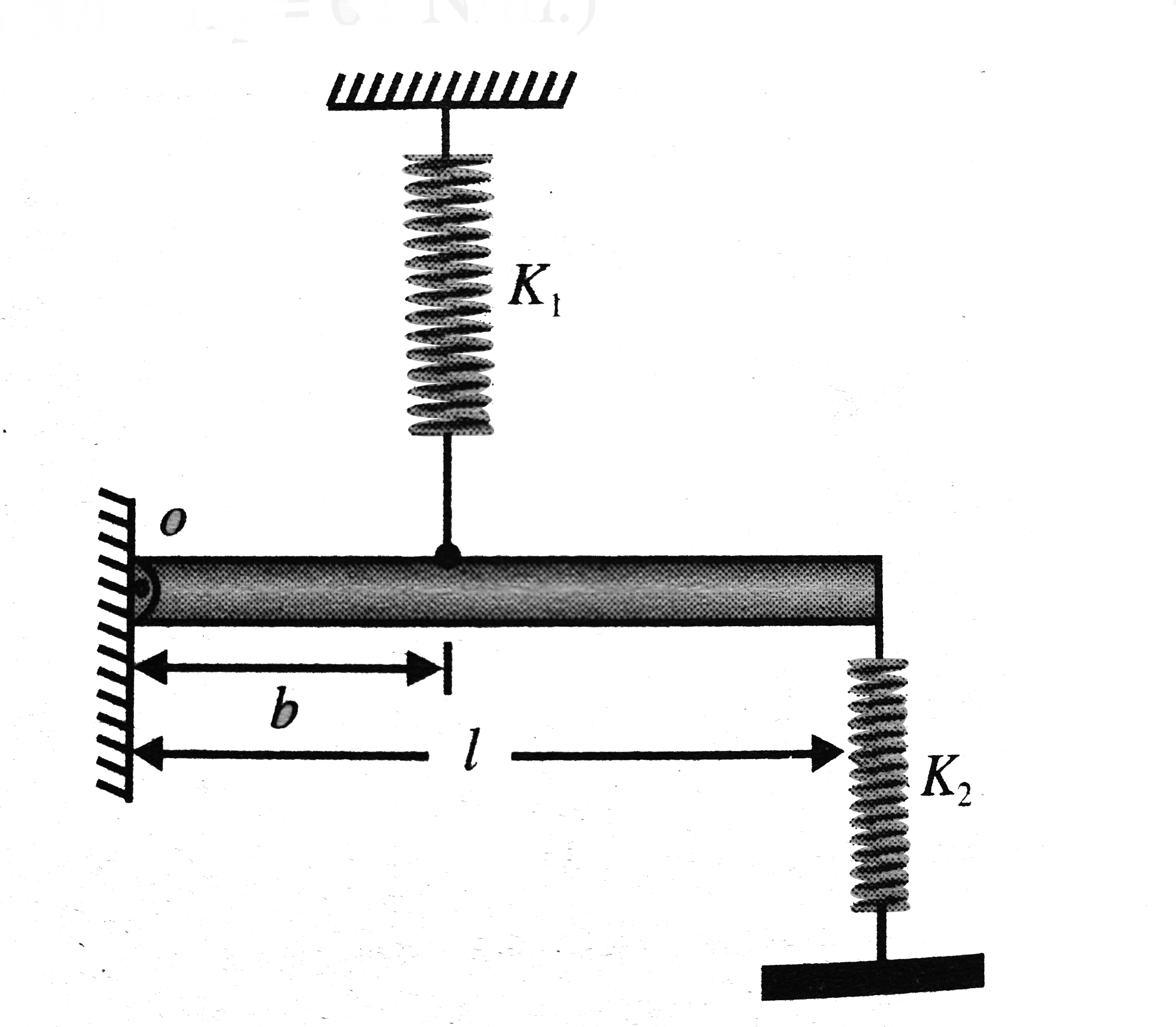
A rod of mass `m` and length `l` hinged at one end is connected by two springs of spring constant `k_1` and `k_2` so that it is horizontal at equilibrium What is the angular frequency of the system? (in `(rad)/(s)`) (Take `l=1m`,`b=(1)/(4)m`,`K_1=16(N)/(m)`,`K_2=61(N)/(m)`.

Text Solution

Verified by Experts
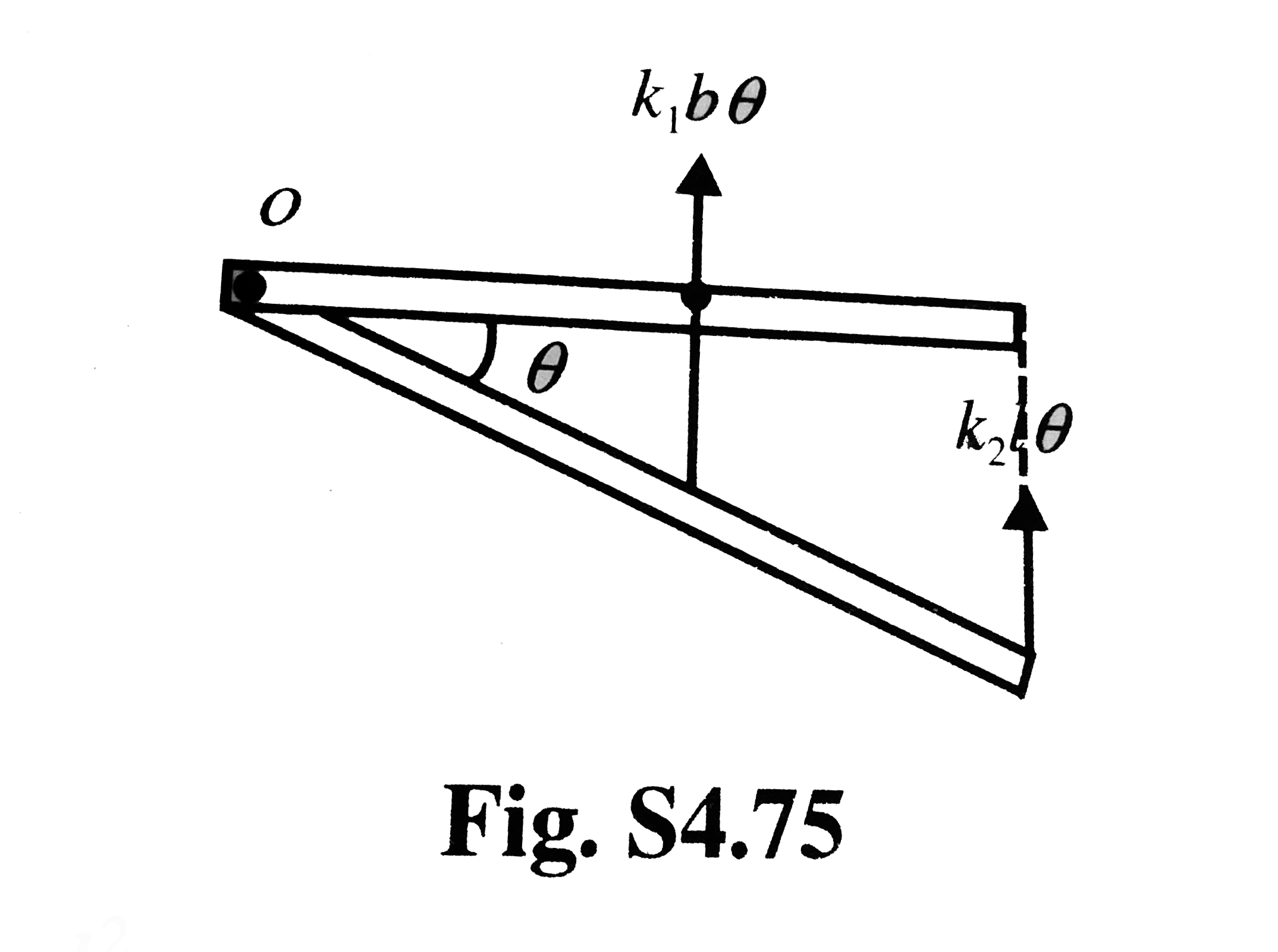

Applying torque equation about
`tau_0=l_0alpha`
`k_1bthetaxxcostheta+(k_2l_theta)/(theta)xxlcostheta=-(Id^2theta)/(dt^2)`
Here `I=(ml^2)/(3)`, and as `theta` is small `costheta=1`
`(ml^2d^2theta)/(3dt^2)+(k_1b^2+k_2l^2)theta=0`
Hence, `omega=sqrt((3k_1b^2+k_2l^2)/(ml))`
On substituting the values we get `omega=8(rad)/(s)`
Promotional Banner

Topper's Solved these Questions

  • LINEAR AND ANGULAR SIMPLE HARMONIC MOTION

    CENGAGE PHYSICS ENGLISH|Exercise Subjective type|2 Videos
  • LINEAR AND ANGULAR SIMPLE HARMONIC MOTION

    CENGAGE PHYSICS ENGLISH|Exercise Single correct Answer Type|29 Videos
  • LINEAR AND ANGULAR SIMPLE HARMONIC MOTION

    CENGAGE PHYSICS ENGLISH|Exercise Comprehension|33 Videos
  • KINETIC THEORY OF GASES AND FIRST LAW OF THERMODYNAMICS

    CENGAGE PHYSICS ENGLISH|Exercise Interger|11 Videos
  • MISCELLANEOUS KINEMATICS

    CENGAGE PHYSICS ENGLISH|Exercise Interger type|3 Videos

Similar Questions

Explore conceptually related problems

A rod of mass m and length l is connected by two spring of spring constants k_(1) and k_(2) , so that it is horizontal at equilibrium. What is the natural frequency of the system?

A horizontal rod of mass m and length L is pivoted at one end The rod's other end is supported by a spring of force constant k. The rod is displaced by a small angle theta from its horizontal equilibrium position and released. The angular frequency of the subsequent simple harmonic motion is

A disk of mass m is connected to two springs of stiffness k_(1) and k_(2) as shown in the figure. Find the angular frequency of the system for small oscillation. Disc can roll on the surface without slipping

A block of mass m suspended from a spring of spring constant k . Find the amplitude of S.H.M.

In the figure a uniform rod of mass 'm' and length 'l' is hinged at one end and the other end is connected to a light vertical of spring constant 'k' as shown in figure. The spring has extension such that rod is equilibrium when it is horizontal . The rod rotate about horizontal axis passing through end 'B' . Neglecting friction at the hinge find (a) extension in the spring (b) the force on the rod due to hinge.

A block of mass m is connected to another .block of mass M by a massless spring of spring constant k. A constant force f starts action as shown in figure, then:

Two masses m_(1) and m_(2) are suspended together by a massless spring of constant k. When the masses are in equilibrium, m_(1) is removed without disturbing the system. Then the angular frequency of oscillation of m_(2) is

A rod of length l and mass m , pivoted at one end, is held by a spring at its mid - point and a spring at far end. The spring have spring constant k . Find the frequency of small oscillations about the equilibrium position.

A horizontal rod of mass m=(3k)/(pi^2) kg and length L is pivoted at one end . The rod at the other end is supported by a spring of force constant k. The rod is displaced by a small angle theta from its horizontal equilibrium position and released . The time period (in second) of the subsequent simple harmonic motion is

As shown in the figure, two light springs of force constant k_(1) and k_(2) oscillate a block of mass m. Its effective force constant will be

