Home
Class 11
PHYSICS
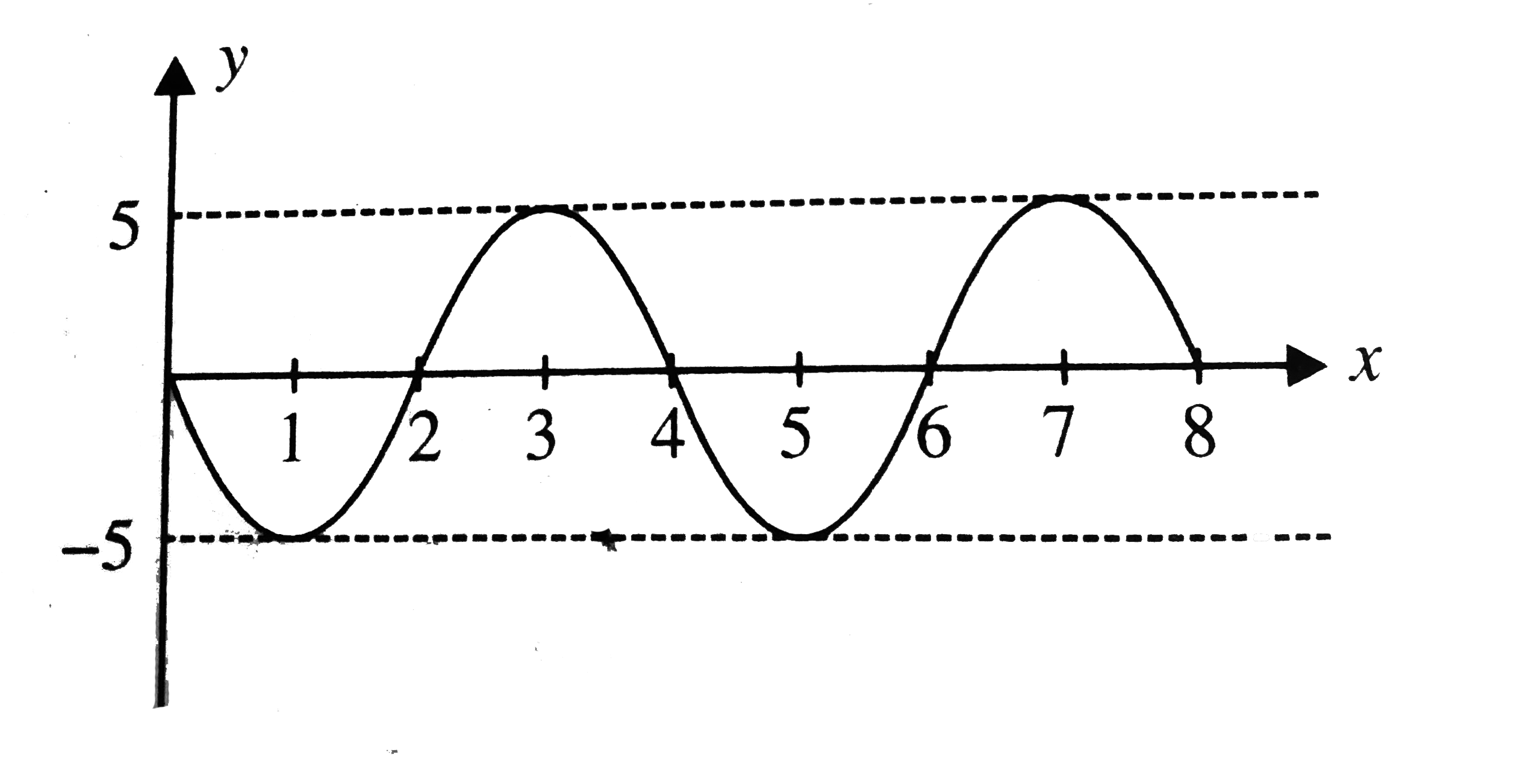
Shows the shape of a progressive wave at...

Shows the shape of a progressive wave at time `t=0`. after a time `t=(1)//(80)`, the particle at the origin has its maximum negative displacement.if the wave speed is `80` units maximum negative displacement. If the wave speed is `80` units, then find the equation of the progressive wave. .

Text Solution

Verified by Experts

The wavelength `lambda=4`
we know, `T=(lambda)/(v)=(4)/(80)=(1)/(20)`
Since after `t=(1)/(80)=(T)/(4)`,the particle at the origin is at its maximum negative, the entire wave pattern would have shifted by a distance of 1 unit `(lambda//4)` to the left.
The wave moves in the negative `x-`axis direction, from this we get `y=A sin[2pi((t)/(t)+(x)/(lambda))+phi]`
we have initially `y=0` for `t=0` and `x=0`
`phi=0,pi,2pi` etc.
Also, `y=-A,` when `t = T//4` and `x=0`
`:. -A=Asin[2pi((1)/(4))+phi]`
`rArr(pi)/(2)+phi=(3pi)/(2),(7pi)/(2)`etc.
or `phi=pi,3pi`,etc.
From Eqs. (i) and (ii), `phi=pi`
Hence `y=5 sin[2pi((t)/(1//20)+(x)/((4)))+pi]`
Promotional Banner

Topper's Solved these Questions

  • TRAVELLING WAVES

    CENGAGE PHYSICS ENGLISH|Exercise Example|9 Videos
  • TRAVELLING WAVES

    CENGAGE PHYSICS ENGLISH|Exercise Exercise 5.1|9 Videos
  • TRANSMISSION OF HEAT

    CENGAGE PHYSICS ENGLISH|Exercise Single correct|9 Videos
  • VECTORS

    CENGAGE PHYSICS ENGLISH|Exercise Exercise Multiple Correct|5 Videos

Similar Questions

Explore conceptually related problems

If the maximum speed of a particle on a travelling wave is v_(0) , then find the speed of a particle when the displacement is half of the maximum value.

The equation of a plane progressive wave is y=Asin(pit-(x)/(3)) . Find the value of A for which the wave speed is equal to the maximum particle speed.

The displacement of the particle at x = 0 of a stretched string carrying a wave in the positive x-direction is given by f(t)=Asin(t/T) . The wave speed is v. Write the wave equation.

A simple harmonic oscillator at the point x=0 genrates a wave on a rope. The oscillator operates at a frequency of 40.0 Hz and with an amplitude of 3.00 cm. the rope has a linear mass density of 50.0 g//m and is strectches with a tension of 5.00 N. (a) determine the speed of the wave. (b) find the wavelength. (c ) write the wave function y(x,t) for the wave, Assume that the oscillator has its maximum upward displacement at time t=0. (d) find the maximum transverse acceleration at time t=0. (d) find the maximum transverse of points on the rope. (e) in the discussion of transverse waves in this chapter, the force of gravity was ignored. is that a reasonable assumption for this wave? explain.

Snapshot of a string carrying a progressive wave is shown in figure at time t = 0. The wave moves along positive x - axis:

In a sinusoidal wave, the time required for a particular point to move from maximum displacement to zero displacement is 0.17 sec. The frequency of the wave is

Figure shows a plot of the transverse displacements of the particles of a string at t = 0 through which a travelling wave is passing in the positive x-direction. The wave speed is 20 cms^-1 . Find (a) the amplitude, (b) the wavelength, (c) the wave number and (d) the frequency of the wave. .

The equation of a progressive wave is y=0.02sin2pi[(t)/(0.01)-(x)/(0.30)] here x and y are in metres and t is in seconds. The velocity of propagation of the wave is

The displacement of A particle at x = 0 of a stretched string carrying a wave in the positive X-direction is given by f(t)=Ae^(-t^2) . The wave speed is V. Write equation of the wave.

The given figure shows the position of a medium particle at t=0, supporting a simple harmonic wave travelling either along or opposite to the positive x-axis. (a) write down the equation of the curve. (b) find the angle theta made by the tangent at point P with the x-axis. (c ) If the particle at P has a velocity v_(p) m//s , in the negative y-direction, as shown in figure, then determine the speed and direction of the wave. (d) find the frequency of the wave. (e) find the displacement equation of the particle at the origin as a function of time. (f) find the displacement equation of the wave.

