Home
Class 11
PHYSICS
One end of each of two identical springs...

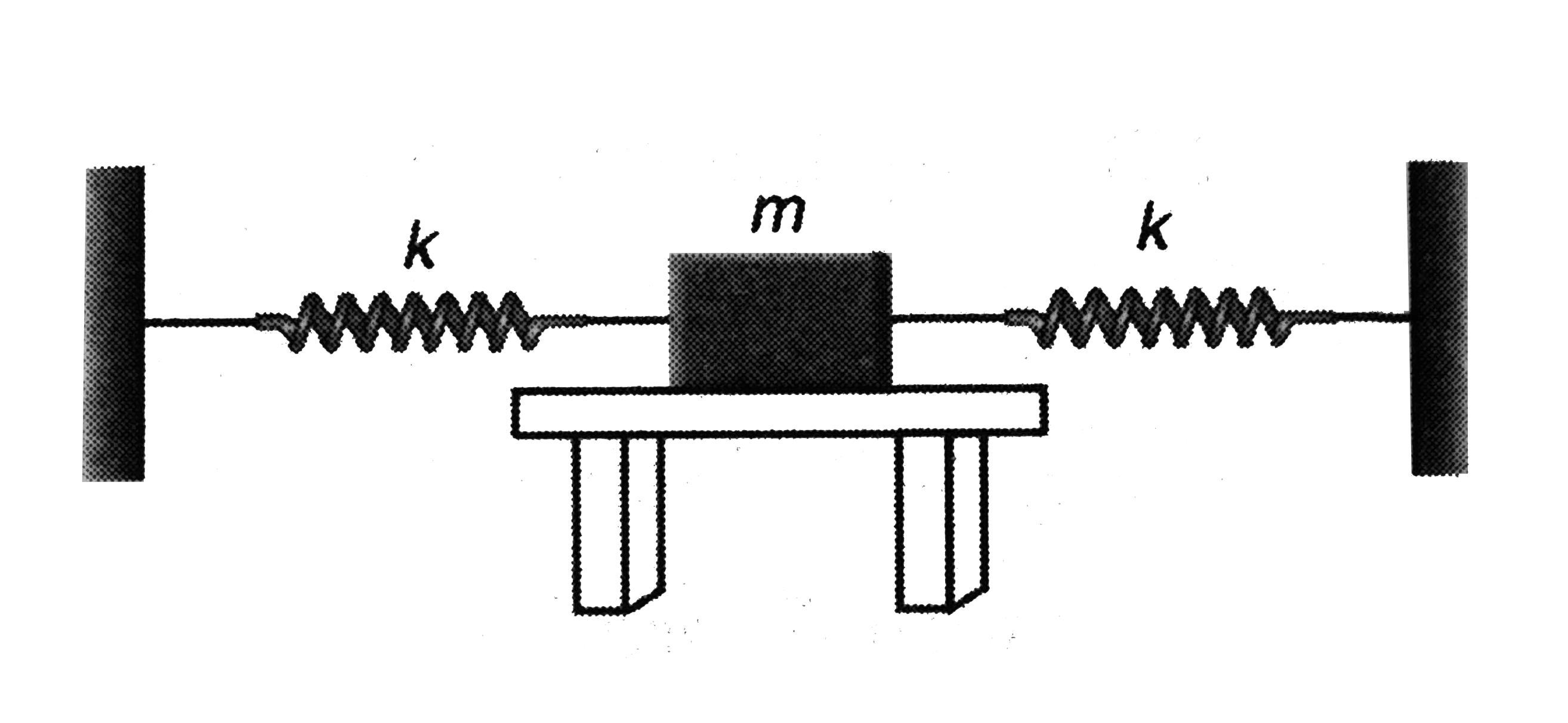
One end of each of two identical springs, each of force constant `0.5N//m` are attached on the opposite sides the a wooden block of mass `0.01kg`. The other ends of the spring are connected to separate rigid supports such that the springs are unstrtched and are collinear in a horizontal plane. To the wooden piece is fixed a pointer which touches a vertically moving plane paper. The wooden piece kept on a smooth horizontal table is now displaced by `0.02m` along the line of springs and released. If the speed of paper is `0.1m//s`, find the equation of the path traced by the pointer on the paper and the distance between two consecutive maximum on this path.

Text Solution

Verified by Experts

The effective force constant of the spring system is `2k` (since they constitute a parallel combination). The angular frequency of simple harmonic oscillation is
`omega sqrt(2k)/(m) sqrt(2xx0.5)/(0.010) 10 rad//s`
the amplitude` A=0.02 m`
The speed of the paper may be assumed as the speed of wave`-`propagators and the curve traced on the paper can be represented by the equation

`y omega A sin(omegat-kx)`..`(i)`
The wavelength
`lambda=(v)/(f)=(v)/(omega//2pi)=(2pi)/(omega)=(2pixx0.1)/(10)=(pi)/(50)m`..`(ii)`
`:.` `k=(2pi)/(lambda)=(omega)/(v)=(10)/(0.1)=100`
substituting the value in `(i)`, we get the required equation of the path
`y=A sinkx=0.02 sin (100x)`
Promotional Banner

Topper's Solved these Questions

  • TRAVELLING WAVES

    CENGAGE PHYSICS ENGLISH|Exercise Exercise 5.1|9 Videos
  • TRAVELLING WAVES

    CENGAGE PHYSICS ENGLISH|Exercise Exercise 5.2|23 Videos
  • TRAVELLING WAVES

    CENGAGE PHYSICS ENGLISH|Exercise Integer|9 Videos
  • TRANSMISSION OF HEAT

    CENGAGE PHYSICS ENGLISH|Exercise Single correct|9 Videos
  • VECTORS

    CENGAGE PHYSICS ENGLISH|Exercise Exercise Multiple Correct|5 Videos

Similar Questions

Explore conceptually related problems

Two identical springs of spring constant k are attached to a block of mass m and to fixed supports as shown in the figure. The time period of oscillation is

A spring with one end attached to a mass and the other to a right support is stretched and released

On a smooth inclined plane, a body of mass M is attached between two springs. The other ends of the springs are fixed to firm supports. If each spring has force constant K , the period of oscillation of the body (assuming the springs as massless) is

On a smooth inclined plane a body of mass M is attached between two springs. The other ends of the springs are fixed to firm supports. If each spring has a force constant k, the period of oscilation of the body is (assuming the spring as massless)

Tow identical springs of spring constant k are attached to a block of mass m and to fixed supports as shown in figure. When the mass is displaced from equilibrum position by a distance x towards right, find the restoring force.

A mass of 0.2 kg is attached to the lower end of a massless spring of force constant 200(N)/(m) the other end of which is fixed to a rigid support. Study the following statements.

Two blocks of masses 6 kg and 3 kg are attached to the two ends of a massless spring of spring constant 2 pi^(2) N//m . If spring is compressed and released on a smooth horizontal surface then find the time period (in seconds) of each block.

two light identical springs of spring constant K are attached horizontally at the two ends of a uniform horizontal rod AB of length l and mass m. the rod is pivoted at its centre 'o' and can rotate freely in horizontal plane . The other ends of the two springs are fixed to rigid supportss as shown in figure . the rod is gently pushed through a small angle and released , the frequency of resulting oscillation is :

In the figure, a block of mass m is rigidly attached to two identical springs of stiffness k each. The other ends of the springs are connected to the fixed wall. When the block is in equilibrium, length of each spring is b, which is greater than the natural length of the spring. The time period of the oscillation of the block if it is displaced by small distance perpendicular to the length of the springs and released. Space is gravity free.

One end of a spring of force constant k is fixed to a vertical wall and the other to a blcok of mass m resting on a smooth horizontal surface. There is another wall at distance x_(0) from the block. The spring is then compressed by 2x_(0) and released. The time taken to strike the wall is

