Home
Class 11
PHYSICS
The given figure shows the position of a...

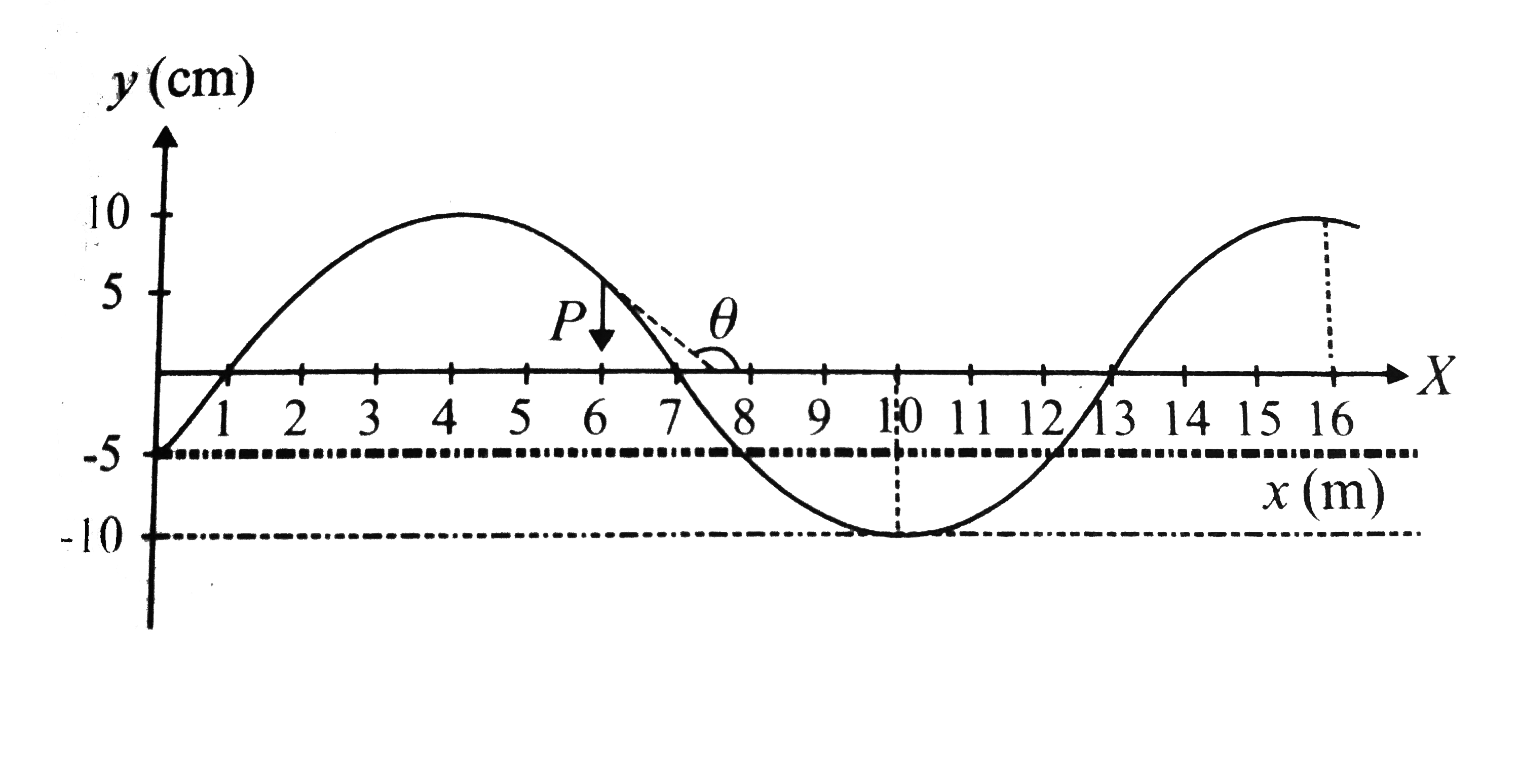
The given figure shows the position of a medium particle at t=0, supporting a simple harmonic wave travelling either along or opposite to the positive x-axis.

(a) write down the equation of the curve.
(b) find the angle `theta` made by the tangent at point P with the x-axis.
(c ) If the particle at P has a velocity `v_(p) m//s`, in the negative y-direction, as shown in figure, then determine the speed and direction of the wave.
(d) find the frequency of the wave.
(e) find the displacement equation of the particle at the origin as a function of time.
(f) find the displacement equation of the wave.

Text Solution

Verified by Experts

(a). From given curve: amplitude of the wave `A=10 cm` and wavelength `lambda=12 cm`
`y=A sin(kx+-omegat+phi)=A sin((2pi)/(lambda)x+-(2pi)/(T)t+phi)`….(i)
At `t=0, y=A sin(kx+phi)=10 sin(pi)/(6)x+phi)`
At `x=0, y=-5 cm=10 sin phi`
`sin phi=-(1)(2) impliesphi=-(pi)/(6)`
hence `y=0.10(m)sin(pi)/(6)x-(pi)/(6))`
(b). `tantheta =(dy)/(dx)=0.10xx(pi)(6) cos(pi)/(6)x-(pi)/(6))`
At `x=6 m`
`(dy)/(dx)tantheta=(pi)/(600cos(pi-(pi)/(6))=(pi)/(60)(-cos(pi)/(6))`
`=-(pi)/(60).sqrt(3)/(2)=(-pisqrt(3))/(120)`
`theta=tan^(-1)(-(pisqrt(3))/(120))`
(c ). nParticle velocity
`v_(p)=v(dy/dx)`
`-v_(p)=-v(-pisqrt(3))/(120))`
`v=(-120)/sqrt(3pi)v_(p)=(-40sqrt(3))/(pi)v_(p)` Along negative `x-`axis.
(d). wave velocity
`v=f lambda`
`impliesf=(v)/(lambda0=(40sqrt(3)v_(p))/(pixx12)`
`=(10sqrt(3))/(3pi)v_(p)s^(-1)`
(e). hence displacement equation of medium particle at origin at `x=0`, from eq... (ii)
`y=10(cm)sin[(20sqrt(3))/(3)v_(p)t-(pi)/(6)]`
(f). As wave is travelling towards negative x-directin hence positive sign should be used between kx and `omegat` in eq. ..(i)
The equation of the wave,
`y=0.1(m)sin[(pi)/(6)x(m)+omegat-(pi)/(6)]`
here `omega=2pi f=2pi(10sqrt(3))/(3pi)v_(p)=(20sqrt(3))/(3)v_(p)`
Hence displacement equation of the wave
`y=0.1(m)sin[(pi)/(6)x(m)+(20sqrt(3))/(3)v-(p)t-(pi)/(6)]`...(ii)
Promotional Banner

Topper's Solved these Questions

  • TRAVELLING WAVES

    CENGAGE PHYSICS ENGLISH|Exercise Single Correct|62 Videos
  • TRAVELLING WAVES

    CENGAGE PHYSICS ENGLISH|Exercise Single Correct Answer|1 Videos
  • TRAVELLING WAVES

    CENGAGE PHYSICS ENGLISH|Exercise Exercise 5.2|23 Videos
  • TRANSMISSION OF HEAT

    CENGAGE PHYSICS ENGLISH|Exercise Single correct|9 Videos
  • VECTORS

    CENGAGE PHYSICS ENGLISH|Exercise Exercise Multiple Correct|5 Videos

Similar Questions

Explore conceptually related problems

The equation of a wave travelling along the positive x-axis, as shown in figure at t = 0 is given by

the equation of a wave travelling along the positive x - axis ,as shown in figure at t = 0 is given by

The differential equation of a particle executing simple harmonic motion along y-axis is

in a sine wave ,postive of different particles at time t=0 is shown in figure. The equation for this wave if it is travelling along postive x -axis can beB

If the perpendicular distance of a point P from the X-axis is 5 units and the foot of the perpendicular lies on the negative direction of X-axis then the point P has

The position of a transverse wave travelling in medium along positive x-axis is shown in figure at time t=0. Speed of wave is v=200 m/s Equation of the wave is (in SI unit)

The position of a transverse wave travelling in medium along positive x-axis is shown in figure at time t=0. Speed of wave is v=200 m/s Frequency of the wave is

The sketch in the figure shows displacement time curve of a sinusoidal wave at x = 8m . Taking velocity of wave v = 6m//s along positive x- axis, write the equation the wave.

A particle moves in the x-y plane with a constant acceleration of 1.5m//s^(2) in the direction making an angle of 37^(@) with the x-axis. At t=0 the particle is at the origin and its velocity is 8.0m/s along the x- aixs . Find the velocity and the position of the particle at t = 4.0s.

The figure below is a representation of a simple harmonic progressive in the negative X-axis, at a given instant. The direction of the velocity of the particle at stage P in the figure is best represent by the arrow.
