Home
Class 11
PHYSICS
Which of the figures, shows the pressure...

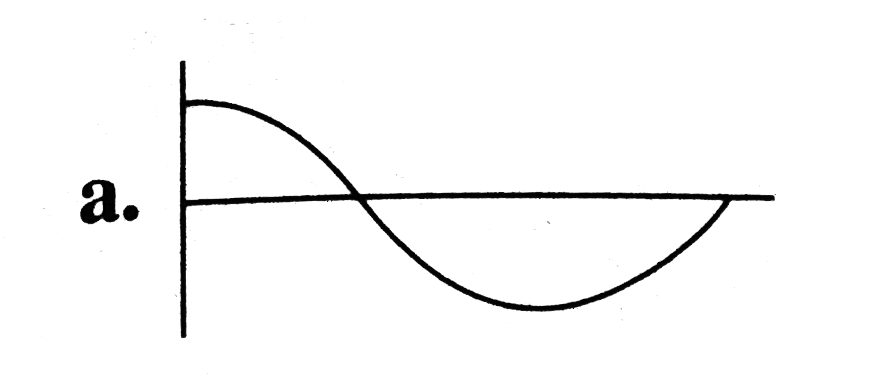
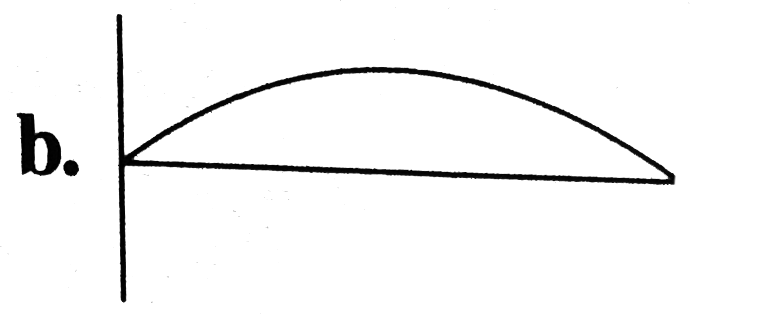
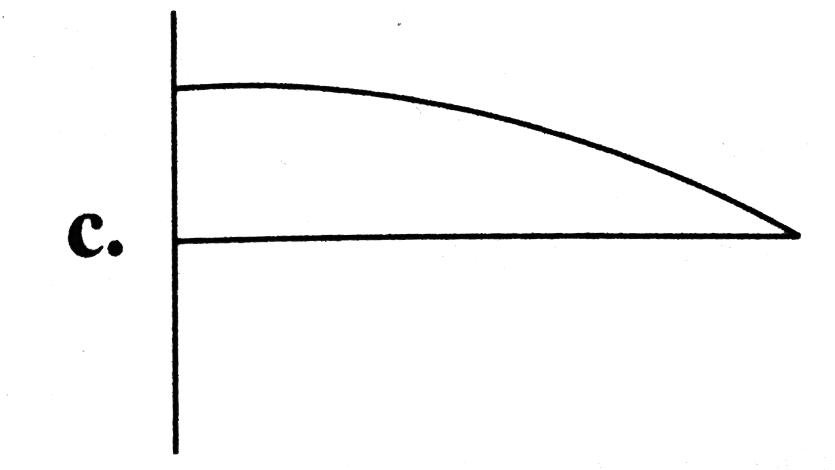
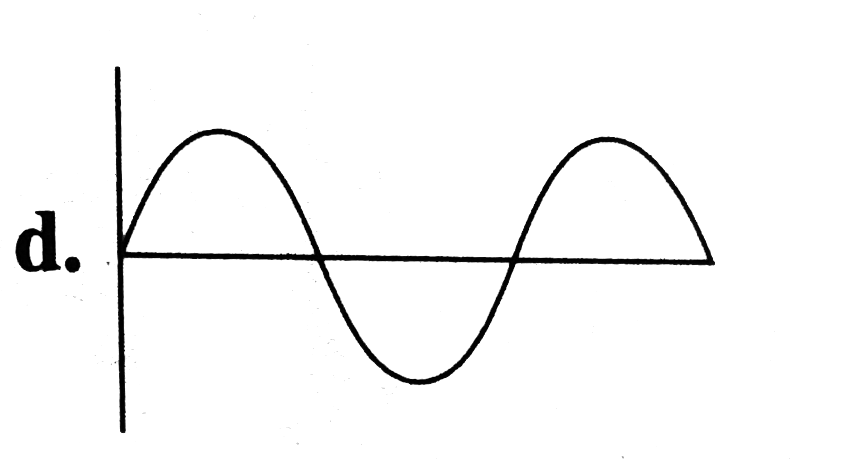
Which of the figures, shows the pressure difference from regular atmospheric pressure for an organ pipe of length `L` closed at one end, corresponds to the `1st` overtime for the pipe ?

A

B

C

D

Text Solution

AI Generated Solution

The correct Answer is:

To solve the problem of identifying which figure corresponds to the pressure difference from regular atmospheric pressure for an organ pipe of length \( L \) closed at one end, we need to understand the behavior of standing waves in such a pipe. ### Step-by-Step Solution: 1. **Understanding the Organ Pipe Configuration**: - An organ pipe closed at one end has one end (the closed end) acting as a displacement node (where the air does not move) and the other end (the open end) acting as a displacement antinode (where the air moves maximally). 2. **Identifying the Fundamental Frequency**: - The fundamental frequency (first harmonic) for a closed organ pipe has one node at the closed end and one antinode at the open end. This configuration creates a quarter wavelength (\( \frac{\lambda}{4} \)) in the length of the pipe \( L \). 3. **Understanding Overtones**: - The first overtone (second harmonic) for a closed organ pipe has one node at the closed end, one antinode at the open end, and an additional node and antinode in between. This results in three-quarters of a wavelength fitting in the length of the pipe, which can be represented as \( \frac{3\lambda}{4} \). 4. **Visualizing the Pressure Difference**: - In terms of pressure difference, the closed end corresponds to a pressure node (minimum pressure), while the open end corresponds to a pressure antinode (maximum pressure). For the first overtone, we will have a pattern that shows one node and two antinodes along the length of the pipe. 5. **Analyzing the Given Figures**: - We need to look for a figure that shows three quarter loops (or three pressure variations) along the length of the pipe. Each quarter loop corresponds to a change in pressure from maximum to minimum. 6. **Selecting the Correct Option**: - Among the options provided, we need to identify the figure that shows three quarter loops. This can be visualized as having one node at the closed end, one antinode at the open end, and one additional node and antinode in between. 7. **Conclusion**: - After analyzing the figures, we find that option (a) is the correct representation of the pressure difference for the first overtone in a closed organ pipe, as it shows three quarter loops. ### Final Answer: The correct figure that corresponds to the pressure difference from regular atmospheric pressure for an organ pipe of length \( L \) closed at one end, representing the first overtone, is option (a).

To solve the problem of identifying which figure corresponds to the pressure difference from regular atmospheric pressure for an organ pipe of length \( L \) closed at one end, we need to understand the behavior of standing waves in such a pipe. ### Step-by-Step Solution: 1. **Understanding the Organ Pipe Configuration**: - An organ pipe closed at one end has one end (the closed end) acting as a displacement node (where the air does not move) and the other end (the open end) acting as a displacement antinode (where the air moves maximally). 2. **Identifying the Fundamental Frequency**: ...
Promotional Banner

Topper's Solved these Questions

  • SUPERPOSITION AND STANDING WAVES

    CENGAGE PHYSICS ENGLISH|Exercise Multiple|26 Videos
  • SUPERPOSITION AND STANDING WAVES

    CENGAGE PHYSICS ENGLISH|Exercise Assertion - Reasoning|6 Videos
  • SUPERPOSITION AND STANDING WAVES

    CENGAGE PHYSICS ENGLISH|Exercise Subjective|24 Videos
  • SOUND WAVES AND DOPPLER EFFECT

    CENGAGE PHYSICS ENGLISH|Exercise Integer|16 Videos
  • THERMODYNAMICS

    CENGAGE PHYSICS ENGLISH|Exercise 24|1 Videos

Similar Questions

Explore conceptually related problems

In closed organ pipe at one end-

A closed organ pipe (closed at one end) is excited to support the third overtone. It is found that air in the pipe has

Show that an organ pipe of length 2l open at both ends has the same fundamental frequency as another pipe of length I closed at one end.

An open organ pipe of length L vibrates in its fundamental mode. The pressure variation is maximum

Velocity of sound in air is 320 m/s. For an organ pipe closed at one end of length 2 m the resonating frequency may be

An open organ pipe of length L vibrates in its second harmonic mode. The correct statement about the Pressure variation is

(a) Explain the formation of standing waves in an organ pipe closed at one end and discuss the various modes of vibration.

In closed organ pipe at one end…………….

The frequency of the 5th harmonic of a pipe closed at one end is 680 Hz. If the speed of the sound is 340 m/s then the length of the pipe will be

(A): A person hears maximum sound at displacement anti node (or) pressure node. (B) : Two organ pipes of same length open at both ends produce sound of different pitch if their radii are different. (C): If oil of density higher than water is filled in place of water in a resonance tube, its frequency remain unchanged.

CENGAGE PHYSICS ENGLISH-SUPERPOSITION AND STANDING WAVES-Single Correct
  1. A tunig fork whose frequency as given by mufacturer is 512 Hz is being...

    Text Solution

    |

  2. A sounding fork whose frequency is 256 Hz is held over an empty measur...

    Text Solution

    |

  3. A 40 cm long brass rod is dropped one end first onto a hard floor but ...

    Text Solution

    |

  4. A metal bar clamped at its centre resonates in its fundamental mode to...

    Text Solution

    |

  5. A string under a tension of 100 N , emitting its fundamental mode , gi...

    Text Solution

    |

  6. If a man at the equator would weight (3/5)th of his weight, the angula...

    Text Solution

    |

  7. A cylindrical tube, open at both ends, has a fundamental frequency, f,...

    Text Solution

    |

  8. A stiff wire is bent into a cylinder loop of diameter D. It is clamped...

    Text Solution

    |

  9. The ratio between masses of two planets is 3 : 5 and the ratio between...

    Text Solution

    |

  10. An air column closed at one end and opened at the other end , resonate...

    Text Solution

    |

  11. Two identical sonometer wires have a fundamental frequency of 500 Hz w...

    Text Solution

    |

  12. A long tube open at the top is fixed verticallly and water level insid...

    Text Solution

    |

  13. Two open pipes A and B are sounded together such that beats are heard ...

    Text Solution

    |

  14. S1 and S2 are two coherent sources of radiations separated by distance...

    Text Solution

    |

  15. A travelling wave y = A sin (k x - omega t + theta) passes from a hea...

    Text Solution

    |

  16. The diagram below shows two pulses traveling towards each other in a u...

    Text Solution

    |

  17. Which of the figures, shows the pressure difference from regular atmos...

    Text Solution

    |

  18. An ideal organ pipe resonates at successive frequencies of 50 Hz , 150...

    Text Solution

    |

  19. When a string is vibrating in a standing wave pattern , the power tran...

    Text Solution

    |

  20. Two pipes are submerged in sea water , arranged as shown in figure . P...

    Text Solution

    |
