Home
Class 12
PHYSICS
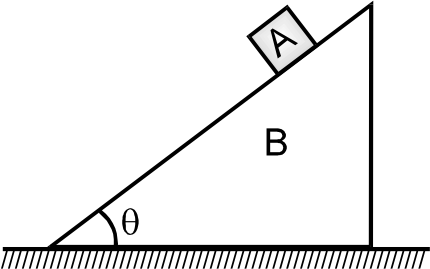
In the figure shown , A and B are free o...

In the figure shown , A and B are free of to move. All the surfaces are smooth. `(0 lt theta lt 90^(@))`

A

the accelration of A will be more than `gsintheta`

B

the acceleration of A will beless than `gsintheta`

C

normal force on A due to B will be more than `mgcostheta`

D

normal force on A due to B will be less than `mgcostheta`

Text Solution

Verified by Experts

The correct Answer is:
A, D


`ma_0sintheta+N=mgcostheta`
`impliesmgcostheta`
`impliesN=mgcostheta-ma_0sintheta`
`impliesNltmgcostheta`
Hence, (D) is true.
`ma_0costheta+mgsintheta=ma`
`impliesa=gsintheta+a_0costheta`
Hence, acceleration of A
`=sqrt((a-a_0costheta)^2+(a_0sintheta)^2)gtgsintheta`
Promotional Banner

Similar Questions

Explore conceptually related problems

In the figure shown A and B are free to move . All the surface are smooth. Mass of A is m . Then

Solve for theta ( 0 ^(@) lt theta lt 90^(@)) 2 cos 3 theta= 1

Solve sin 9 theta = sin theta, for 0^(@) lt theta lt 360^(@).

In the figure shown all the surface are smooth. All the blocks A,B and C are movable x-axis is horizontal and y-axis vertical as shown. Just after the system is relased from the position as shown.

In the figure shown all the surface are smooth. All the blocks A,B and C are movable x-axis is horizontal and y-axis vertical as shown. Just after the system is relased from the position as shown.

Two smooth wedges of equal mass m are placed as shown in figure. All surfaces are smooth. Find the velocities of A & B when A hits the ground.

Solve tan theta tan 4theta=1 for 0 lt theta lt pi .

In the shown figure, if all the surface are smooth and the two masses are allowed to move then center of mass of the system will move

The reflecting surface of two intersecting flat mirrors are at an angle theta (0^(@) lt theta lt 90^(@)) . As shown in Figure. For a light ray that strikes the horizontal mirror, the emerging ray intersects the incident ray at an angle beta . If one of the mirrors is rotated at (d theta)/(dt) = 1^(@)//s , then the angle beta changes aat the rate of

In the system shown in figure all surface are smooth.Rod is moved by external agent with acceleration 9 ms^(-2) vertically downwards.Force exerted on the rod by the wedge will be

