Home
Class 12
PHYSICS
Same spring is attached with 2kg , 3kg a...

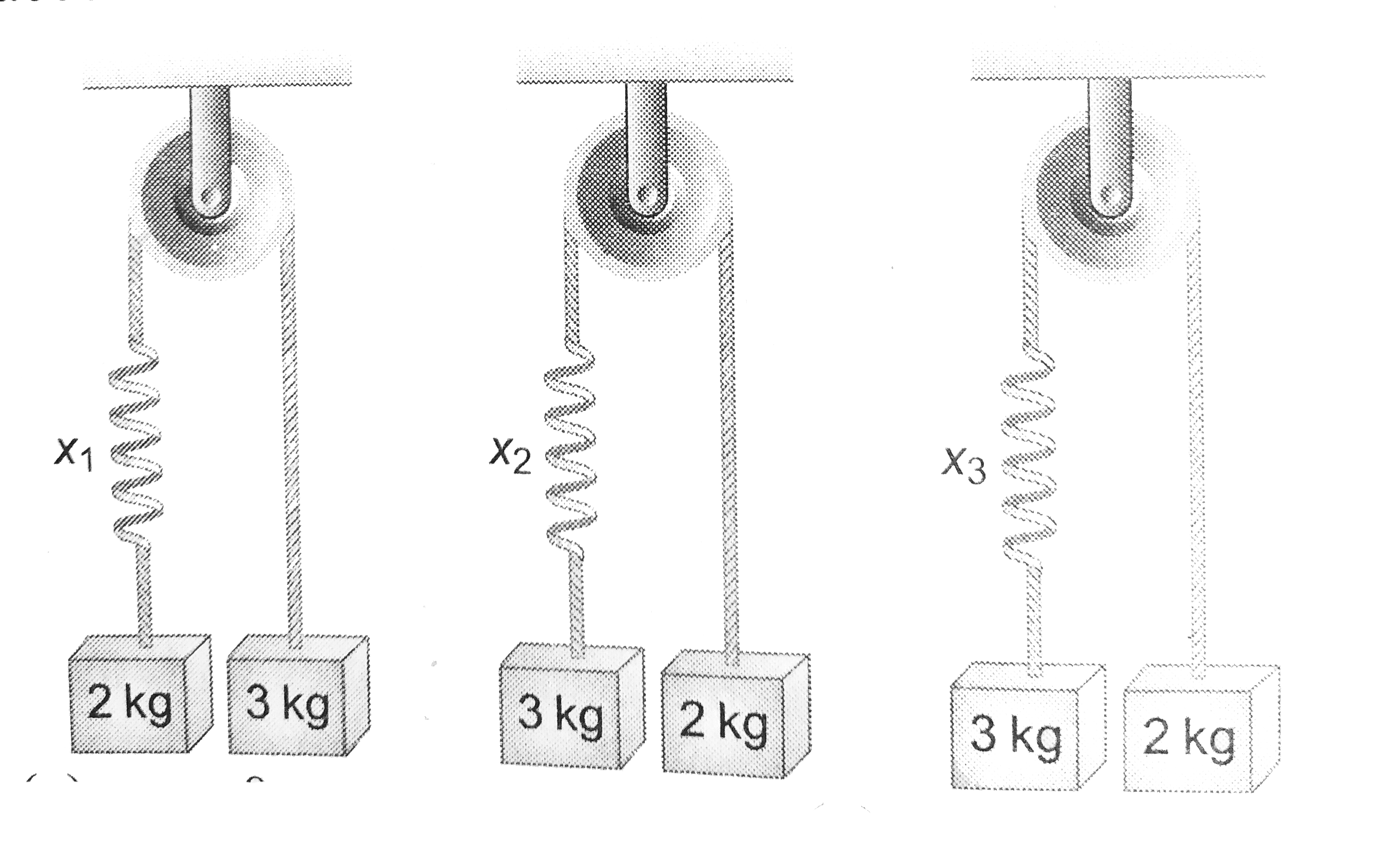
Same spring is attached with `2kg` , `3kg` and `1kg` blocks in three different cases as shown in figure. If `x_(1)` , `x_(2)` and `x_(3)` be the extensions in the spring in these cases then (Assume all the block s to move with uniform acceleration).

A

`x_1=0`,`x_3gtx_2`

B

`x_2gtx_1gtx_3`

C

`x_3gtx_1gtx_2`

D

`x_1gtx_2gtx_3`

Text Solution

Verified by Experts

The correct Answer is:

B

If `m_1` and `m_2` are masses of blocks, then tension T in the string as well as spring is
`T=(2m_1m_2)/(m_1+m_2)g`
`T_1=2g`,`T_2=2.4g` and `T_3=1.33g`
`T_2gtT_1gtT_3`
or `x_2gtx_1gtx_3`
Promotional Banner

Similar Questions

Explore conceptually related problems

From the fixed pulley, masses 2kg, 1kg and 3kg are suspended as shown in the figure. Find the extension in the spring if k=100 N//m . (Neglect oscillations due to spring)

In the arrangement shown in figure , find the ratio of tension in the strings attached with 4kg block and the with 1kg block

Three block of masses 1kg , 4 kg and 2 kg are placed on a smooth horizontal plane as shown in figure. Find (a) the acceleration of the system, (b) the normal force between 1kg block and 4 kg block, ( c) the net force on 2kg block

Consider the situation shown in figure. Calculate a. the acceleration of the 1.0 kg blocks, b. the tension in the strilng connecting the 1.0 kg blocks and c. the tension in the stting attached to 0.50 kg.

In each case m_(1) = 4 kg and m_(2) = 3 kg . If a_(1) and a_(2) and a_(3) are the respective acceleration of the block m_(1) in given situation, then

A block is attached with an ideal spring and string, and is in equilibrkum as shown in Figure. The acceleration of the block just after breaking the string is a_(1) and just after breaking the spring is a_(2) . Then

Three blocks are kept as shown in figure Acceleration of 20 kg block with respect to ground is

From the fixed pulley, masses 2 kg, 1 kg and 3 kg are suspended as shown is figure. Find the extension in the spring when acceleration of 3 kg and 1 kg is same if spring constant of the spring k = 100 N/m. (Take g = 10 ms^(-2) )

Two block of mass 4 kg and 5 kg attached a light spring are suspended by a string as shown in figure. Find acceleration of block 5 kg and 4 kg just after the string is cut.

In figure, a block A of mass 2kg is moving to the right with a speed 5m//s on a horizontal frictionless surface. Another block B of mass 3kg a massless spring of spring constant 222N//m attached to it, is moving to the left on the same surface and with a speed 2m//s . Let us take the direction to the right as the positive X- direction. At some instant, block A collides with the spring attached to block B . At some other instant , the spring has maximum compression and then, finally, blocks move with their final velocities. Assuming that (i) the spring force is conservative and so there is no conversion of kinetic energy to internal energy and (ii) , no sound is made when block A hits the spring, answer the following questions. When the blocks are yet to attain their final velocities, in this situation at any instant when block A is moving with a velocity 4 hat(i) m//s , velocity of block B will then be :
