Home
Class 12
PHYSICS
The coefficient of friction between the ...

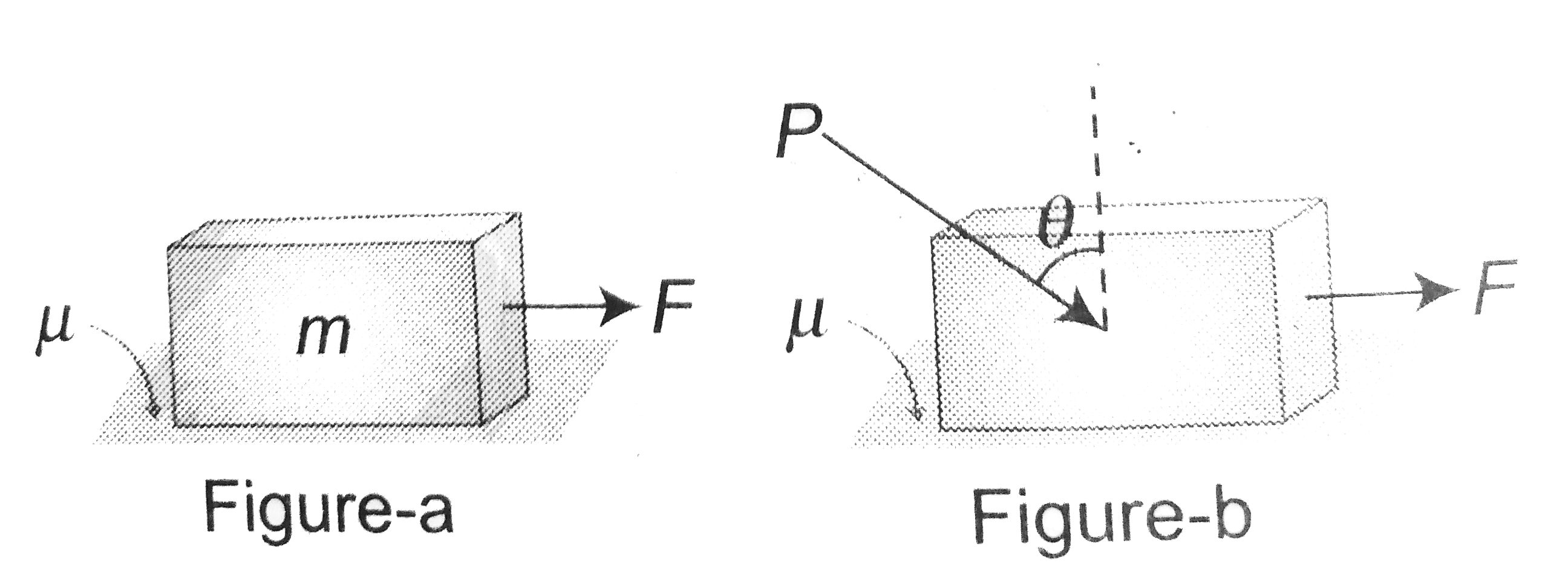
The coefficient of friction between the block and the horizontal surface is `mu`. The block moves toward right under action of horizontal force `F` (figure-a). Sometime later another force `P` is applied to the block making an angle theta (such that `tan theta`=`mu`) with vertical as shown in (figure-b). After application of force `P` , the acceleration of block shall.

A

increase

B

decrease

C

remain same

D

information insufficient to draw inference

Text Solution

Verified by Experts

The correct Answer is:
C


The free body diagram of block in fig. b is as shown.
`N=mg+Pcostheta`
and acceleration of block
`a=(F+P sintheta-mu(mg+Pcostheta))/(m)`
`a=(F+P sintheta-(sintheta)/(costheta)(mg+Pcostheta))/(m)=(F-mumg)/(m)`
Hence P does not change acceleration.
Promotional Banner

Similar Questions

Explore conceptually related problems

The coefficient of static friction between the two blocks shown in figure is mu and the table is smooth. What maximum horizontal forced F can be applied to he block of mass M so that the block move together?

The coefficient of static friction between the two blocks shown in figure is mu and the table is smooth. What maximum horizontal forced F can be applied to he block of mass M so that the block move together?

A horizontal force F is applied to a block of mass m on a smooth fixed inclined plane of inclination theta to the horizontal as shown in the figure. Resultant force on the block up the plane is:

A block of mass M is kept on as rough horizontal surface. The coefficient of static friction between the block and the surface is mu . The block is to be pulled by applying a force to it. What minimum force is needed to slide the block? In which direction should this force act?

The coefficient of static friction between a block of mass m and an incline is mu_s=0.3 , a. What can be the maximum angle theta of the incline with the horizontal so that the block does not slip on the plane? b. If the incline makes an angle theta/2 with the horizontal, find the frictional force on the block.

A block is kept on a rough horizontal surface as shown. Its mass is 2 kg and coefficient of friction between block and surface (mu)=0.5. A horizontal force F is acting on the block. When

A block of mass M is kept on as rough horizontal surface. The coefficient of static frictionbetween the block and the surface is mu . The block is to be pulled by applying a force to it. What minimum force is needed to slide the block? In which direction should this force act?

Two bodies A and B of masses 10 kg and 5 kg placed very slightly seperated as shown in figure The coefficient of friction between the floor and the block are as mu_(s) = 0.4 block A is pushed by an external force F The value of F can be changed when the weight between block A and ground breaks block A will start pressing block B will start pressing the vertical wall The force of friction acting on B verius with the applied force F acceleration to curve

A block placed on a horizontal surface is being pushed by a force F making an angle theta with the vertical. If the friction coefficient is mu . How much force is needed to get the block just started. Discuss the situation when tan thetaltmu .

