Home
Class 12
PHYSICS
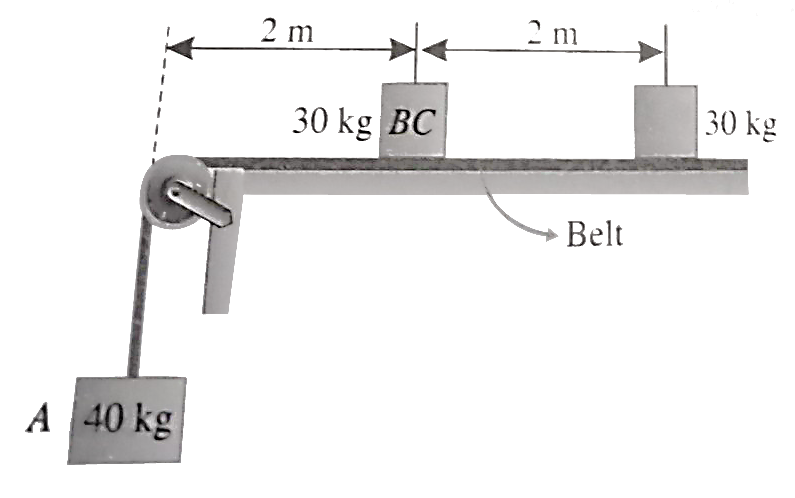
Two 30 kg blocks rest on a massless belt...


Two 30 kg blocks rest on a massless belt which passes over a fixed pulley and is attached to a 40 kg block. If coefficient of friction between the belt and the table as well as between the belt and the blocks B and C is `mu` and the system is released from rest from the position shown, the speed with which the block B falls off the belt is

A

`2sqrt2(m)/(s)` if `mu=0.2`

B

`sqrt2(m)/(s)` if `mu=0.2`

C

`2(m)/(s)` if `mu=0.5`

D

`2.5(m)/(s)` if `mu=0.5`

Text Solution

Verified by Experts

The correct Answer is:
A, C


Maximum possible acceleration of block will be `=mug`
(i) When `mu=0.2` maximum acceleration possible so that blocks does not slip is `2(m)/(s^2)`. Now acceleration of system assuming blocks don't slip is
As `3.8gt2` hence the assumption is wrong and blocks slip on the belt.
Maximum force applicable on block B is `mumg`
Acceleration of block`=2(m)/(s^2)`
Hence velocity of B when it strikes pulley is `V^2=0^2+2xx2xx2`
`V^2=8`
`V=2sqrt2(m)/(s)`
Hence (a).
(ii) When `mu=0.5` maximum acceleration possible so the block dows not slip is `5(m)/(s^2)`
Now acceleration of system assuming blocks don't slip is
`a=(40g-2mumg)/(100)=1(m)/(s^2)`
`mu=0.5`
as `1lt5` hence, blocks do not slip and acceleration of block B is `1(m)/(s^2)`
hence velocity of B when it strikes pulley is
`V^2=0^2+2.1.2`
`V^2=4`
`V=2(m)/(s)`
Hence (c).
Promotional Banner

Similar Questions

Explore conceptually related problems

Two blocks A & B are connected by a light inextensible string passing over a fixed smooth pulley as shown in the figure. The coefficient of friction between the block A and the horizontal table is mu=0.2 . If the block A is just to slip, find the ratio of the masses of the blocks.

Consider the system shown in fig. the system is released from rest, find the tension in the cord connected between 1kg and 2 kg blocks.

Consider the system shown in fig. the system os released from rest, find the tension in the cord connected between 1kg and 2 kg blocks.

Consider the system shown in the figure. Coefficient of friction between the block and table is mu=0.5. The system is released from rest. Find the work done by friction, when the speed of block is 10 m/s (m=1kg)

A block rests on a rough inclined plane making an angle of 30^@ with the horizontal. The coefficient of static friction between the block and the plane is 0.8. If the frictional force on the block is 10N, the mass of the block (in kg) is

A block of mass 2kg rests on a rough inclined plane making an angle of 30^@ with the horizontal. The coefficient of static friction between the block and the plane is 0.7. The frictional force on the block is

A block of mass 2kg rests on a rough inclined plane making an angle of 30^@ with the horizontal. The coefficient of static friction between the block and the plane is 0.7. The frictional force on the block is

A block of mass 3 kg rests on a rough inclined plane making an angle of 30^(@) . With the horizontal. The coefficient of static friction between the block and the plane is 0.7. The frictional force on the block is

Block A of mass m and block B of mass 2m are placed on a fixed triangular wedge by means of a light and inextensible string and a frictionless pulley as shown in fig . The wedge is inclined at 45^(@) to the horizontal on both sides . The coefficient of friction between the block A and the wedge is 2//3 and that between the block B and the wedge is 1//3 .If the system of A and B is released from rest then find . a. the acceleration of A b. tension in the string c.the magnitude and direction of the frictional force acting on A

The block A in the given figure is of mass 10sqrt(3) kg The coefficient of friction between the block and the surface on which it rests is 0.5. Find maximum mass of block B possible such that the system will be in equilibrium is.

