Home
Class 12
PHYSICS
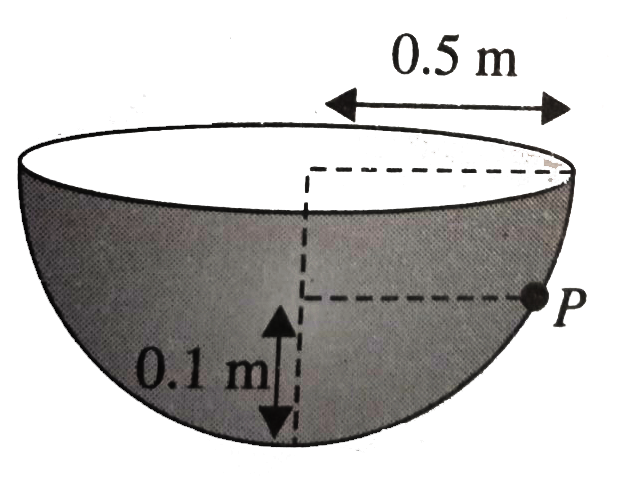
A small mass of 10 g lies in a hemispher...


A small mass of 10 g lies in a hemispherical bowl of radius 0.5 m at a height of 0.1 m from the bottom of the bowl. The mass will be in equilibrius if the bowl rotates at an

A

`(10)/(sqrt3)(rad)/(s)`

B

`10sqrt3(rad)/(s)`

C

`5(rad)/(s)`

D

none of these

Text Solution

Verified by Experts

The correct Answer is:
C


`Nsintheta=mromega^2`
`tantheta=(romega^2)/(g)`
`omega=sqrt((g tantheta)/(r ))`
`omega=5(rad)/(s)`
Promotional Banner

Similar Questions

Explore conceptually related problems

How many litres of milk can a hemispherical bowl of diameter 10.5 cm hold?

A hemispherical bowl is made of steel 0.5 cm thick. The inside radius of the bowl is 4cm.

A hemispherical bowl has a radius of 3.5 cm. What would be the volume of water it would contain?

A small ball of radius r rolls without sliding in a big hemispherical bowl. of radius R. what would be the ratio of the translational and rotaional kinetic energies at the bottom of the bowl.

Two identical small balls each have a mass m and charge q. When placed in a hemispherical bowl of radius R with frictionless, nonconductive walls, the bead move, and at equilibrium the line joining the balls is horizontal and the distance between them is R (see figure). Neglect any induced charge on the hemispherical bowl. Then the charge on each bead is : (here K=(1)/(4piepsilon_(0)) )

A hemispherical bowl is made of steel 0.5 cm thick. The inside radius of the bowl is 4cm. find volume of steel

A circuilar disc of radius 'R' is placed co-axially and horizontally inside and opaque hemispherical bowl of radius 'a', Fig. The far edge of the disc is just visible when viewed from the edge of the bowl. The bowl is filled with transparent liquid of refractive index mu and the near edge of the dise becomes just visible. How far below the top of the bowl is the disc placed ? .

Two identical beads each have a mass m and charge q. When placed in a hemispherical bowl of radius R with frictionless, non-conducting walls, the beads move, and at equilibrium they area distance R apart (figure). Determine the charge on each bead.

A hemispherical bowl is made of steel, 0.25 cm thick. The inner radius of the bowl is 5 cm. Find the outer curved surface area of the bowl.

A hemispherical bowl is made of steel, 0.25 cm thick. The inner radius of the bowl is 5 cm. Find the outer curved surface area of the bowl.

