Home
Class 12
PHYSICS
A toy car of mass 5 kg moves up a ramp u...


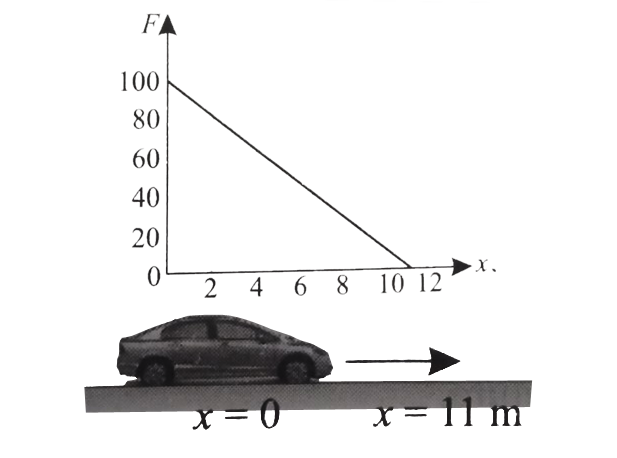
A toy car of mass 5 kg moves up a ramp under the influence of force F plotted against displacement x. The maximum height attained is given by

A

`v_(max)=20M`

B

`v_(max)=15M`

C

`v_(max)=11M`

D

`v_(max)=5M`

Text Solution

Verified by Experts

The correct Answer is:

C

Work done `=` Gain in potential energy
Area under curve `=mgh`
`implies(1)/(2)xx11xx100=5xx10xxh`
`impliesh=11m`
Promotional Banner

Similar Questions

Explore conceptually related problems

A particle of mass m moves from rest under the action of a constant force F which acts for two seconds. The maximum power attained is

A particle of mass m moves on positive x-axis under the influence of force acting towards the origin given by -kx^2 hat i. If the particle starts from rest at x=a, the speed it will attain when it crosses the origin is

A particle of mass m moves on the x-axis under the influence of a force of attraction towards the origin O given by F=-(k)/(x^(2))hat(i) . If the particle starts from rest at x = a. The speed of it will attain to reach at distance x from the origin O will be

A body of mass 0.01 kg executes simple harmonic motion about x = 0 under the influence of a force as shown in figure. The time period of SHM is

A body of mass 2 kg is moving under the influence of a central force whose potential energy is given by U = 2r^(3) J . If the body is moving in a circular orbit of 5 m , its energy will be a) 625 J b) 250 J c) 500 J d) 125 J

A stationary particle of mass m=1.5kg is acted upon by a variable force. The variation of force with respect to displacement is plotted in figure. a. Calculate the velocity acquired by the particle after getting displaced through 6m . b. What is the maximum speed attained by the particle and at what time is it attained?

A particle of mass 1kg moves from rest along a straight line due to acition of a force F which varies with the displacement x as shown in graph - ( Use (1)/(sqrt(2))=0.8 if needed )

A body of mass 0.01 kg executes simple harmonic motion (SHM) about x=0 under the influence of a force shown in the figure. The period of the SHM is

A particle of mass m starts moving from origin along a horizontal x-y plane under the influence of a force of constant magnitude F ( which is always parallel to the x-axis ) and a constraint force. The trajectory of its motion is f ( x) = ( x)/( x^(2) + 1) . Then,

A body of mass 5kg moves under a force of 10hati+10hatj-20hatk . What is the acceleration produced?
