Home
Class 12
PHYSICS
The force acting on a body moving along ...

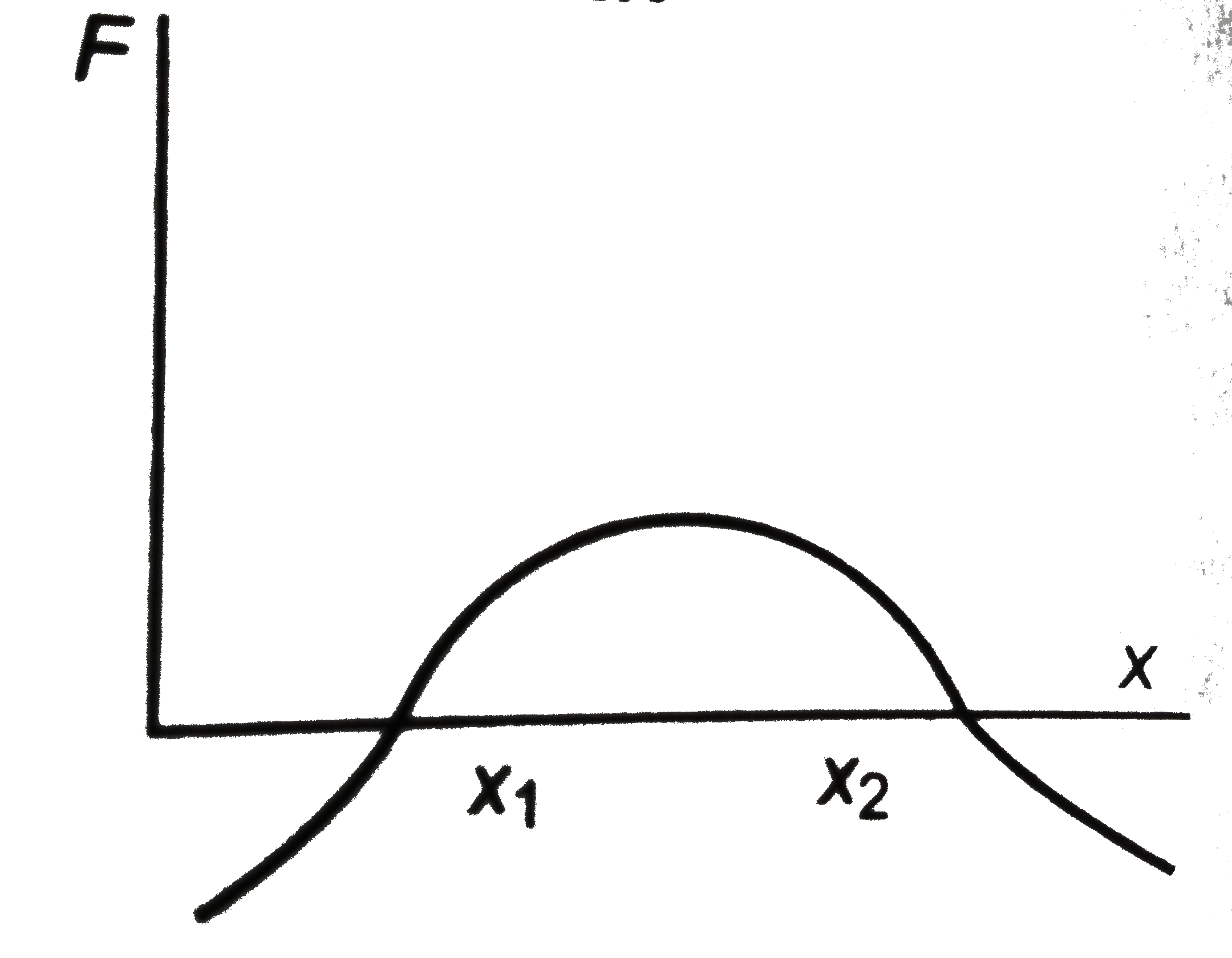
The force acting on a body moving along x-axis variation of the particle particle shown in the figure. The body is in stable equilibrium at
.

A

`x=x_1`

B

`x=x_2`

C

both `x_1` and `x_2`

D

neither `x_1` nor `x_2`

Text Solution

Verified by Experts

The correct Answer is:

B

When particle moves aways from the origin then at position `x=x_1` force is zero and at `xgtx_1`, force is positive (repulsive in nature) so particle moves further and does not return back to original position. i.e. the equilibrium is not stable. Similarly at position `x=x_2` force is zero and at `xgtx_2`, force is negative (attractive in nature) So particle returns back to original position i.e. The equilibrium is stable.
Promotional Banner

Similar Questions

Explore conceptually related problems

The force acting on a body moving along x -axis varies with the position of the particle as shown in the fig. The body is in stable equilibrium at.

The variation of force F acting on a body moving along x - axis varies with its position (x) as shown in figure The body is in stable equilibrium stable at

The variation of potential energy U of a body moving along x - axis varies with its position (x) as shown in figure The body is in equilibrium state at

The kinetic energy of a body moving along a straight line varies with time as shown in figure. The force acting on the body:

The magnitude of force acting on a particle moving along x-axis varies with time (t) as shown in figure. If at t = 0 the velocity of particle is v_(0) , then its velocity at t=T_(0) will be

If v is the velocity of a body moving along x-axis, then acceleration of body is

The net force acting on a particle moving along a straight line varies with time as shown in the diagram. Force is parallel to velocity. Which of the following graph is best representative of its speed with time? (Initial velocity of the particle is zero)

The rate of doing work by force acting on a particle moving along x-axis depends on position x of particle and is equal to 2x. The velocity of particle is given by expression :-

A time varying force, F=2t is acting on a particle of mass 2kg moving along x-axis. velocity of the particle is 4m//s along negative x-axis at time t=0 . Find the velocity of the particle at the end of 4s.

The speed - time graph for a body moving along a straight line is shown in figure. The average acceleration of body may be
