Home
Class 12
PHYSICS
In figure, the variation of potential en...

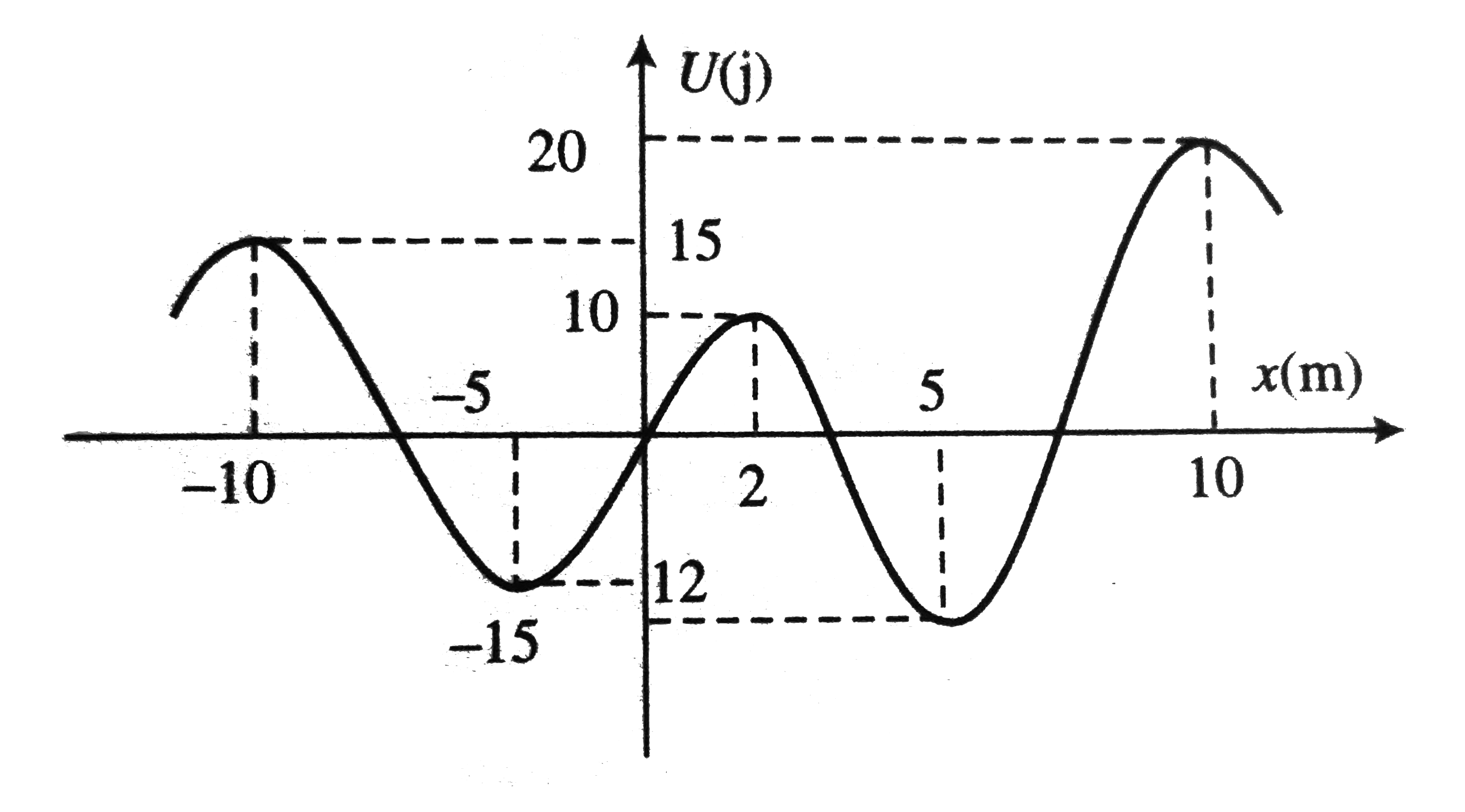
In figure, the variation of potential energy of a particle of mass `m=2kg` is represented w.r.t its x-coordinate. The particle moves under the effect of the conservative force along the x-axis. Which of the following statements is incorrect about the particle?

A

If it is released at the origin it will move in negative x-axis

B

If it is released at `x=2+triangle` where `trianglerarr0` then its maximum speed will be `5(m)/(s)` and it will perform oscillatory motion

C

If initially `x=-10m` and `vecu=sqrt(6)hati(m)/(s)` then it will cross `x=10m`

D

`x=-5m` and `x=+5` m are unstable equilibrium positions of the particle.

Text Solution

Verified by Experts

The correct Answer is:

A, B, C

If the particle is released at the origin, it will try to go in the direction of force. Here `(du)/(dx)` is positive and hence force is negative, as a result it will move towards`-ve`x-axis.
When the particle is released at `x=2+triangle`, it will reach the point of least possible potential energy `(-15J)` where it will have maximum kinetic energy.
`(1)/(2)mv_(max)^2=25impliesv_(max)=5(m)/(s)`
The particle will now perform oscillatory motion between `-15JleUle15J`, because reaching `U=+15J`, the kinetic energy and hence speed becomes zero.
`-15JleUle15J`,`U=+15J`,
In (C ), `E_i=U_i+k_i=15+6=21J`
At `x=10m` , `U_f=20JimpliesK_f=1Jne0impliesx=10m`
`implies` the particle cross `x=10m`.
Promotional Banner

Topper's Solved these Questions

  • CENGAGE PHYSICS DPP

    CENGAGE PHYSICS ENGLISH|Exercise Single Correct Answer type|491 Videos
  • CENGAGE PHYSICS DPP

    CENGAGE PHYSICS ENGLISH|Exercise subjective type|51 Videos
  • CENGAGE PHYSICS DPP

    CENGAGE PHYSICS ENGLISH|Exercise Comprehension Type|31 Videos
  • CAPACITOR AND CAPACITANCE

    CENGAGE PHYSICS ENGLISH|Exercise Integer|5 Videos
  • COULOMB LAW AND ELECTRIC FIELD

    CENGAGE PHYSICS ENGLISH|Exercise Single Answer Correct Type|22 Videos

Similar Questions

Explore conceptually related problems

The variation of potential energy of a particle of mass m = 5kg to its x-coordinate . The particle moves under the effect of this conservative force only along the x-axis. Then, choose the correct option.

In the figure the variation of potential energy of a particle of mass m = 2kg is represented w.r.t. its x-coordinate. The particle moves under the effect of this conservative force along the x-axis. x = - 5m and x = 10 m position of the particle are respectively of

In the figure, the variation of potential energy of a particle of mass m = 2kg is represented with respect to its x-coordinate. The particle moves under the effect of this conservative force along the X-axis. If the particle is released at the origin, then (A)it will move towards positive x-axis (B)it will move towards negative x-axis (C)it will remain stationary at the origin (D)Either of (a) or (b)

In the figure, the variation of potential energy of a particle of mass m = 2kg is represented with respect to its x-coordinate. The particle moves under the effect of this conservative force along the X-axis. If the particle is released at x = 2 + Delta where Delta rarr 0 (it is positive), then its maximum speed in subsequent motion will be

Figure shows a plot of the potential energy as a function of x for a particle moving along the x-axis. Which of the following statement(s) is/are true?

Figure shows a plot of the potential energy as a function of x for a particle moving along the x-axis. Which of the following statement(s) is/are true?

A particle moves along x-axis as x=4(t-2)+a(t-2)^2 Which of the following is true?

In the figure shown the potential energy U of a particle is plotted its position 'x' from origin. Then which of the following statement is correct A particle at :

The variation of force (F) acting on a particle of mass 800 g with position (x) is as shown in figure. The time period of oscillation of the particles is

In the figure the variation of components of acceleration of a particle of mass is 1 kg is shown w.r.t. time. The initial velocity of the particle is vec u=(- 3i + 4j) m//s . The total work done by the resultant force on the particle in time from t = 0 to t = 4 seconds is : .

CENGAGE PHYSICS ENGLISH-CENGAGE PHYSICS DPP-Multiple correct Answer Type
  1. A smooth wedge of mass M is pushed with an acceleration a=g tantheta a...

    Text Solution

    |

  2. A smooth wedge of mass M is pushed with an acceleration a=gtantheta an...

    Text Solution

    |

  3. A smooth wedge of mass M is pushed with an acceleration a=gtantheta an...

    Text Solution

    |

  4. Figure shown two blocks A and B connected to an ideal pulley string sy...

    Text Solution

    |

  5. Two blocks A and B of equal mass m are connected through a massless st...

    Text Solution

    |

  6. In the figure shown all the surface are smooth. All the blocks A,B and...

    Text Solution

    |

  7. For the following system shown assume that pulley is frictionless, str...

    Text Solution

    |

  8. For the following system shown assume that pulley is frictionless, str...

    Text Solution

    |

  9. For the following system shown assume that pulley is frictionless, str...

    Text Solution

    |

  10. Two blocks of mass M and m, are used to compress two different massles...

    Text Solution

    |

  11. When a bicycle is in motion, the force of friction exerted by the grou...

    Text Solution

    |

  12. A solid cube of mass 5 kg is placed on a rough horizontal surface, in ...

    Text Solution

    |

  13. Two blocks of masses m(1) and m(2) are connected by a string of neglig...

    Text Solution

    |

  14. An insect of mass m, starts moving on a rough inclined surface from po...

    Text Solution

    |

  15. The given plot shows the variation of U, the potential energy of inter...

    Text Solution

    |

  16. In figure, the variation of potential energy of a particle of mass m=2...

    Text Solution

    |

  17. One of the forces acting on the particle is conservative, then

    Text Solution

    |

  18. A particle of maas m is attched to a light string of length l, the oth...

    Text Solution

    |

  19. As shown in figure BEF is a fixed vertical circular tube. A block of m...

    Text Solution

    |

  20. A small block of mass m is pushed on a smooth track from position A wi...

    Text Solution

    |
