Home
Class 12
PHYSICS
A curved surface is shown in figure. The...

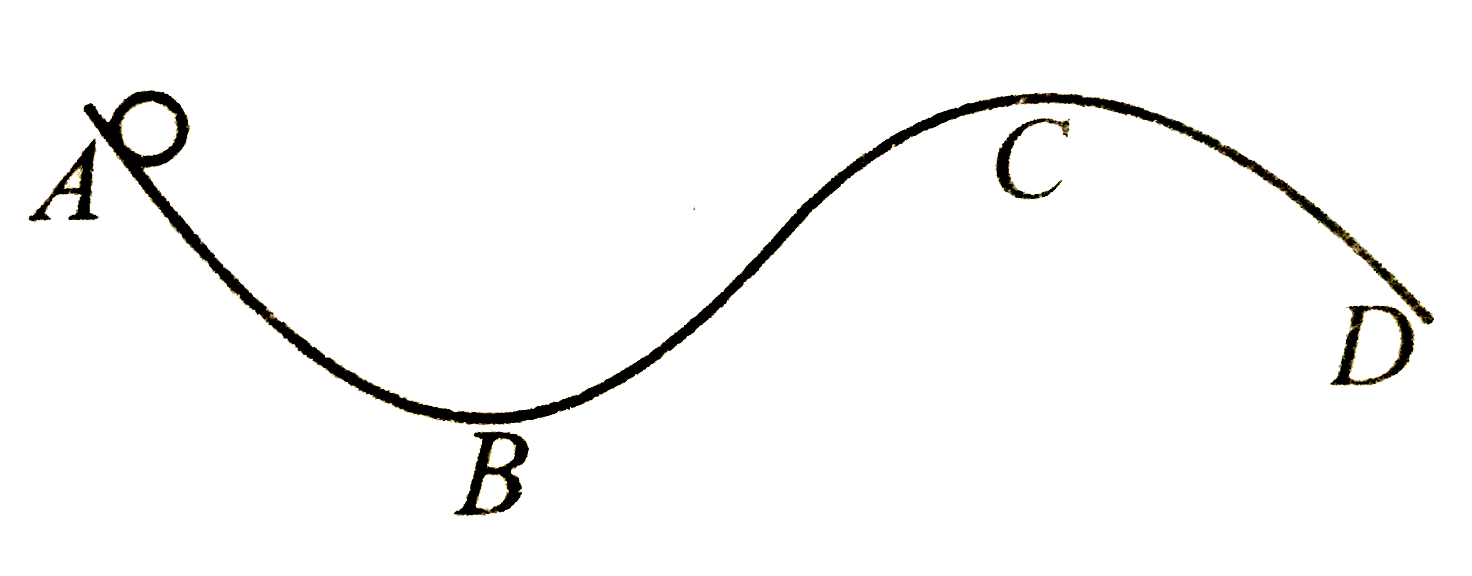
A curved surface is shown in figure. The portion BCD is frictionless. There are two spherical balls of identical radii and masses. Balls are released from rest one by one from A which is at a slightly greater height than C. With the surface AB ball 1 has a small friction and ball 2 has a negligible friction. For which balls is total mechanical energy conserved?

Text Solution

Verified by Experts

(a) As ball 1 is rolling down without slipping there is no dissipation of energy, hence total mechanical energy is conserved.
(b) Ball 1 acquires rotational energy, ball 2 loses energt by friction. They cannot cross at C. Ball # can cross over.
(c ) Balls 1 and 2 turn back before reaching C. Because of loss of energy, ball 2 cannot reach back to A. Ball 1 has a rotational motion in wrong sense when it reaches B. It cannot roll back to A because of kinetic friction.
Promotional Banner

Topper's Solved these Questions

  • CENGAGE PHYSICS DPP

    CENGAGE PHYSICS ENGLISH|Exercise Single Correct Answer type|491 Videos
  • CAPACITOR AND CAPACITANCE

    CENGAGE PHYSICS ENGLISH|Exercise Integer|5 Videos
  • COULOMB LAW AND ELECTRIC FIELD

    CENGAGE PHYSICS ENGLISH|Exercise Single Answer Correct Type|22 Videos

Similar Questions

Explore conceptually related problems

A curved suface is shown in figure. The portion BCD is free of friction. There are three spherical balls of identical radii and masses. Balls are released from rest one by one from A which is at a slightly greater height than C. Wioth the surface AB, ball 1 has large enough friction to cause rolling down without slipping, ball 2 has a small friction and ball 3 has a negligible friction. (a) For which ball is total mechanical energy conserved? (b) Which ball(s) can reach D? (c )For ball which do not reach D, which of the balls can reach back A?

A curved suface is shown in figure. The portion BCD is free of friction. There are three spherical balls of identical radii and masses. Balls are released from rest one by one from A which is at a slightly greater height than C. Wioth the surface AB, ball 1 has large enough friction to cause rolling down without slipping, ball 2 has a small friction and ball 3 has a negligible friction. (a) For which ball is total mechanical energy conserved? (b) Which ball(s) can reach D? (c )For ball which do not reach D, which of the balls can reach back A?

Two identical balls A and B are released from the position shown in Fig. They collide elastically with each other on the horizontal portion. The ratio of heights attained by A and B after collision is (neglect friction)

Two identical balls A and B are released from the position shown in Fig. They collide elastically with each other on the horizontal portion. The ratio of heights attained by A and B after collision is (neglect friction)

There are 2 identical white balls, 3 identical red balls, and 4 green balls of different shades. Find the number of ways in which they can be arranged in a row so that atleast one ball is separated from the balls of the same color.

A small ball of mass m is released from rest from the position shown . All contact surface are smooth . The speed of the ball when it reaches its lowest position is

A small ball of mass m is released from rest from the position shown . All contact surface are smooth . The speed of the ball when it reaches its lowest position is

Figure shows a flat car of mass M on a frictionless road. A small massless wedge is fitted on it as shown. A small ball of mass m is released from the top of the wedge, it slides over it and falls in the hole at distance l from the initial position of the ball. Find the distance the flat car moves till the ball gets into the hole.

There are two bags each of which contains n balls. A man has to select an equal number of balls from both the bags. Prove that the number of ways in which a man can choose at least one ball from each bag is ^(2n)C_n-1.

A solid sphere is released from rest from the top of a curved surface as shown in figure. Half portion of surface is rough and another half is smooth. If sphere is released from rough side, then the maximum height attained by it on smooth side is (Rough surface has sufficient friction to roll the body)

CENGAGE PHYSICS ENGLISH-CENGAGE PHYSICS DPP-subjective type
  1. The block of mass m is in equilibrium relative to the smooth wedge of ...

    Text Solution

    |

  2. A force F is applied on block A of mass M so that the tension in light...

    Text Solution

    |

  3. In pulley system shown in figure, block C is going up at 2(m)/(s) and ...

    Text Solution

    |

  4. System is shown in the figure and man is pulling the rope from both si...

    Text Solution

    |

  5. An ideal speing, with a pointer attached to its end, hangs next to a s...

    Text Solution

    |

  6. In an elevator a system is arranged as shown in figure. Initially elev...

    Text Solution

    |

  7. In the figure shoen calculate the angle of friction . The block dows n...

    Text Solution

    |

  8. A block of 7 kg is placed on a rough horizontal surface and is pulled ...

    Text Solution

    |

  9. The block of mass m(1) is placed on a wedge of an angle theta, as show...

    Text Solution

    |

  10. In the figure shown , the coefficient of static friction between B and...

    Text Solution

    |

  11. Two blocks of mass M and 3M (in kg) are connected by an inextensible l...

    Text Solution

    |

  12. Three blocks are connected as shown in the figure. Valculate the minim...

    Text Solution

    |

  13. The three flat blockss in the figure are positioned on the 37@ incline...

    Text Solution

    |

  14. 1 kg particle at a height of 4 m has a speed of 2 m/s down a incline m...

    Text Solution

    |

  15. A cone of mass m falls from a height h and penetrates into sand. The r...

    Text Solution

    |

  16. A particle of mass m=1kg lying on x-axis experiences a force given by ...

    Text Solution

    |

  17. A block of mass m is pushed against a spring of spring constant k fixe...

    Text Solution

    |

  18. Consider a one-dimensional motion of a particle with total energy E. T...

    Text Solution

    |

  19. A curved surface is shown in figure. The portion BCD is frictionless. ...

    Text Solution

    |

  20. A particle of mass 5kg is free to slide on a smooth ring of radius r=2...

    Text Solution

    |
