Home
Class 12
PHYSICS
Which of the following graph is correct ...

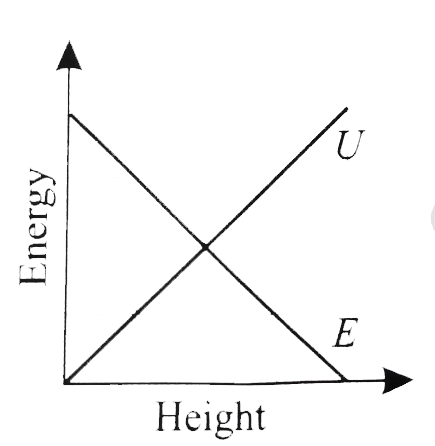
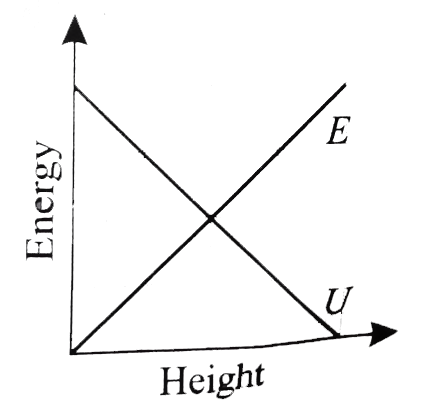
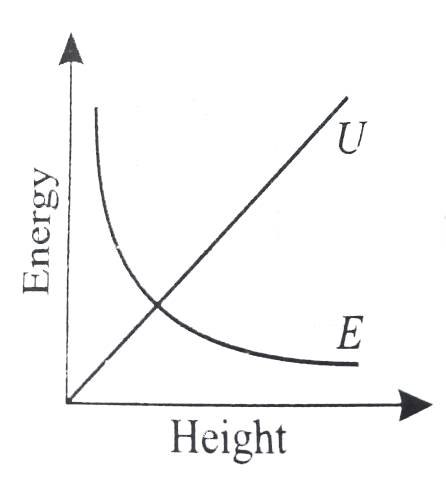
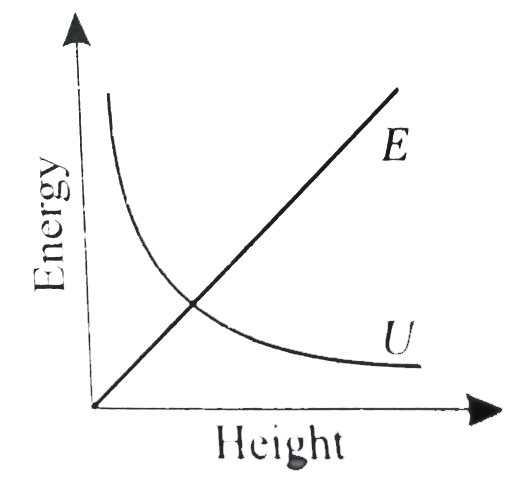
Which of the following graph is correct between kinetic energy `E`, potential energy `(U)` and height `(h)` from the ground of the partical

A

B

C

D

Text Solution

AI Generated Solution

The correct Answer is:

To solve the problem of determining the correct relationship between kinetic energy (E), potential energy (U), and height (h) from the ground for a particle, we can follow these steps: ### Step 1: Understand the Concepts - **Potential Energy (U)**: The potential energy of an object at height \( h \) is given by the formula: \[ U = mgh \] where \( m \) is the mass of the object, \( g \) is the acceleration due to gravity, and \( h \) is the height above the ground. - **Kinetic Energy (E)**: The kinetic energy of an object is given by: \[ E = \frac{1}{2}mv^2 \] where \( v \) is the velocity of the object. ### Step 2: Analyze Energy Conservation - According to the law of conservation of mechanical energy, the total mechanical energy (sum of kinetic and potential energy) of the particle remains constant if only conservative forces (like gravity) are acting on it. Thus, we can write: \[ E + U = \text{constant} \] This implies that if potential energy increases, kinetic energy must decrease, and vice versa. ### Step 3: Relationship Between Height, Kinetic Energy, and Potential Energy - As height \( h \) increases: - Potential energy \( U \) increases because \( U = mgh \). - Kinetic energy \( E \) decreases due to the conservation of energy. ### Step 4: Graphical Representation - The graph of potential energy \( U \) versus height \( h \) will be a straight line that increases linearly. - The graph of kinetic energy \( E \) versus height \( h \) will decrease as height increases, leading to a downward slope. ### Conclusion - The correct graph will show: - An increasing linear graph for potential energy \( U \) as height \( h \) increases. - A decreasing graph for kinetic energy \( E \) as height \( h \) increases. ### Final Answer The correct option is the one that shows potential energy increasing linearly with height and kinetic energy decreasing as height increases.

To solve the problem of determining the correct relationship between kinetic energy (E), potential energy (U), and height (h) from the ground for a particle, we can follow these steps: ### Step 1: Understand the Concepts - **Potential Energy (U)**: The potential energy of an object at height \( h \) is given by the formula: \[ U = mgh \] where \( m \) is the mass of the object, \( g \) is the acceleration due to gravity, and \( h \) is the height above the ground. ...
Promotional Banner

Similar Questions

Explore conceptually related problems

Distinguish between Kinetic energy and potential energy

Differentiate between Kinetic energy and potential energy.

Which of the following is the graph between the height (h) of a projectile and time (t), when it is projected from the ground

The relationship between kinetic energy (K) and potential energy (U) of electron moving in a orbit around the nucleus is

Find the kinetic energy of the disc when it is fallen of a height h .

In S.H.M., potential energy (U) V/s, time (t) . Graph is

Potential energy is converted into kinetic energy by

Which of the following equations is dimensionally incorrect ? (E= energy, U= potential energy, P=momentum, m= mass, v= speed)

Name the following Kinetic and potential energy together

Which of the following statemente is / are INCORRECT? (a) Mechanical energy is the sum of kinetic energy and potential energy. (b) Potential energy is a relative quantity. It depends on the choice of reference point. (c ) Kinetic energy must be non negative. (d) Potential energy must be postive.
