Home
Class 12
PHYSICS
Indentical isolated conduction sphers 1 ...

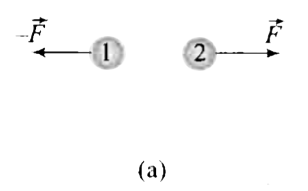
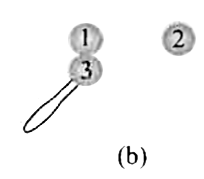
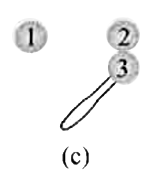
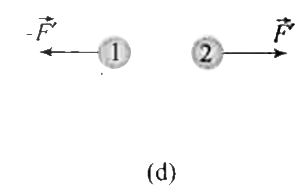
Indentical isolated conduction sphers 1 and 2 have equal charges and are separated by a distance that is large compared with their diameters (Fig.a). The electrostatic force acting on spkhere 2 due to sphere 1 is F. Suppose now that a third identical sphere 3, having an insulation handle and initially neutral, is touched first to sphere 1 (Fig. b), then to sphere 2 (Fig. c), and dinally removed (Fig. d). The electrostatic force that now acts on sphere 2 has magnitude F'. What is the `(F')/(F)`?

A

B

C

D

Text Solution

AI Generated Solution

The correct Answer is:

To solve the problem, we will analyze the situation step by step: ### Step 1: Initial Setup We have two identical isolated conducting spheres, Sphere 1 and Sphere 2, each with an equal charge \( q \). The electrostatic force \( F \) acting on Sphere 2 due to Sphere 1 is given by Coulomb's law: \[ F = k \frac{q \cdot q}{r^2} = k \frac{q^2}{r^2} \] where \( k \) is Coulomb's constant and \( r \) is the distance between the centers of the two spheres. **Hint:** Remember that the force between two point charges is given by Coulomb's law. ### Step 2: Touching Sphere 3 to Sphere 1 Sphere 3 is initially neutral and is touched to Sphere 1. When Sphere 3 touches Sphere 1, charge will redistribute. The total charge before touching is \( q + 0 = q \). After touching, the charge will be equally distributed between Sphere 1 and Sphere 3: \[ \text{Charge on Sphere 1} = \frac{q + 0}{2} = \frac{q}{2} \] \[ \text{Charge on Sphere 3} = \frac{q + 0}{2} = \frac{q}{2} \] **Hint:** When two conductors touch, charge redistributes equally because they are identical. ### Step 3: Touching Sphere 3 to Sphere 2 Next, Sphere 3 (now with charge \( \frac{q}{2} \)) is touched to Sphere 2, which has charge \( q \). The total charge when they touch is: \[ \text{Total charge} = q + \frac{q}{2} = \frac{3q}{2} \] After touching, this charge will also redistribute equally between Sphere 2 and Sphere 3: \[ \text{Charge on Sphere 2} = \text{Charge on Sphere 3} = \frac{3q/2}{2} = \frac{3q}{4} \] **Hint:** Again, charge redistributes equally when two identical conductors touch. ### Step 4: Calculating the New Force \( F' \) Now, we need to calculate the new force \( F' \) acting on Sphere 2 due to Sphere 1. Sphere 1 now has a charge \( \frac{q}{2} \) and Sphere 2 has a charge \( \frac{3q}{4} \). The force \( F' \) is given by: \[ F' = k \frac{\left(\frac{q}{2}\right) \left(\frac{3q}{4}\right)}{r^2} = k \frac{3q^2}{8r^2} \] ### Step 5: Finding the Ratio \( \frac{F'}{F} \) Now we can find the ratio of the new force \( F' \) to the original force \( F \): \[ \frac{F'}{F} = \frac{k \frac{3q^2}{8r^2}}{k \frac{q^2}{r^2}} = \frac{3}{8} \] ### Final Answer Thus, the ratio \( \frac{F'}{F} \) is: \[ \frac{F'}{F} = \frac{3}{8} \] ---
Promotional Banner

Topper's Solved these Questions

  • COULOMB LAW AND ELECTRIC FIELD

    CENGAGE PHYSICS ENGLISH|Exercise Subjective|32 Videos
  • COULOMB LAW AND ELECTRIC FIELD

    CENGAGE PHYSICS ENGLISH|Exercise Single Correct|47 Videos
  • COULOMB LAW AND ELECTRIC FIELD

    CENGAGE PHYSICS ENGLISH|Exercise Exercises|58 Videos
  • CENGAGE PHYSICS DPP

    CENGAGE PHYSICS ENGLISH|Exercise subjective type|51 Videos
  • ELECTRIC CURRENT & CIRCUITS

    CENGAGE PHYSICS ENGLISH|Exercise Kirchhoff s law and simple circuits|15 Videos

Similar Questions

Explore conceptually related problems

Two identical conducting spheres 1 and 2 carry equal amounts of charge and are ficed apart at a certain distance larger than their diameters. The spheres repel each other with an electrical force of 88mN. A thired identical sphere 3, having an insulating handle and initially uncharged, is touched first to sphere 1 and then to sphere 2 and finally removed. Find the force between spheres 1 and 2 as shown if Figure. ,

Two identical small conducting spheres having unequal positive charges q_1 and q_2 are separated by a distance r. If they are now made to touch each other and then separated again to the same distance, the electrostatic force between them in this case will be

Two identical small conducting spheres having unequal positive charges q_1 and q_2 are separated by a distance r. If they are now made to touch each other and then separated again to the same distance, the electrostatic force between them in this case will be

An isolated conduction sphere sphere whose radius R=1 m has a charge q=1/9nC. The energy density at the surfasce of the sphere is

Two identical conducting spheres A and B, carry equal charge. They are separated by a distance much larger than their diameters, and the force between them is F. A third identical conducting spheres, C,is uncharged. Sphere C is first touched to A, then to B, and then removed. As a result, the force between A and B would be equal to :

Two conducting spheres of radii 3 cm and 1 m are separated by a distance of 10 cm in free space. If the spheres are charged to same potential of 10 V each, then the force of repulsion between them is

Two insulated charged metallic spheres P and Q have their centres separated by a distance of 60 cm. The radii of P and Q are negligible compared to the distance of separation. The mutual force of electrostatic repulsion if the charge on each is 3.2xx10^(-7)C is

Two identical conducting spheres are charged by induction and then separated by a large distance, sphere 1 has charge +Q and sphere 2 has charge -Q. A third sphere is initially uncharged. If sphere 3 is touched to sphere 1 and separated and then touched to sphere 2 and separated what is the final charge on each of the three spheres?

The electrostatic attracting froce on a small sphere of charge 0.2muC due to another small sphere of charge -0.4muC in air is 0.4N. The distance between the two spheres is

Two conducting spheres of radius R and 3R carry charges Q and -2 Q . Between these spheres a neutral conducting sphere of radius 2R is connected. The separation between the sphere is considerably large Charge flows through conducting wire due to potential difference. The final charge on initially neutral conducting sphere is :
