Home
Class 12
PHYSICS
Figure shows four Gaussion surfaces cons...

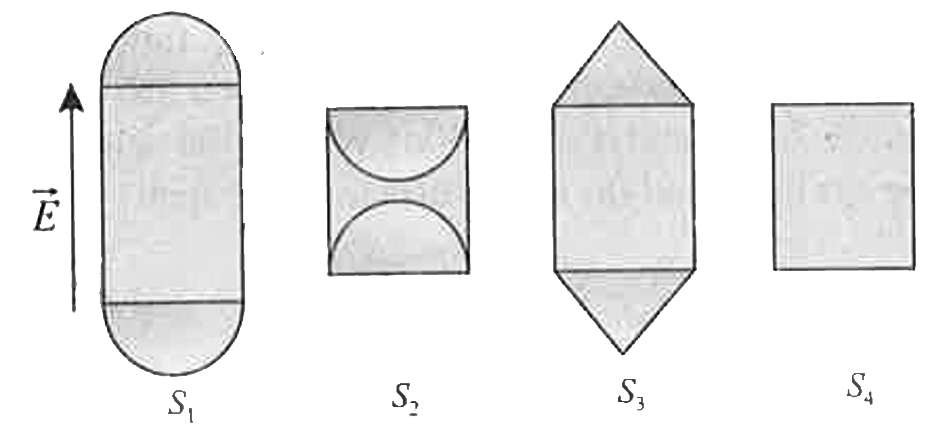
Figure shows four Gaussion surfaces consisting of identical cylindrical midsections but different end caps. The surfaces central axis of each . Cylindrical midsection , the end caps have these shapes, `S_(1)` convex hemispheres `S_(2)` concave hermisphere `S_(3)` cones `S_(4)`e flat disks. rank the surfaces acccording to (a) the net electric flux through them and (b) the electric flux through the top end caps , greatest first.

A

net flux through all the four Gaussion surface will be equal

B

the electric flux though the top end cops will be equal

C

the electric flux through the top end cap `S_(1)` is greatest

D

the electric flux through the top end cop `S_(3)` is greatest

Text Solution

Verified by Experts

The correct Answer is:

a,b
Promotional Banner

Topper's Solved these Questions

  • ELECTRIC FLUX AND GAUSS LAW

    CENGAGE PHYSICS ENGLISH|Exercise Subjective type|7 Videos
  • ELECTRIC CURRENT AND CIRCUIT

    CENGAGE PHYSICS ENGLISH|Exercise Interger|8 Videos
  • ELECTRIC POTENTIAL

    CENGAGE PHYSICS ENGLISH|Exercise DPP 3.5|15 Videos

Similar Questions

Explore conceptually related problems

Fig shows three point charges +2q, -q and + 3q , What is the electric flux due to this configuration through the surface S ?

S_1 and S_2 are two hollow concentric spheres enclosing charge Q and 2Q, respectively, as shown in figure. What is the ratio of the electric flux leaving through the surface of S_1 and S_2 ?

Figure shows four charges q_1,q_2,q_3,and q_4 fixed is space. Then the total flux of the electric field through a closed surface S, due to all the charges, is

Consider the hemispherical closed surface as shown in Fig. 3.19. if the hemisphere is a uniform magnetic field that makes an angle theta with the vertical, calculate the magnetic flux (a) through the flat surface S_(1) . (b) through the hemisphere surface S_(2) .

Figure shows three point charges +2q,-q and +3q. Two charges +2q and -q are enclosed within a surface .S.. What is the electric flux due to this configuration through the surface.S?

A cube has sides of length L. It is placed with one corner at the origin as shown in figure. The electric field is uniform and given by E = - B hati + Chatj - Dhatk , where B, C and D are positive constants. (a) Find the electric flux through each of the six cube faces S_1, S_2, S_3 , S_4 and S_5 and S_6 . (b) Find the electric flux through the entire cube.

In a thin rectangular metallic strip a constant current I flows along the positive x-direction , as shown in the figure. The length , width and thickness of the strip are l, w and d , respectively. A uniform magnetic field vec(B) is applied on the strip along the positive y- direction . Due to this, the charge carriers experience a net deflection along the z- direction . This results in accumulation of charge carriers on the surface PQRS ansd apperance of equal and opposite charges on the face opposite to PQRS . A potential difference along the z-direction is thus developed. Charge accumulation contiues untill the magnetic force is balanced by the electric force. The current is assumed to be uniformly distributed on the cross- section of the strip and carried by electrons. Consider two different metallic strips (1 and 2) of the same material . Their lengths are the same,widths are w_(1) and w_(2) and thickness are d_(1) and d_(2) respectively. Two points K and M are symmetrically located on the opposite faces parallel to the x-y plane ( see figure) . V_(1) and V_(2) are the potential differences between K and M in strips 1 and 2 , respectively . Then, for a given current I flowing through them in a given magnetic field strength B , the correct statement(s) is (are)

In a thin rectangular metallic strip a constant current I flows along the positive x-direction , as shown in the figure. The length , width and thickness of the strip are l, w and d , respectively. A uniform magnetic field vec(B) is applied on the strip along the positive y- direction . Due to this, the charge carriers experience a net deflection along the z- direction . This results in accumulation of charge carriers on the surface PQRS ansd apperance of equal and opposite charges on the face opposite to PQRS . A potential difference along the z-direction is thus developed. Charge accumulation contiues untill the magnetic force is balanced by the electric force. The current is assumed to be uniformly distributed on the cross- section of the strip and carried by electrons. Consider two different metallic strips (1 and 2) of the same material . Their lengths are the same,widths are w_(1) and w_(2) and thickness are d_(1) and d_(2) respectively. Two points K and M are symmetrically located on the opposite faces parallel to the x-y plane ( see figure) . V_(1) and V_(2) are the potential differences between K and M in strips 1 and 2 , respectively . Then, for a given current I flowing through them in a given magnetic field strength B , the correct statement(s) is (are)

In the figure B_(1) , B_(2) and B_(3) represent uniform time varying magnetic fields in three different infinitely long cylindrical regions with axis passing through P , Q and R and perpendicular to the plane of the paper. PQR is an equilateral triangle of side 4sqrt(3)r , where r is radius of each cylindrical region (r=1m) . The magnetic inductions vary with time t as B_(1)=A+at , B_(2)=A-bt and B_(3)=A+ct . Here a=2 Tesla//s , b=2 Tesla//s and c=1 Tesla//s and A is a constant with dimensions of magnetic field and 't' is time. Find the induced electric field strength at the centroid of the triangle PQR .

When a current through the medium, an electric field exists as well as a potential which varies in space. Suppose that there is a break in a high - voltage transmission line and the free end of a wire of length L is lying on the ground. An electric current flows through the regions of soil adjoining the conductor. If a man happens to be walking near by a potential difference, which is called the step voltage appears between the points where his feet touch the ground, Consequently, an electric current whose strength depends on this potential difference flows through the man. Let us calculate the step voltage. Since the conductor is quite long, we assume that the current flows from it to the ground in a direction perpendicular to the conductor. The equipotential surfaces are the surfaces of semi-cylinders whose axes coincide with the conductor. Suppose that the man is walking in a direction perpendicular to the conductor with a step of length 'b' the distance between the conductor and the foot closer to it being d. Assuming that the current flows uniformly from the conductor over the semi cylindrical region we obtain the following expression for the current density at a distance from the conductor: j=i/(pirL) In this case , the field strength along the radii perpendicular to the conductor is E_r=j/sigma=l/(pirLsigma) Consequently , the step voltage is V_(st)=int_d^(d+b) Edr =1/(pisigmaL)ln((d+b)/d) For example , If l=500A , d=1 m , b=65 cm and L=30 m we find that V_(st) =270 V. Much higher voltages may appear under other conditions and other shapes of conductors. When a part of a high- voltage transmission line falls on the ground, it creates a hazard

CENGAGE PHYSICS ENGLISH-ELECTRIC FLUX AND GAUSS LAW-MCQ s
  1. In the figure a hemispherical bowl of bowl of radius R is shown Electr...

    Text Solution

    |

  2. figure shows, in cross section, two Gaussian spheres and two Gaussian ...

    Text Solution

    |

  3. Figure shows four Gaussion surfaces consisting of identical cylindrica...

    Text Solution

    |

  4. In figure , a solid sphere of radius a = 2.00cm is concentric with a s...

    Text Solution

    |

  5. A uniform charge density of 500 nC//m^(3) is distributed throughout a ...

    Text Solution

    |

  6. the net electric flux through each face of a die (singular of dice) ha...

    Text Solution

    |

  7. A Gaussian surface S encloses two charges q(1)= q and q(2) = -qthe fie...

    Text Solution

    |

  8. The electric field in a region is radially outward with magnitude E=A...

    Text Solution

    |

  9. A charge q is placed at the centre of the open end of a cylindrical ve...

    Text Solution

    |

  10. Electric charge is uniformly distributed along a long straight wire of...

    Text Solution

    |

  11. In a region of space having a spherical symmetic distribution of char...

    Text Solution

    |

  12. In a region of space the electric field in the x-direction and proport...

    Text Solution

    |

  13. Figure shows a closed dotted surface which intersects a conduccting un...

    Text Solution

    |

  14. figure shows a neutral metallic sphere with a point charge +Q placed n...

    Text Solution

    |

  15. A and B are semi - spherical surfaces of radius r(1)and r(2) (r(1) lt ...

    Text Solution

    |

  16. the electric field intensity at all points is space is given by vecE...

    Text Solution

    |

  17. the electric field intensity at all points is space is given by vecE...

    Text Solution

    |

  18. the electric field intensity at all points is space is given by vecE...

    Text Solution

    |

  19. Figure, shown above, shows three situations involving a charged partic...

    Text Solution

    |

  20. There are three concentric thin spheres of radius a,b,c (agtbgtc). The...

    Text Solution

    |
