Home
Class 12
PHYSICS
figure(a) shows three sheets that are la...

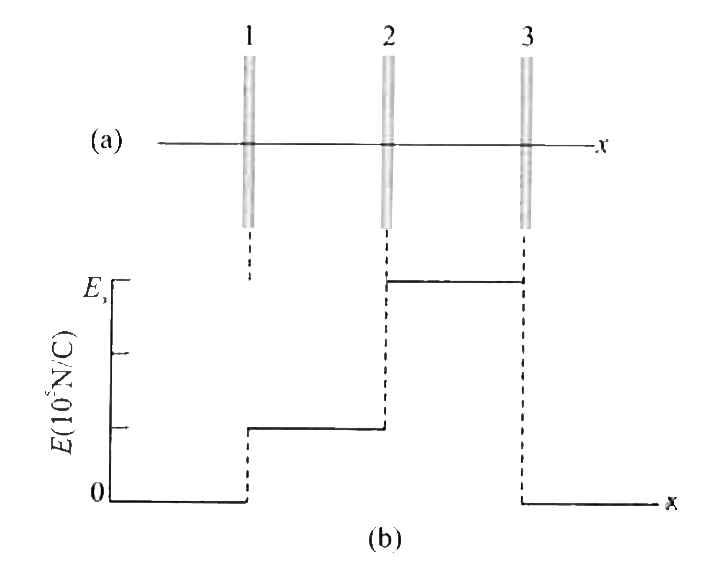
figure(a) shows three sheets that are large, parallel and uniformaly charged. Figure (b) gives the component of the net electric field along and x-axis through the sheets. The scale of the vertical axis is set by `E_(s)= 6.0 xx10^(5)N//C` what is the ratio of the charge density on sheet 3 to that on sheet 2?

Text Solution

Verified by Experts

The correct Answer is:

1.5
Promotional Banner

Topper's Solved these Questions

  • ELECTRIC FLUX AND GAUSS LAW

    CENGAGE PHYSICS ENGLISH|Exercise MCQ s|38 Videos
  • ELECTRIC FLUX AND GAUSS LAW

    CENGAGE PHYSICS ENGLISH|Exercise Comprehension|36 Videos
  • ELECTRIC CURRENT AND CIRCUIT

    CENGAGE PHYSICS ENGLISH|Exercise Interger|8 Videos
  • ELECTRIC POTENTIAL

    CENGAGE PHYSICS ENGLISH|Exercise DPP 3.5|15 Videos

Similar Questions

Explore conceptually related problems

In Fig. a, particle 1 (of charge q_(1) ) and particle 2 (of charge q_(2) ) are fixed in place on an x axis, 8.00 cm apart. Particle 3 (of charge q_(3)=+8.00xx10^(-19)C ) is to be placed on the line between particles 1 and 2 so that they produce a net electrostatic force F_("net")=2F_(0) on it Figure b gives the x component of that force versus the coordinate x at which particle 3 is placed. The scale of the x-axis is set by x_(s)=8.0 cm. What are (a) the sign of charge q_(1) and (b) the ratio q_(2)//q_(1) ?

Two infinite sheets of unifrom charge density +sigma and -sigma are parallel to each other as shown in the figure. Electric field at the

Figure shows three point charges +2q,-q and +3q. Two charges +2q and -q are enclosed within a surface .S.. What is the electric flux due to this configuration through the surface.S?

What is the charge per unit area in C//m^2 of an infinite plane sheet of charge if the electric field produced by the sheet of charge has magnitude 3.0 N//C ?

An infinite thin plane sheet of charge density 7.08 xx 10^(-11)(C //m^(2)) is held in air. Find the electric field at a point very close to the sheet.

In fig, two particles, each of charge -q are arranged symmetrically about the y-axis, each producing an electric field at point P on the y-axis. . (a) Are the magnitudes of the fields at P equal? (b) Is each electric field directed towards or away form the charge producing it ? (c ) Is the magnitude of the net electric field at P equal to the sum of the magnitudes E of the two field vectors (is it equal to 2E)? (d) Do the x-components of those two field vectors add or cancel? (e ) Do their y-components add or cancel? (f) Is the diretion of the net field at P that of the canceling components or the adding components? (g) What is the direction of the net field?

There is and electric field E in the +x direction. If the work done by the electric field in moving a charges 0.2C through a distance of 2m along a line making an angle of 60^(@) with the x-axis is 1.0J , what is the value of E in NC^(-1) ?

The electric force experienced by a charge of 1.0xx10^(-6) C is 1.5 xx 10^(-3) N . Find the magnitude of the electric field at the position of the chaerge.

Two parallel plates have equal and opposite charges. When the space between the plates is evacuted, the electric field is E_0=3.20xx10^5V//m . When the space is filled with electric the electric field is E-2.50xx10^5V//m a. What is the dielectric constant? b. What is the charge density on each surface of the dielectric?

A flat square sheet of charge (side 50 cm) carries a uniform surface charge density. An electrons0.5 cm form a point near the center of the sheet experiences a force of 1.8xx10^(-12)N directed away from the sheet. Determine the total charge on the sheet.
