

Home
Class 12
PHYSICS
A test charge q is made to move in the e...

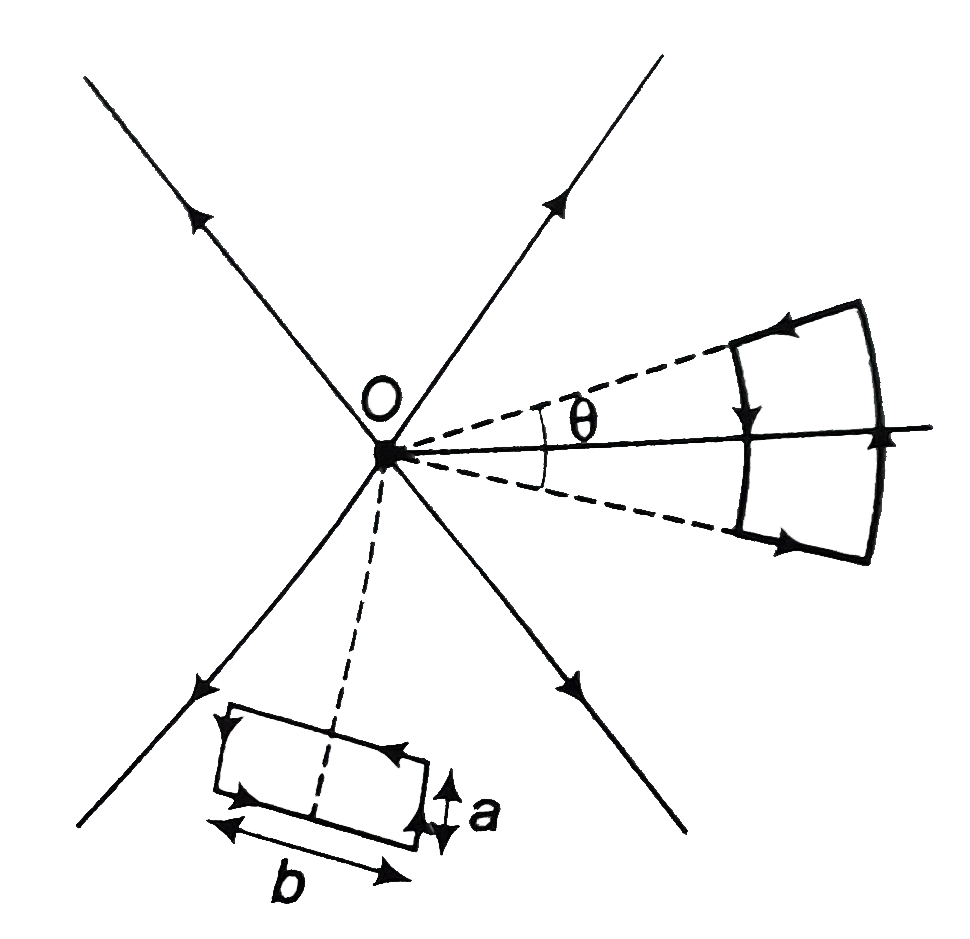
A test charge q is made to move in the electric field of a point cahrge Q along two different clsoed parths [figure first path has sections along and perpendicular to lines of electric field. Second path is a rectangular loop of the same area as the first loop. how does the work done compare in the two cases?

Promotional Banner

Topper's Solved these Questions

  • ELECTRIC POTENTIAL

    CENGAGE PHYSICS ENGLISH|Exercise DPP 3.4|15 Videos
  • ELECTRIC POTENTIAL

    CENGAGE PHYSICS ENGLISH|Exercise DPP 3.5|15 Videos
  • ELECTRIC POTENTIAL

    CENGAGE PHYSICS ENGLISH|Exercise DPP 3.2|15 Videos
  • ELECTRIC FLUX AND GAUSS LAW

    CENGAGE PHYSICS ENGLISH|Exercise MCQ s|38 Videos
  • ELECTRICAL MEASURING INSTRUMENTS

    CENGAGE PHYSICS ENGLISH|Exercise M.C.Q|2 Videos

Similar Questions

Explore conceptually related problems

A test charge q is made to move in the electric field of a point charge Q along two different closed paths. Fig. First path has sections along and perpendicular loop of the same area as the first loop. How does the work done compare in the two cases?

A point charge q is rotated along a circle in the electric field generated by anotherj point charge Q. The work done by the electric field on the rotatin charge in one complete revolution is

A uniformly charged disc of radius R with a total charge Q lies in the XY -plane. Find the electric field at a point at a point P, along the Z-a xis that passes through the centre of the discc perpendicular to its plane. Discuss the limit when R gt gt z . Strategy : By treating the disc as a set of concentric uniformly charged rings, the problem could be solved by using the result obtained in example for ring. Consider a ring of radius of radius r' and thickness as shown in figure.

In the electric field of a point charge ( + q) , placed at the centre of a circle , a certain test charge is carried from point A to B, C,D and E Least amount of work is done along the path

A few electric field lines for a system of two charges Q_1 and Q_2 fixed at two different points on the x-axis are shown in the figure. These lines suggest that

Plot a graph comparing the variation of potential ‘V’ and electric field ‘E’ due to a point charge ‘Q’ as a function of distance r from point charge (ii) Find the ratio of the potential differences that must be applied across the parallel and the series combination of two identical capacitors so that the energy stored, in the two cases, becomes the same.

The variation of electric field between two charge q_1 and q_2 along the line joining the charges is plotted against distance from q_1 (taking rightward direction of electric field as positive) as shown in the figure. Then the correct statement is

Bainbridge's mass spectrometer separates ion having the same velocity. The ions, after enteering through slits, S_(1) and S_(2) , pass through a velocity selector composed of an electric field pproduced by the charged plates P and P' abd a magnetic field vecB perpendicular to electric field and the ion path.Thew ions that then passs undeviated through the crossed vecE 1 and vecB fields enter into a region where a second magnetic field vecB exists, where they are made to follow circular path. A photographic plate ( or a modern detector) registors their arrival. If r is the radius of the circular orbit , then specific charge (q)/(m) of ion is

A bob of mass m is tied with a thread and is made to move in a circular path on a frictionless table surface about point 'O' as shown in diagram. A hypothetical electric field in radial direction exists along the table surface. In this condition the bob is uncharged and tension in the thread is T. If bob is given some charge-

A long solenoid having n = 200 turns per metre has a circular cross-section of radius a_(1) = 1 cm . A circular conducting loop of radius a_(2) = 4 cm and resistance R = 5 (Omega) encircles the solenoid such that the centre of circular loop coincides with the midpoint of the axial line of the solenoid and they have the same axis as shown in Fig. A current 't' in the solenoid results in magnetic field along its axis with magnitude B = (mu)ni at points well inside the solenoid on its axis. We can neglect the insignificant field outside the solenoid. This results in a magnetic flux (phi)_(B) through the circular loop. If the current in the winding of solenoid is changed, it will also change the magnetic field B = (mu)_(0)ni and hence also the magnetic flux through the circular loop. Obvisouly, it will result in an induced emf or induced electric field in the circular loop and an induced current will appear in the loop. Let current in the winding of solenoid be reduced at a rate of 75 A //sec . When the current in the solenoid becomes zero so that external magnetic field for the loop stops changing, current in the loop will follow a differenctial equation given by [You may use an approximation that field at all points in the area of loop is the same as at the centre

CENGAGE PHYSICS ENGLISH-ELECTRIC POTENTIAL-DPP 3.3
  1. Two metal spheres, one of radius R and the other of radius 2R, both ha...

    Text Solution

    |

  2. Two charges q(1) and q(2) are placed at (0,0,d) and (0,0,-d) respectiv...

    Text Solution

    |

  3. Equipotentials at a great distance from a collection of charges whose ...

    Text Solution

    |

  4. Figure shows ome equipotential lines distributed in space. A charged o...

    Text Solution

    |

  5. In the electric field of a point chargde q, a cetrain charge is carrie...

    Text Solution

    |

  6. Equipotential surfaces are shown in figure. Then the electric field st...

    Text Solution

    |

  7. In moving from A to B along an electric field line, the work done by t...

    Text Solution

    |

  8. Electric lines of force are as shown in the figure. Then potential at ...

    Text Solution

    |

  9. Two infinitely large charged planes having uniform suface charge densi...

    Text Solution

    |

  10. Equipotential surfaces

    Text Solution

    |

  11. Consider a uniform electric field in the z-direction. The potential i...

    Text Solution

    |

  12. Across the surface of a charged conductor, the electric

    Text Solution

    |

  13. Mark the correct statements.

    Text Solution

    |

  14. A conducting sphere of radius R has a charge. Then,

    Text Solution

    |

  15. Consider two conducting spheres of radii R(1) and R(2) with R(1) gt R(...

    Text Solution

    |

  16. Free electrons travel to reion of higher potential or lower potential.

    Text Solution

    |

  17. Assertion: Two adjacent conductors of unequal dimensions, carrting the...

    Text Solution

    |

  18. A test charge q is made to move in the electric field of a point cahrg...

    Text Solution

    |

  19. Prove that a closed equipotential surface with no charge within itself...

    Text Solution

    |

  20. Prove that, if an insulated, uncharged conductor is plated near a char...

    Text Solution

    |