Home
Class 12
PHYSICS
A negative charge Q is distributed unifo...

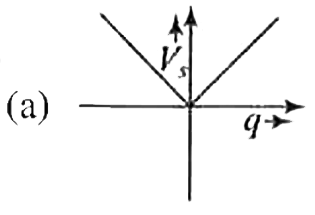
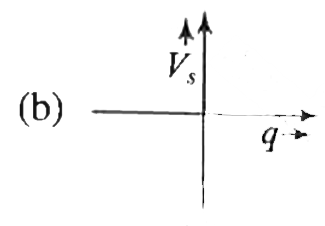
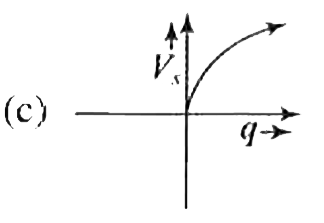
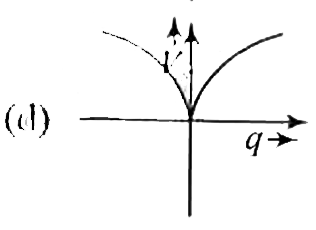
A negative charge `Q` is distributed uniformly in volume of a sphere is radius R and a point charge particle (may be negative or positive) is present on the surface of this sphere then variation of escape velocity `(v_(s))` of charge 'q' as a function of 'q' will be [negect gravitational interaction].

A

B

C

D

Text Solution

AI Generated Solution

The correct Answer is:

To solve the problem, we need to analyze the escape velocity of a charge \( q \) placed on the surface of a uniformly charged sphere with a negative charge \( Q \) distributed throughout its volume. ### Step-by-Step Solution: 1. **Understanding Escape Velocity**: The escape velocity \( v_s \) is the minimum velocity required for an object to escape the gravitational or electrostatic influence of another object. In this case, we are dealing with electrostatic forces since we are neglecting gravitational interactions. 2. **Energy Conservation Principle**: The total mechanical energy at the point of escape must equal zero. The kinetic energy of the charge \( q \) when it is at the surface of the sphere is given by: \[ KE = \frac{1}{2} m v_s^2 \] where \( m \) is the mass of the charge \( q \) and \( v_s \) is the escape velocity. 3. **Electrostatic Potential Energy**: The electrostatic potential energy \( U \) at the surface of the sphere due to the charge \( Q \) is given by: \[ U = \frac{k Q q}{R} \] where \( k \) is Coulomb's constant, \( Q \) is the charge distributed in the sphere, \( q \) is the charge at the surface, and \( R \) is the radius of the sphere. 4. **Setting Up the Equation**: According to the conservation of energy: \[ \frac{1}{2} m v_s^2 + \frac{k Q q}{R} = 0 \] Rearranging gives: \[ \frac{1}{2} m v_s^2 = -\frac{k Q q}{R} \] 5. **Solving for Escape Velocity**: Now, we can express \( v_s \): \[ v_s^2 = -\frac{2 k Q q}{m R} \] Taking the square root: \[ v_s = \sqrt{-\frac{2 k Q q}{m R}} \] 6. **Analyzing the Sign of \( Q \)**: - If \( Q \) is negative, then \( -Q \) is positive, and since \( q \) can be either positive or negative, we need to analyze both cases: - If \( q \) is positive, \( v_s \) will be real and positive. - If \( q \) is negative, \( v_s \) will be zero because the product \( Qq \) will be positive, leading to a zero escape velocity. 7. **Conclusion**: The escape velocity \( v_s \) is proportional to the square root of \( |q| \) when \( Q \) is negative and \( q \) is positive. Therefore, we can conclude that: - For \( Q < 0 \) and \( q > 0 \), \( v_s \) is proportional to \( \sqrt{q} \). - For \( Q < 0 \) and \( q < 0 \), \( v_s = 0 \). ### Final Result: The variation of escape velocity \( v_s \) as a function of charge \( q \) is: - \( v_s \propto \sqrt{|q|} \) for \( q > 0 \) - \( v_s = 0 \) for \( q < 0 \)
Promotional Banner

Topper's Solved these Questions

  • ELECTRIC POTENTIAL

    CENGAGE PHYSICS ENGLISH|Exercise DPP 3.5|15 Videos
  • ELECTRIC POTENTIAL

    CENGAGE PHYSICS ENGLISH|Exercise DPP 3.3|20 Videos
  • ELECTRIC FLUX AND GAUSS LAW

    CENGAGE PHYSICS ENGLISH|Exercise MCQ s|38 Videos
  • ELECTRICAL MEASURING INSTRUMENTS

    CENGAGE PHYSICS ENGLISH|Exercise M.C.Q|2 Videos

Similar Questions

Explore conceptually related problems

A rubber balloon is given a charge Q distributed uniformly over its surface. Then

A positive charge Q is uniformly distributed along a circular ring of radius R .a small test charge q is placed at the centre of the ring.

A positive charge Q is uniformly distributed along a circular ring of radius R .a small test charge q is placed at the centre of the ring .The

A charge q is distributed uniformly on the surface of a sold sphere of radius R. It covered by a concentric hollow conduction sphere of radius 2R . Find the charges inner and outer surface of hollow sphere if it is earthed.

A charge q_0 is distributed uniformly on a ring of radius R. A sphere of equal radius R constructed with its centre on the circumference of the ring. Find the electric flux through the surface of the sphere.

Charge Q is uniformly distributed throughout the volume of a solid hemisphere of radius R metres. Then the potential at centre O of hemisphere in volts is:

Flux passing through the shaded surface of a sphere when a point charge q is placed at the center is (radius of the sphere is R)

Let P(r)=(Q)/(piR^4)r be the charge density distribution for a solid sphere of radius R and total charge Q. For a point 'p' inside the sphere at distance r_1 from the centre of the sphere, the magnitude of electric field is:

A uniformly charged solid sphere a mass M, radius R having charge Q is rotated about its diameter with frequency f_0 . The magnetic moment of the sphere is

A positive charge Q is uniformly distributed throughout the volume of a dielectric sphere of radius R. A point mass having charge +q and mass m is fired toward the center of the sphere with velocity v from a point at distance r (r gt R) from the center of the sphere. Find the minimum velocity v so that it can penetrate (R//2) distance of the sphere. Neglect any resistance other than electric interaction. Charge on the small mass remains constant throughout the motion.
