Home
Class 12
PHYSICS
Two metallic bodies separated by a dista...

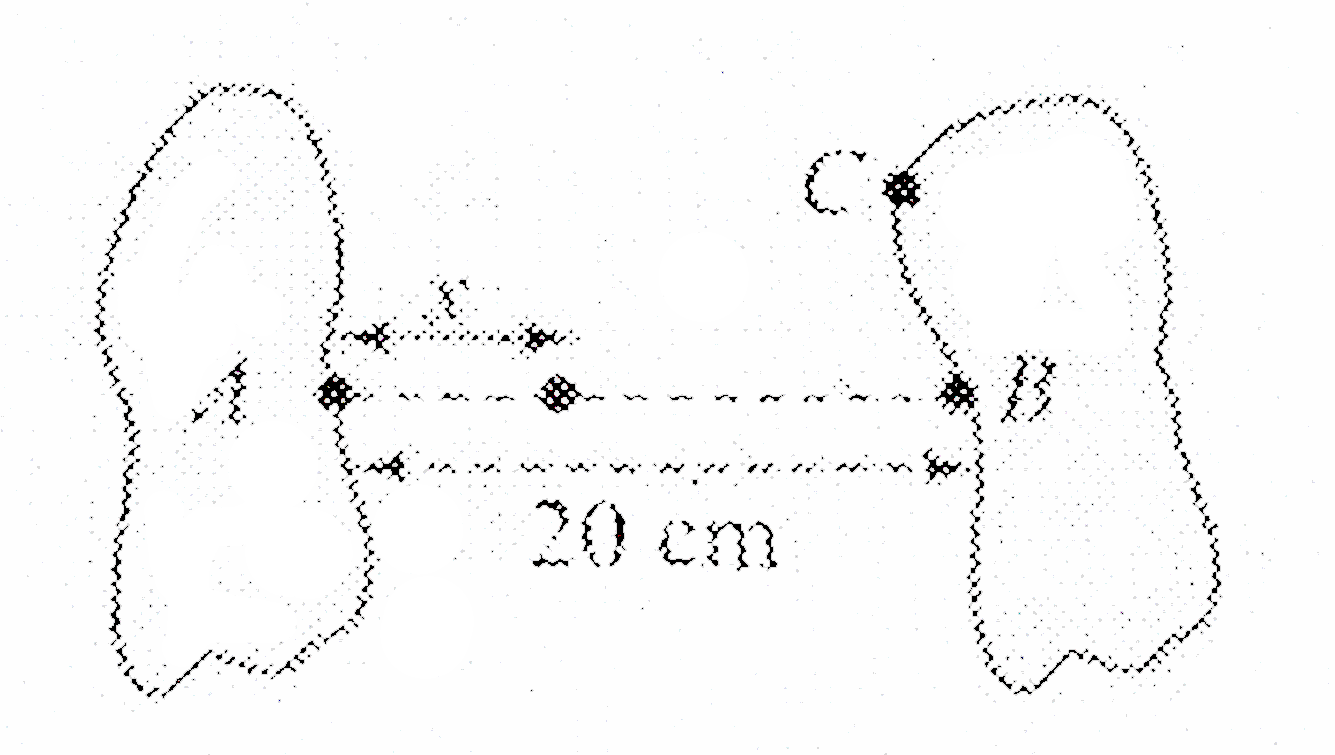
Two metallic bodies separated by a distance 20 cm are given equal and opposite charged on magintude 0.88 `muC`.The component of electric field along the line AB,between the plates, varies as `E_(x)=3x^(2)+0.4N//C,` where x (in meter) is the distance from one body towards the other body as shown

A

The capacitance of the system is 10 `muF`

B

The capacitance of the system is 20 `muF`

C

The potential difference between A and C is 0.088 volt

D

The potential difference between A and C natnot be determined from the given

Text Solution

Verified by Experts

The correct Answer is:

A, C
Promotional Banner

Similar Questions

Explore conceptually related problems

A hollow conducting sphere of radius 3 m is given a positive charge of 1 muC. Choose the correct plot of electric field (E) along x axis with position (x) from centre of sphere (0,0,0)

Two fixed, equal, positive charges, each of magnitude 5xx10^-5 coul are located at points A and B separated by a distance of 6m. An equal and opposite charge moves towards them along the line COD, the perpendicular bisector of the line AB. The moving charge, when it reaches the point C at a distance of 4m from O, has a kinetic energy of 4 joules. Calculate the distance of the farthest point D which the negative charge will reach before returning towards C.

A body is moving down along inclined plane of angle of inclination q. The coefficient of friction between the body and the plane varies as mu = 0.5x, where x is the distance moved down the plane. The body will have the maximum velocity when it has travelled a distance x given by

Passage-I : Two large plates are located in vacuum. One of them serves as a cathode, a source of electrons whose initial velocity is negligible. An electron flow directed toward the opposite plate produces a space charge causing the potential in the gap between the plates to vary as V=ax^(4//3) , where a is a positive constant, and x is the distance from the cathode. The electric field between the plate as a function of x is

Passage-I : Two large plates are located in vacuum. One of them serves as a cathode, a source of electrons whose initial velocity is negligible. An electron flow directed toward the opposite plate produces a space charge causing the potential in the gap between the plates to vary as V=ax^(4//3) , where a is a positive constant, and x is the distance from the cathode. The volume density of sapce charge as a function of x

A body starts from rest on a long inclined plane of slope 45^(@) . The coefficient of friction between the body and the plane varies as mu = 0.3 x , where x is the distance travelled down the plane. The body will have maximum speed (for g = 10 m//s^(2) ) when x =

Two identical charged particles each carrying charge q=0.1mC and of mass m=10 mg are projected along two parallel lines separated by a distance 'l' , with equal speed V_(0)=10^(4)m//s in opposite directions. In the beginning electrostatic interaction between the charges can be ignored due to a large distance between them. The minimum distance between the particles is found to be 12cm . . The value of l is equal to

Two plates of a parallel plate capacitor carry charges q and -q and are separated by a distance a from each other. The capacitor is connected to a constant voltage source V_0 . The distance between the plates is changed to x+dx . Then in steady state.

Two positive point charges q_1=16muC and q_2=4muC are separated in vacuum by a distance of 3.0m . Find the point on the line between the charges where the net electric field is zero.-

An electric dipole consists of two opposite charges each of magnitude 2 muC separated by a distance 1 cm. The dipole is placed in an external field of 10^(3) N/C. The maximum torque on the dipole is
