Home
Class 11
PHYSICS
The diagram below shows an instantaneous...


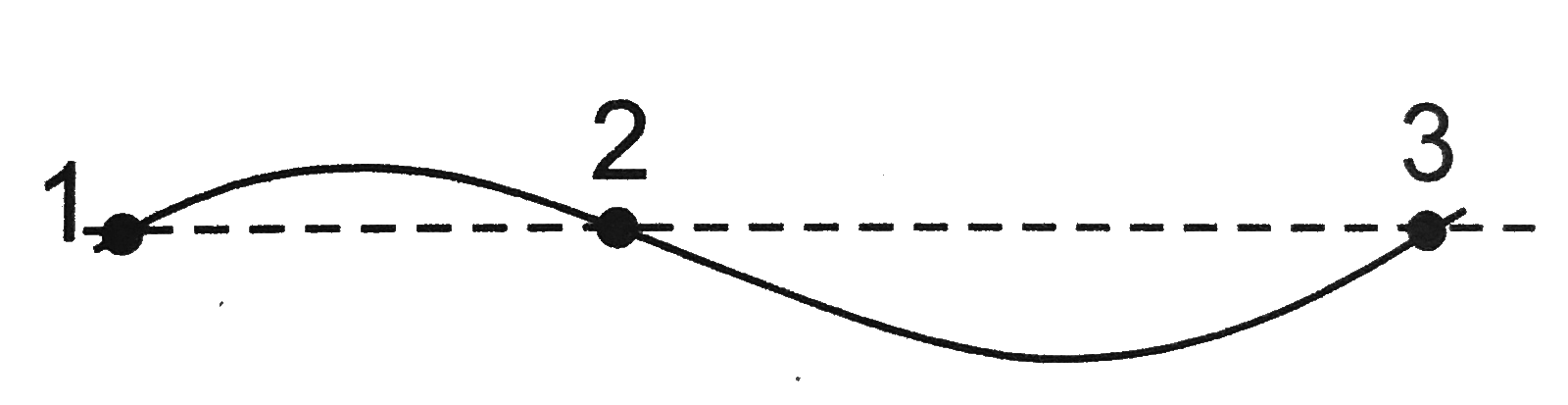
The diagram below shows an instantaneous position of a string as a transverse progressive wave travels along it from left to right Which one of the following correctly shows the direction of the velocity of the points 1,2 and 3 on the string?

A

`rarr" " rarr" " rarr`

B

`larr" " larr" " rarr`

C

`darr" " darr" " darr`

D

`darr" " uarr" " darr`

Text Solution

Verified by Experts

The correct Answer is:

C
Promotional Banner

Similar Questions

Explore conceptually related problems

The figure show an instantaneous profile of a rope carrying a progressive wave moving from left to right , then

A transverse wave is travelling along a string from right to left. The figure represents the shape of the string at the given instant. A point M has a velocity

Figure shows the shape of part of a long string in which transverse waves are produced by attaching one end of the string to tuning fork of frequency 250 Hz. What is the velocity of the waves?

A transverse wave is travelling along a string from left to right. The figure below represents the shape of the string at a given instant. At this instant, among the following, choose the wrong statement.

Two strings, A and B , of lengths 4L and L respectively and same mass M each, are tied together to form a knot 'O' and stretched under the same tension. A transverse wave puise is sent along the composite string from the side A , as shown to the right. Which of the following diagrams correctly shows the reflected and transmitted waves pulses near the knot 'O' ?

The diagram below (Fig. 15.13.1) show the propagation of a wave. Which points are in phase ?

Consider a standing wave formed on a string . It results due to the superposition of two waves travelling in opposite directions . The waves are travelling along the length of the string in the x - direction and displacements of elements on the string are along the y - direction . Individual equations of the two waves can be expressed as Y_(1) = 6 (cm) sin [ 5 (rad//cm) x - 4 ( rad//s)t] Y_(2) = 6(cm) sin [ 5 (rad//cm)x + 4 (rad//s)t] Here x and y are in cm . Answer the following questions. Figure 7.104( c) shows the standing wave pattern at t = 0 due to superposition of waves given by y_(1) and y_(2) in Figs.7.104(a) and (b) . In Fig. 7.104 (c ) , N is a node and A and antinode . At this instant say t = 0 , instantaneous velocity of points on the string named as A

Consider a standing wave formed on a string . It results due to the superposition of two waves travelling in opposite directions . The waves are travelling along the length of the string in the x - direction and displacements of elements on the string are along the y - direction . Individual equations of the two waves can be expressed as Y_(1) = 6 (cm) sin [ 5 (rad//cm) x - 4 ( rad//s)t] Y_(2) = 6(cm) sin [ 5 (rad//cm)x + 4 (rad//s)t] Here x and y are in cm . Answer the following questions. If one end of the string is at x = 0 , positions of the nodes can be described as

Consider a standing wave formed on a string . It results due to the superposition of two waves travelling in opposite directions . The waves are travelling along the length of the string in the x - direction and displacements of elements on the string are along the y - direction . Individual equations of the two waves can be expressed as Y_(1) = 6 (cm) sin [ 5 (rad//cm) x - 4 ( rad//s)t] Y_(2) = 6(cm) sin [ 5 (rad//cm)x + 4 (rad//s)t] Here x and y are in cm . Answer the following questions. Amplitude of simple harmonic motion of a point on the string that is located at x = 1.8 cm will be

A bob of mass m is connected by string of length L to point P. The system is released from rest with the pendulum bob in a horizontal position. Which of the following graph is correctly showing the variation of T (tension) with Ɵ?
