Home
Class 11
PHYSICS
In the following P-V diagram two adiabat...

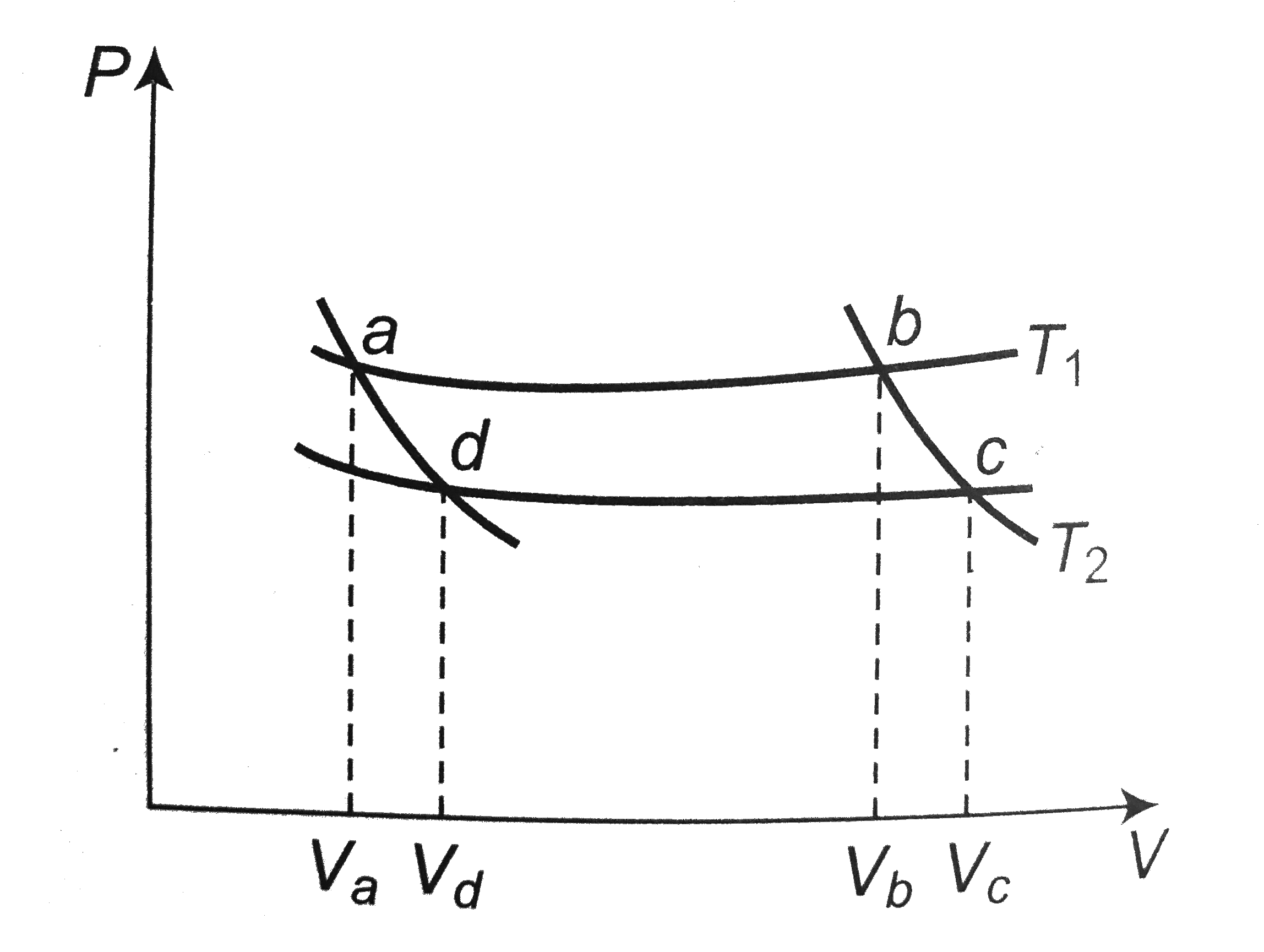
In the following P-V diagram two adiabatics cut two isothermals at temperature `T_(1) and T_(2)` (fig). The value of `V_(a)/V_(d)` will be

A

`(V_(b))/(V_(c))`

B

`(V_(c))/(V_(b))`

C

`(V_(d))/(V_(a))`

D

`V_(b)V_(c)`

Text Solution

Verified by Experts

The correct Answer is:

A
Promotional Banner

Topper's Solved these Questions

  • THERMODYNAMICS

    CENGAGE PHYSICS ENGLISH|Exercise 8|3 Videos
  • THERMODYNAMICS

    CENGAGE PHYSICS ENGLISH|Exercise 9|3 Videos
  • THERMODYNAMICS

    CENGAGE PHYSICS ENGLISH|Exercise 6|3 Videos
  • SUPERPOSITION AND STANDING WAVES

    CENGAGE PHYSICS ENGLISH|Exercise Comprehension Type|5 Videos
  • TRANSMISSION OF HEAT

    CENGAGE PHYSICS ENGLISH|Exercise Single correct|9 Videos

Similar Questions

Explore conceptually related problems

Two different adiabatic parts for the same gas intersect two isothermals at T_(1) "and" ^ T_2 as shown in P-V diagram . Then the ratio of (V_(a))/(V_(b)) will be

Two different adiabatic curves for the same gas intersect two isothermals at T_(1), and T_(2) as shown in P-V diagram, (figure). How does the ratio (V_(a)//V_(d)) compare with the ratio (V_(b)//V_(c)) ?

The V - i graph for a conductor at temperature T_(1) and T_(2) are as shown in the figure. ( T_(2) - T_(1)) is proportional to

The voltage V and current I v graphs for a conductor at two different temperatures T_(1) and T_(2) are shown in the figure. The relation between T_(1) and T_(2) is

The p-V diagrams of same mass of a gas are drawn at two different temperatues T_(1) and T_(2) Explain whether T_(1)gtT_(2) or T_(2)gtT_(1).

The current (I) and voltage (V) graphs for a given metallic wire at two different temperature (T_(1)) and (T_(2)) are shown in fig. It is concluded that

The velocities of sound in an ideal gas at temperature T_(1) and T_(2) K are found to be V_(1) and V_(2) respectively. If ther.m.s velocities of the molecules of the same gas at the same temperatures T_(1) and T_(2) are v_(1) and v_(2) respectively then

The velocities of sound in an ideal gas at temperature T_(1) and T_(2) K are found to be V_(1) and V_(2) respectively. If ther.m.s velocities of the molecules of the same gas at the same temperatures T_(1) and T_(2) are v_(1) and v_(2) respectively then

An ideal gas (1 mol ,monatomic) is in the initial state P (see diagram) on an isothermal curve A at a temperature T_0 . It is brought under a constant volume (2V_0) process to Q which lies on an adiabatic curve B intersecting the isothermal curve A at (P_0,V_0,T_0) . The change in the internal energy of the gas (in terms of T_0 ) during the process is (2^(2//3)=1.587)

p - V diagram of same mass of a gas are drawn at two different temperatures (T_1) and (T_2) . Explain whether T_1 gt T_2 or T_2 gt T_1 . .
