Home
Class 11
PHYSICS
Two blocks A (5kg) and B (2kg) attached ...

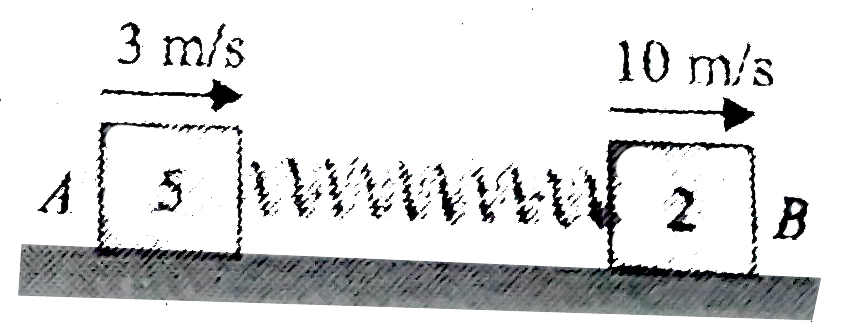
Two blocks A (5kg) and B (2kg) attached to the ends of a spring constant 1120 `N//m` are placed on a smooth horizontal plane with the spring unreformed. Simulataneously velocities of 3 `m//s` and 10 `m//s` along the line of the spring in the same direction are imparted to A and B then

A

the maximum extension of the spring is 0.25 m

B

the first maximum compression occurs after start at `(3pi)/(56)s`

C

the maximum extension of the spring is 0.50 m

D

Time period of oscillation is `(pi)/(14)s`

Text Solution

Verified by Experts

The correct Answer is:

B, D
Promotional Banner

Topper's Solved these Questions

  • LINEAR AND ANGULAR SIMPLE HARMONIC MOTION

    CENGAGE PHYSICS ENGLISH|Exercise Subjective type|3 Videos
  • LINEAR AND ANGULAR SIMPLE HARMONIC MOTION

    CENGAGE PHYSICS ENGLISH|Exercise Single correct anwer type|14 Videos
  • LINEAR AND ANGULAR SIMPLE HARMONIC MOTION

    CENGAGE PHYSICS ENGLISH|Exercise Multiple Correct Answer Type|5 Videos
  • KINETIC THEORY OF GASES AND FIRST LAW OF THERMODYNAMICS

    CENGAGE PHYSICS ENGLISH|Exercise Interger|11 Videos
  • MISCELLANEOUS KINEMATICS

    CENGAGE PHYSICS ENGLISH|Exercise Interger type|3 Videos

Similar Questions

Explore conceptually related problems

Two blocks A (5 kg) and B( 5kg) attached to the ends of a spring constant 1000 N//m are placed on a smooth horizontal plane with the spring undeformed . Simultaneously velocities of 10m//s and 4m//s along the line of the spring in the same direction are imparted to A and B then

Two blocks A(3 kg) and B(2 kg) resting on a smooth horizontal surface is connected by a spring of stiffness 480N//m . Initially the spring is underformed and a velocity of 2 m//s is imparted to A along the line of the spring away from B. The maximum extension in meters of the spring during subsequent motion is :-

a block of mass 0.1 kg attached to a spring of spring constant 400 N/m pulled horizontally from x=0 to x_1 =10 mm. Find the work done by the spring force

Two blocks of masses 6 kg and 3 kg are attached to the two ends of a massless spring of spring constant 2 pi^(2) N//m . If spring is compressed and released on a smooth horizontal surface then find the time period (in seconds) of each block.

Two blocks of masses m_1 =1kg and m_2 = 2kg are connected by a spring of spring constant k = 24 N/m and placed on a frictionless horizontal surface. The block m_(1) is imparted an initial velocity v_(0) = 12cm/s to the right. The amplitude of oscillation is

Two blocks A and B of mass m and 2m respectively are connected by a light spring of force constant k. They are placed on a smooth horizontal surface. Spring is stretched by a length x and then released. Find the relative velocity of the blocks when the spring comes to its natural length

Two blocks of masses 7 kg and 3 kg are connected by a spring of stiffness 1000Nm^(-1) and placed on a smooth horizontal surface. They are acted by horizontal forces of 72 N and 32 N in opposite directions as shown in the figure. When accelerations of the blocks are equal and constant, the extension of the spring is

Two blocks of mass 2 kg and 4 kg are accelerated with same acceleration by a force 10 N as shown in figure on a smooth horizontal surface. Then the spring force between the two blocks will be (spring is massless)

A block attached with an ideal spring is kept on a smooth horizontal surface. Now the free end of the spring is pulled with a constant velocity u horizontally. Then the maximum energy stored in the spring and bock system during subsequent motion is :

Two blocks of masses 5kg and 2kg are connected by a spring of negligible mass and placed on a frictionless horizontal surface. An impulse provides a velocity of 7m/s to the heavier block in the direction of the lighter block. The velocity of the centre of mass is :-
