Home
Class 12
PHYSICS
A pair of parallel conducting rails lie ...

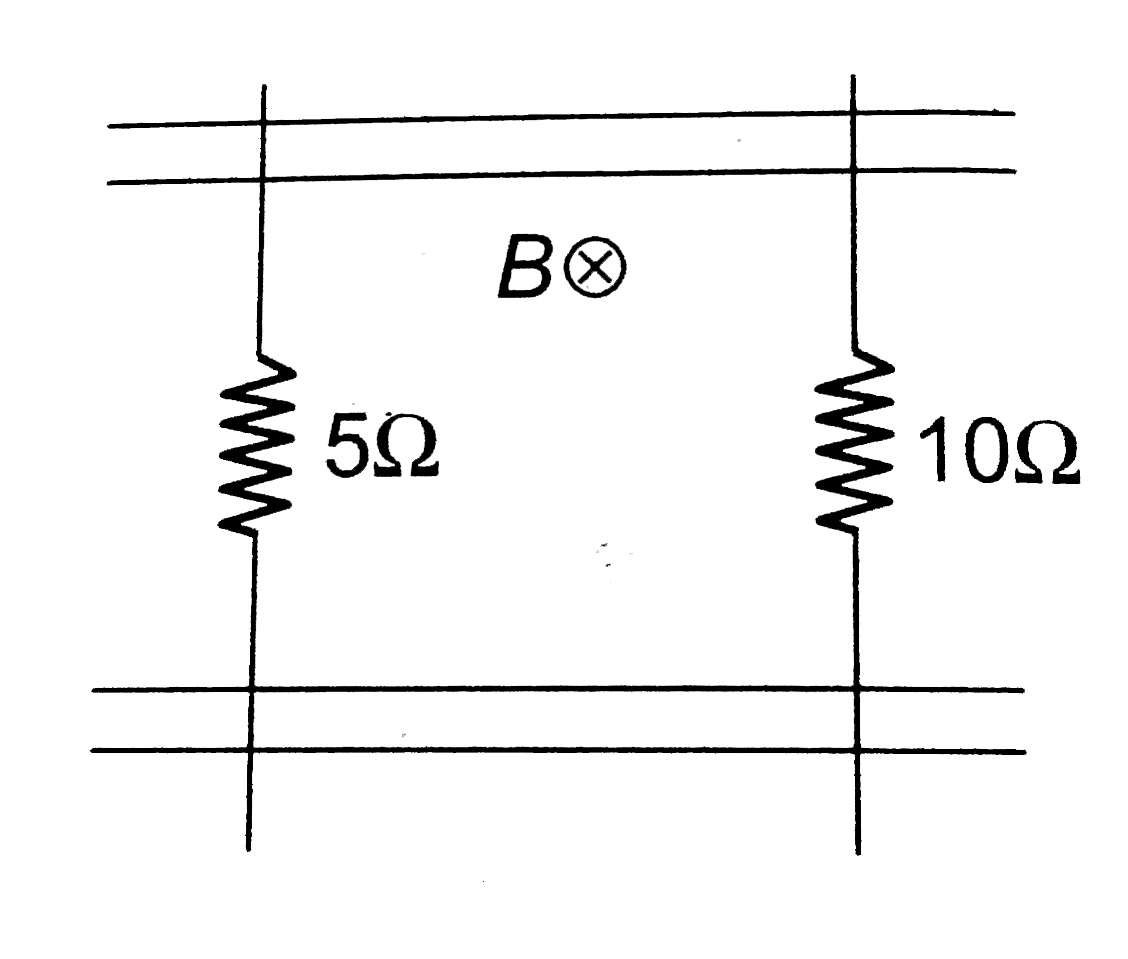
A pair of parallel conducting rails lie at right angle to a uniform magnetic field of `2.0T` as shown in the fig. two resistor `10Omega` and `5Omega` are to slide without friction along the rail. The distance between the conducting rails is `0.1m`. Then

A

Induced current = `(1)/(150)` A directed clockwise if `10 Omega` resistor is pulled to the right with speed `0.5 ms^(-1)` and `5 Omega` resistor is held fixed

B

Induced current `(1)/(300)` A directed anticlockwise if `10 Omega` resistor is pulled to the right with speed `0.5 ms^(-1)` and `5 Omega` resistor is held fixed

C

Induced current `(1)/(300)` A directed anticlockwise if `5 Omega` resistor is pulled to the left at `0.5 ms^(-1)` and `10Omega` resistor is held at rest

D

Induced current `(1)/(150)` A directed anticlockwise if `5 Omega` resistor is pulled to the left at `0.5 ms^(-1)` and `10 Omega` resistor is held at rest.

Text Solution

Verified by Experts

The correct Answer is:

d
Promotional Banner

Topper's Solved these Questions

  • ELECTROMAGNETIC INDUCTION

    CENGAGE PHYSICS ENGLISH|Exercise comprehensive type|7 Videos
  • ELECTROMAGNETIC INDUCTION

    CENGAGE PHYSICS ENGLISH|Exercise single correct answer|3 Videos
  • ELECTROMAGNETIC INDUCTION

    CENGAGE PHYSICS ENGLISH|Exercise comprehensive|5 Videos
  • ELECTRICAL MEASURING INSTRUMENTS

    CENGAGE PHYSICS ENGLISH|Exercise M.C.Q|2 Videos
  • ELECTRON,PHONTS,PHOTOELECTRIC EFFECT & X-RAYS

    CENGAGE PHYSICS ENGLISH|Exercise dpp 3.3|15 Videos

Similar Questions

Explore conceptually related problems

Consider parallel conducting rails separated by a distance l. There exists a uniform magnetic field B perpendicular to the plane of the rails as shown in Fig. Two conducting wires each of length l are placed so as to slide on parallel conducting rails. One of the wires is given a velocity v_(0) parallel to the rails. Till steady state is achieved, loss in kinetic energy of the system is

A conducting rod of length is moved at constant velocity v_(0) on two parallel, conducting, smooth, fixed rails, that are placed in a uniform constant magnetic field B perpendicular to the plane for the rails as shown in Fig. A resistance R is connected between the two ends of the rails. Then which of the following is/are correct:

A conducting rod of length is moved at constant velocity v_(0) on two parallel, conducting, smooth, fixed rails, that are placed in a uniform constant magnetic field B perpendicular to the plane for the rails as shown in Fig. A resistance R is connected between the two ends of the rails. Then which of the following is/are correct:

A wire of length l , mass m and resistance R slides without any friction down the parallel conducting rails of negligible resistance . The rails are connected to each other at the bottom by a resistanceless rail parallel to the wire so that the wire and the rails form a closed rectangualr conducting loop. The plane of the rails makes an angle theta with the horizontal and a uniform vertical magnetic field of the inducetion B exists throughout the rregion. Find the steady state velocity of the wire.

A conducting rod of length l slides at constant velocity v on two parallel conducting rails, placed in a uniform and constant magnetic field B perpendicular to the plane of the rails as shown in Fig.3.49. A resistance R is connected between the two ends of the rails. (a) Idenify the cause which produces change in magnetic flux. (b) Identify the direction of current in the loop. ( c) Determine the emf induced in the loop. (d) Compute the electric power dissipated in the resistor. (e) Calcualte the mechenical power required to pull the rod at a cinstant velovity.

Shows a wire sliding on two parallel, conducting rails placed at a separaton l. A magnetic feld B exists in a direction perpendicular to the plane of the rails. What force is necessary to keep the wire moving at a constatn velocity v ?

Two smooth horizontal parallel conducting rails are connected with a capacitor and a resistor at the two ends as shown. A uniform conducting rod PQ of mass 'm' and length 'l' is dragged with a constant horizontal force 'F'. The terminal velocity aquired by the conducting rod is

On an inclined plane, two conducting rails are fixed along the line of greatest slope. A conducting rod AB is placed on the radils so that it is horizontal. A vertically upward uniform magnetic field is present in the region. A current i flows through AB from B to A. The mass of AB is m and the coefficient of friction between the rod and rails is mu . Find the minimum and maximum value of B, so that the rod can stay in equilibrium. Assume that mu lt tan theta

Figure shows a wire sliding on two parallel, conducting rails placed at a separation L . A magnetic field B exists in a direction perpendicular to the plane of the rails. What force is necessary to keep the wire moving at a constant velocity V ?

Two long parallel conducting horizontal rails are connected by a conducting wire at one end. A uniform magnetic field B (directed vertically downwards) exists in the region of space. A light uniform ring of diameter d which is practically equal to separation between the rails is placed over the rails as shown in Fig. If resistance of ring be (lambda) per unit length The force required to pull the ring with uniform velocity v is
