Home
Class 12
PHYSICS
In the set up shown in figure, the two s...

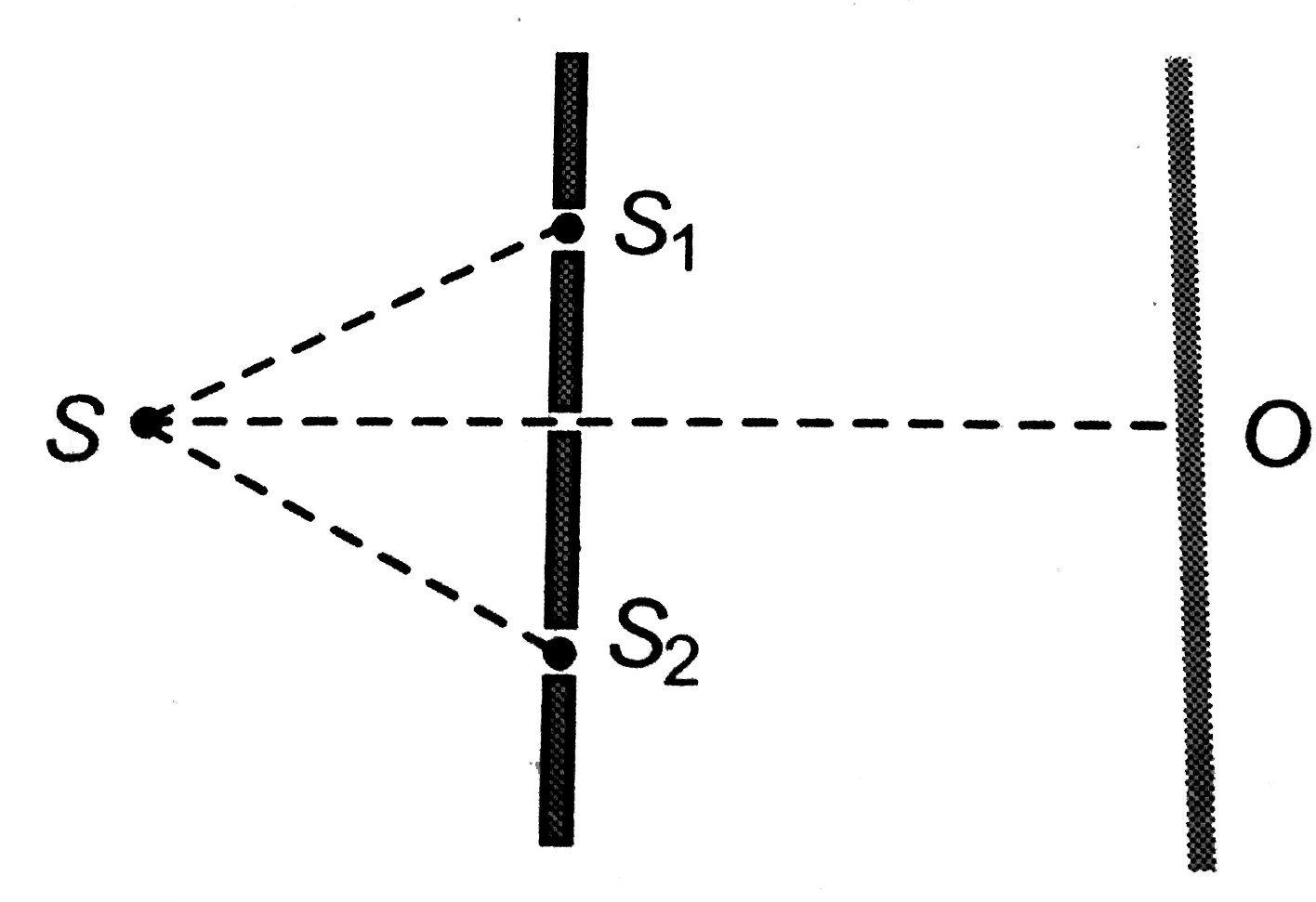
In the set up shown in figure, the two slits `S_1` and `S_2` are not equidistant from the slit S. The central fringe at O is then

A

always right

B

always dark

C

either dark or bright depending on the position of S.

D

neither dark nor bright.

Text Solution

Verified by Experts

The correct Answer is:

C
Promotional Banner

Similar Questions

Explore conceptually related problems

Consider the situation shown in figure. The two slits S_1 and S_2 placed symmetrically around the central line are illuminated by a monochromatic light of wavelength lamda . The separation between the slits is d. The light transmitted by the slits falls on a screen Sigma_1 placed at a distance D from the slits. The slit S_3 is at the placed central line and the slit S_4 , is at a distance z from S_3 . Another screen Sigma_2 is placed a further distance D away from 1,1. Find the ratio of the maximum to minimum intensity observed on Sigma_2 if z is equal to a. z=(lamdaD)/(2d) b. (lamdaD)/d c. (lamdaD)/(4d)

Consider the situation shown in figure. The two slite S_1 and S_2 placed symmetrically around the centre line are illuminated by a monochromatic light of wavelength lambda. The separation between the slits is d. The light transmitted by the slits falls on a screen M_1 placed at a distance D from the slits. The slit S_3 is at the centre line and the slit S_4 is at a distance y form S_3 . Another screen M_2 is placed at a further distance D away from M_1 . Find the ration of the maximum to minimum intensity observed on M_2 if y is equal to (dltltD) .

A monochromatic beam of light fall on YDSE apparatus at some angle (say theta ) as shown in figure. A thin sheet of glass is inserted in front of the lower slit s_(2) . The central bright fringe (path difference = 0 ) will be obtained

A monochromatic beam of light fall on YDSE apparatus at some angle (say theta ) as shown in figure. A thin sheet of glass is inserted in front of the lower slit s_(2) . The central bright fringe (path difference = 0 ) will be obtained

A monochromatic beam of light fall on YDSE apparatus at some angle (say theta ) as shown in figure. A thin sheet of glass is inserted in front of the lower slit s_(2) . The central bright fringe (path difference = 0 ) will be obtained

In young's double slit experiment shown in figure, S_1 and S_2 are coherent sources and S in the screen having a hole at a point 1.0 mm away from the central line. White light (400 to 700 nm) is sent through the slits. Which wavelength passing through the hole has strong intensity?

Assertion In the YDSE set up shown in figure a glass slab is inserted in front of the slit S_(1) as shown in figure Then zero order maxima (where path difference =0) will lie above point O. Reason Glass slab will produce an extra path difference in the path of the ray passing through S_(1)

A monochromatic light source of wavelength lamda is placed at S. three slits S_(1),S_(2) and S_(3) are equidistant from the source S and the point P on the screen S_(1)P-S_(2)P=lamda//6 and S_(1)P-S_(3)P=2lamda//3 . if I be the intensity at P when only one slit is open the intensity at P when all the three slits are open is-

In the YDSE the monochronic source of wavelength lambda is palced at a distance d/2 from the central axis (as shown in the figure ) , where d is the separation between two slits S_(1) and S_(2) .Find the position of the central maxima . (Given d = 6 mm )

In the figure , if a parallel beam of white light is incident on the plane of the slits S_1 and S_2 then the distance of the nearest white spot on the screen from O is [ Assume D gtgtd, d gtgtlamda ]
