Home
Class 11
PHYSICS
A string of length 20 cm and linear mass...

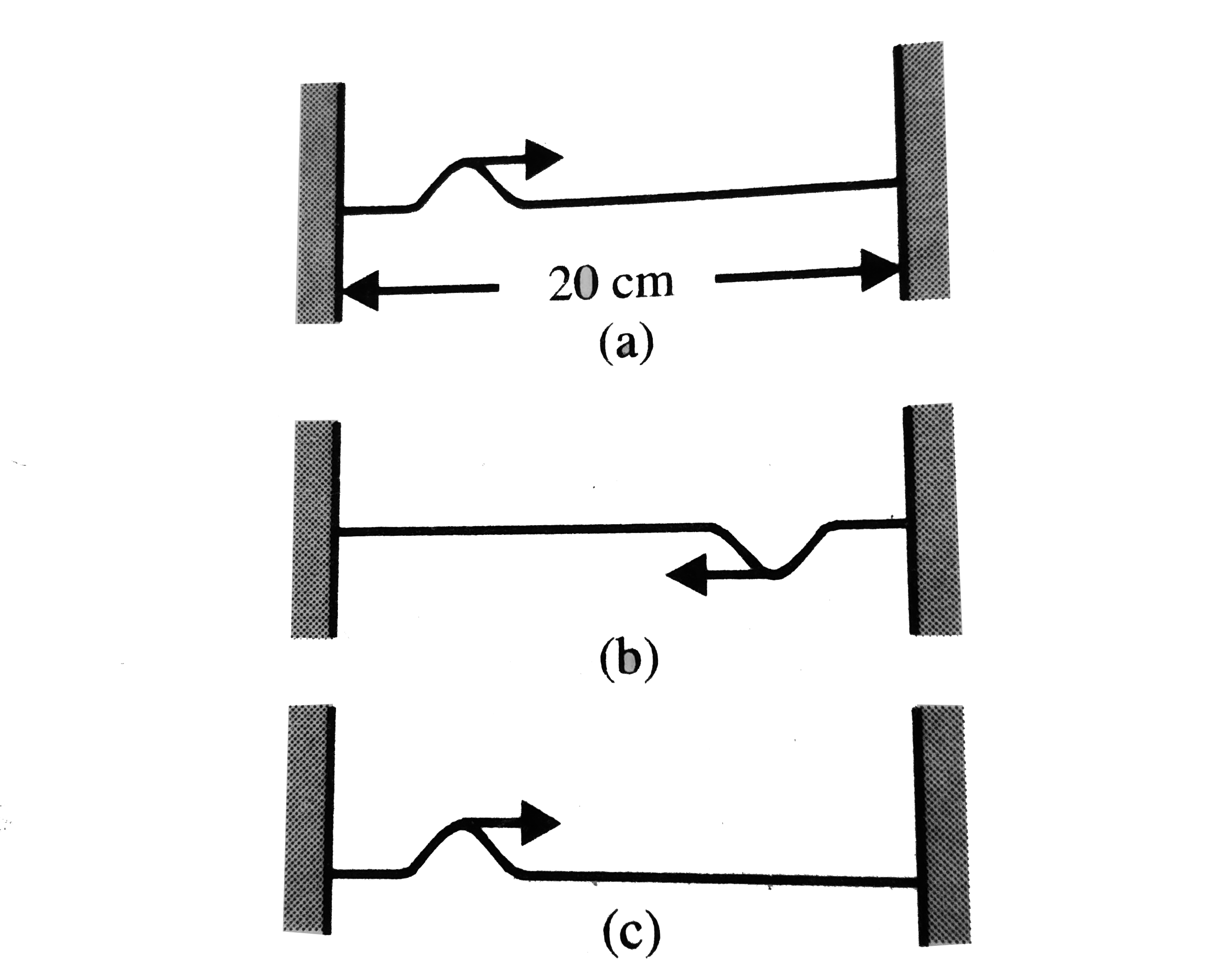
A string of length `20 cm` and linear mass density `0.40 g//cm` is fixed at both ends and is kept under a tension of `16 N` . A wave pulse is produced at `t = 0 ` near an ends as shown in Fig. 7.17 (b) , which travels towards the other end . When will the string have the shape shown in the Fig . ( c).

Text Solution

Verified by Experts

Given `mu = 0.40 g//cm = ( 0.40)/(1000) xx 100 = 0.040 kg//m`
Wave speed in the stretched string ,
` v = sqrt ((F)/(mu)) = sqrt((16)/( 0.040)) = 20 m//s`
The string will have the same shape after the pulse travels a distance ` = 20 + 20 = 40 cm`
Thus time period ` t = 0.40//20 = 0.02 s`
Promotional Banner

Similar Questions

Explore conceptually related problems

A string of length 20 cm and linear mass density 0.40 g//cm is fixed at both ends and is kept under a tension of 16 N.A wave pulse is produced at t=0 nearj an end as shown in figure which travels towards the other end. when will the string have the shape shown in the figure again? (inxx10^(-2)s)

A sting of length 1m and linear mass density 0.01 kg//m is stretched to a tension of 100 N. When both ends of the string are fixed, the three lowest frequencies for standing wave are f_1, f_2 and f_3 . When only one end of the string is fixed, the three lowest frequencies for standing wave are n_1, n_2 and n_3 . Then,

Figure shown a clamped metal string of length 30 cm and linear mass density 0.1 kg //m . Which is taut at a tension of 40N . A small rider ( piece of paper ) is placed on string at point P as shown. An external vibrating tuning fork is brought near this string and oscillations of rider are carefully observed. Now if the tension in the string is made 160N , at which of the following frequencies of turning fork , rider will not vibrate at all

A string of linear mass density 0.5 g cm^-1 and a total length 30 cm is tied to a fixed wall at one end and to a frictionless ring at the other end. The ring can move on a vertical rod. A wave pulse is produced on the string which moves towards the ring at a speed of 20 cm s^-1 . The pulse is symmetric about its maximum which is located at a distance of 20 cm from the end joined to the ring. (a) Assuming that the wave is reflected from the ends without loss of energy, find the time taken by the string to regain its shape. (b) The shape of the string changes periodically with time. Find this time period. (c) What is the tension in the string ?

A string of length 0.4 m and mass 10^(-2)kg is tightly clamped at its ends. The tension in the string is 1.6 N . Identical wave pulse are produced at one end at equal intervals of time, Deltat . The minimum value of Deltat which allows constructive interference of successive pulse is

A taut string having tension 100 N and linear mass density 0.25 kg//m is used inside a cart to generate a wave pulse starting at the left end, as shown. What should be the velocity of the cart so that pulse remains stationary w.r.t. ground.

A taut string having tension 100 N and linear mass density 0.25 kg//m is used inside a cart to generate a wave pulse starting at the left end, as shown. What should be the velocity of the cart so that pulse remains stationary w.r.t. ground.

Figure shown a clamped metal string of length 30 cm and linear mass density 0.1 kg //m . Which is taut at a tension of 40N . A small rider ( piece of paper ) is placed on string at point P as shown. An external vibrating tuning fork is brought near this string and oscillations of rider are carefully observed. At which of the following frequencies the point P on string will have maximum oscillation amplitude among all points on string :

Two wires are together end to end . The wires are made of the same material , but the diameter of one is twice that of the other . They are subjected to a tension of 4.60 N . The thin wire has a length of 40.0 cm and a linear mass density of 2.00 g//m . The combination is fixed at both ends and vibrated in such a way that two antinodes are present , with the node between them being precisely at the weld . (a) What is the frequency of vibration ? (b) Find the length of the thick wire .

A string of length 0.4 m and mass 10 ^(-2) kg is tightly clamped at its ends. The tension in the string is 1. 6 N. identical wave pulses are produced at one end at equal intervals of time Delta t . The value of Delta t which allows construction interference between successive pulses is
